Cosmic Fountain: How Shock Waves Control the Growth of Black Holes ✛ ✦
Observations by James Webb showed: already 500 million years after the Big Bang (at redshifts z~10), the Universe was aglow with black holes with masses of billions of solar masses. This baffles theories of gradual growth: matter would not have time to 'feed' the seeds at the required rate. One likely way out is direct collapse of low-metallicity gas into a massive object. However, until now there was no precise picture of such a collapse. Classical models painted a smooth, unimpeded fall.
But the laws of thermodynamics demand otherwise. The growth of entropy during compression inevitably gives birth to a discontinuity — a relativistic shock wave. It is this wave, like a frenzied cosmic fountain, that stands in the path of the collapsing gas. In a new work, physicists found exact self-similar solutions of the equations of general relativity of Einstein for such a wave in an isothermal sphere. Using the Schwarzschild metric and generalizing the Landau–Lifshitz conditions to the relativistic case, they showed: the front speed reaches ~40% of the speed of light, and the ejected energy — up to 10% of the rest mass of the infalling matter. For comparison: thermonuclear fusion in stars converts only 0.7% of mass into radiation. Here gravity squeezes almost 15 times more — efficiency comparable to annihilation of matter and antimatter.
Such dynamics paint a different portrait of a growing black hole. The central accretion rate drops by 5–7 times compared to the shock-free scenario: while matter is fountain-ing, it barely adds mass. This mechanism serves as a powerful feedback — a natural growth regulator. Moreover, the colossal energy release (~10⁵⁷–10⁵⁸ erg) heats and inflates the circum-black-hole shell, turning newborn objects into the mysterious 'red dots' — compact active galactic nuclei in dusty cocoons, which is what JWST observes.
Generalization to rotation and magnetic fields, going beyond the isothermal approximation — are the next steps. It is already clear: such shock-wave fountains could have served as a trigger for quasars in the young Universe, and their gravitational-wave echo might be caught by future detectors. Numerical simulation will verify the realism of this analytical scenario and turn it into a working tool for reading the history of the cosmos.
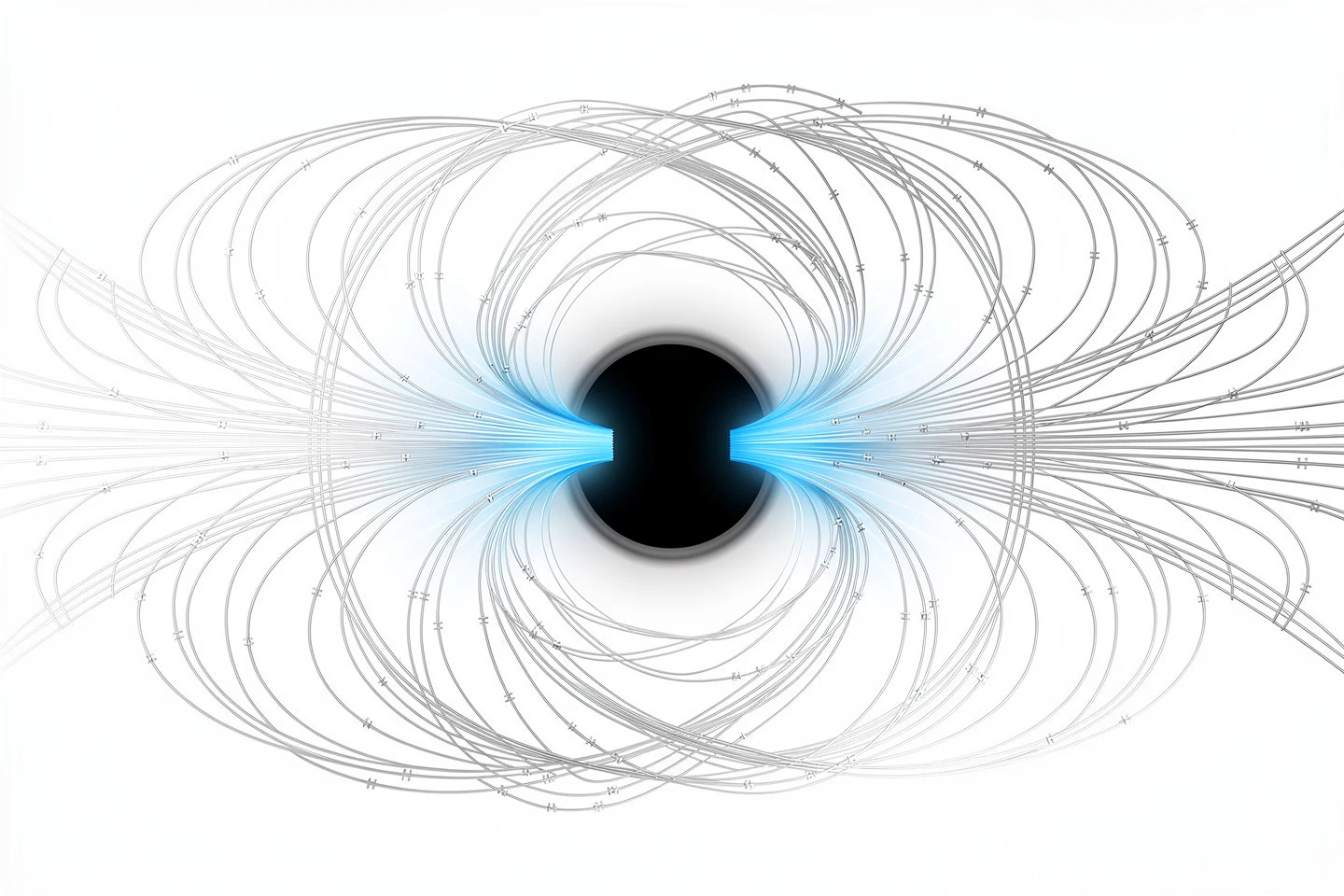
In shock-wave solutions, gas doesn't just fall into the black hole, but performs a 'fountain' loop: first the shock wave flings it outward, and only when the expanding zero-velocity surface catches up with the gas, it turns around and rushes unimpeded toward the singularity.