Simple

The Black Hole Fountain: Matter is Blown Away

Original: "General Relativistic Shock Wave Solutions with Black Hole Formation: The Singular Isothermal Sphere Case"
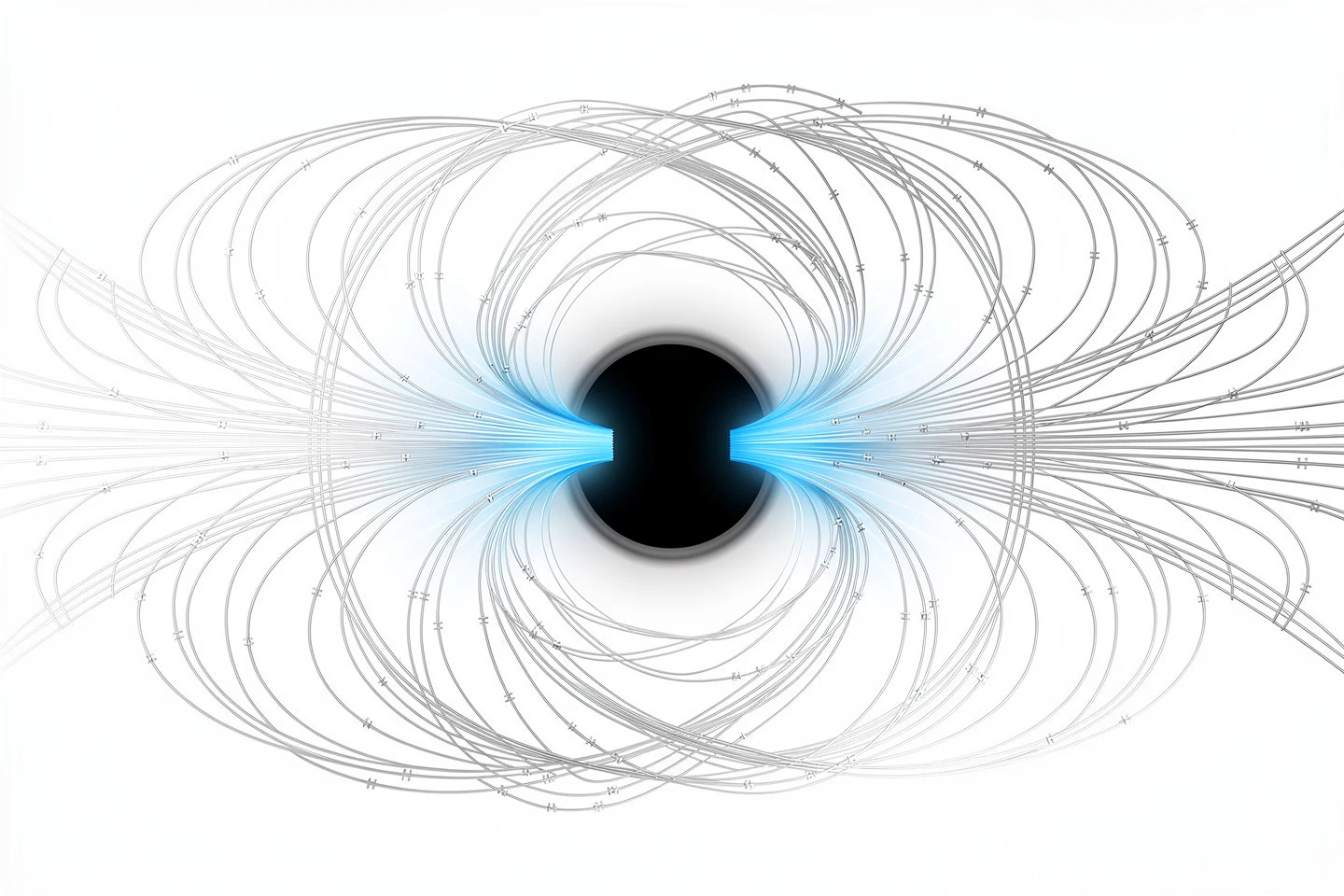
Shock waves, like a splash from a narrow bottleneck, prevent a black hole from growing too fast.
Abstract

How are supermassive black holes born in the early universe? New research shows that when a giant gas cloud contracts, shock waves are generated, racing at nearly the speed of light. They unleash a sea of energy, slowing the infall of matter — like a traffic jam on a highway, where cars alternately brake and accelerate. This sheds light on the mysterious 'little red dots' discovered by the James Webb Space Telescope.

Links in the knowledge graph 1

The telescope James Webb has found black holes in the early Universe with masses of billions of suns, even though there was catastrophically little time for them to grow. One explanation is the direct collapse of a huge cloud almost devoid of heavy elements. But such an infall is anything but calm.

During the rapid compression, a shock wave arises — like water splashing out of a narrow neck if you pour it too fast.

This 'fountain' accelerates gas to half the speed of light and flings it away. Only later, when the funnel of curved spacetime catches up with the matter, does it fall into the central point of zero size.

As a result, the black hole receives 5–7 times less mass.

But the same wave, according to the mass-energy equivalence law, converts up to a tenth of the infalling gas into radiation — twice as efficiently as the spinning gas disk. This flare heats the cloud, creating bright 'cocoons' that Webb sees in the active nuclei of distant galaxies (their light is strongly reddened due to the Universe's expansion).

Without the fountain, the black hole would grow quietly and remain invisible — nature prefers a fireworks display.

The calculations are based on the Schwarzschild solution for black holes, the general relativity equations of Einstein, and the theory of shock discontinuities of Landau; disruptions in the flow are inevitable according to the law of increasing disorder, and future computer simulations will test these ideas.

🎯 For a black hole to shine at the edge of the Universe, it first has to spit out almost everything it planned to devour.

p_{\rm pre} p_{\rm post} = \frac{\gamma}{1+\gamma}
The product of the proper momenta of the gas before and after the shock front is constant and depends only on the square of the sound speed.
Scientists
Christian DopplerD. B. McLaughlinDidier QuelozMichel MayorR. A. RossiterStephen Hawking
Tags
black hole JWST redshift Accretion disk active galactic nucleus spacetime curvature speed of light entropy metallicity singularity numerical simulation
Laws
second law of thermodynamicsDoppler effectHawking radiationgravitational lensingprinciple of constancy of the speed of lightBekenstein-Hawking entropy
Original: arXiv:2606.29607 · CC BY 4.0 · bridge42worlds