Dark Matter Gains Strength When Crowded express
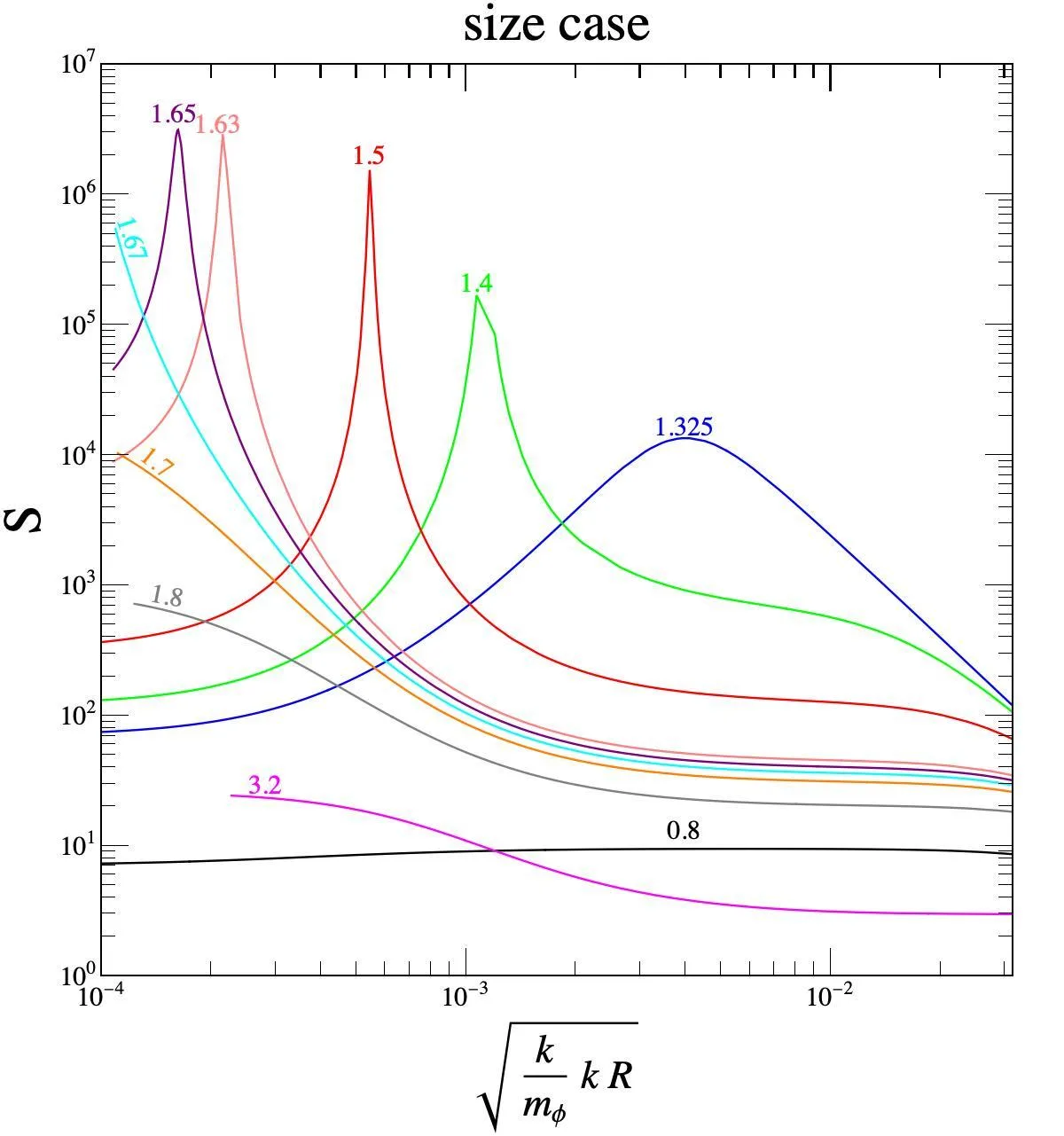
When two dark matter particles approach each other, they can attract more strongly than expected. This phenomenon is called Sommerfeld enhancement — it works like an invisible spring that compresses before impact. For a long time, it was believed that the spring compresses more strongly the slower the particles approach each other. But the authors of the new work showed that there is a second hand pulling on this spring: the size of the particles themselves.
They considered 'fluffy' dark matter — particles that are not point-like but have some volume. Using the mathematical machinery of partial waves (decomposing the interaction into simple components), the physicists found two dimensionless parameters that govern resonances — special states where the enhancement becomes maximal. It turned out that even without knowing the internal structure of the particle, the mere fact of its finite size gives rise to the same resonances as low speed.
As a concrete example, the scientists took 'nugget' dark matter — hypothetical clumps that may have complex internal structure. Even for such composite objects, the resonant enhancement of annihilation (mutual destruction of particles with energy release) behaves the same as for point particles. This means that in dense regions, such as galactic centers, dark matter may annihilate much more actively than previously thought.
The Sommerfeld effect was originally discovered in atomic physics to explain why slow electrons sometimes attract more strongly to the nucleus — and only later was it applied to dark matter.
In Liu Cixin's novel 'The Dark Forest', dark matter turns out to be not just a backdrop but an active medium capable of interactions — similar to how 'fluffy' particles can resonantly enhance their annihilation.