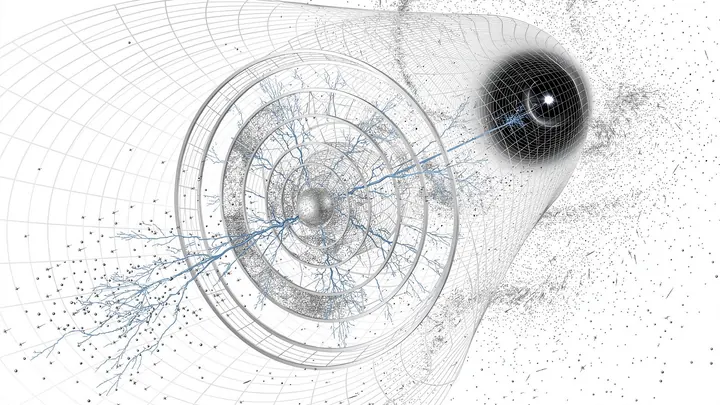
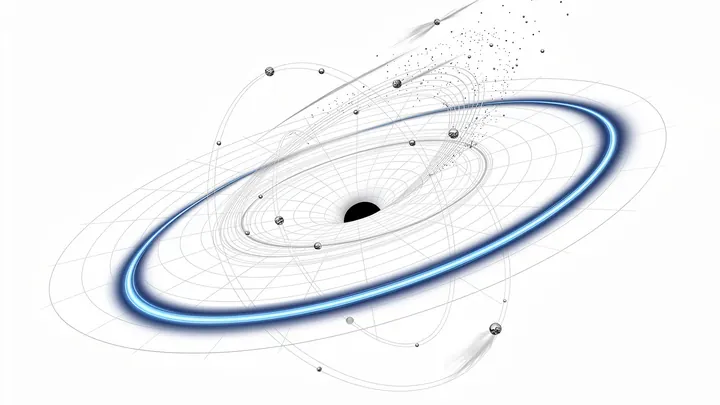
The galactic center is the rotational heart of a galaxy, a region of extreme density and activity. In the Milky Way, it lies about 26,000 light-years away in the constellation Sagittarius, hidden from optical view by thick dustclouds. It hosts a supermassive black hole (Sagittarius A*) with about 4 million times the Sun's mass, surrounded by a dense cluster of stars, gas clouds, and strong magnetic fields. This environment is a natural laboratory for extreme physics, where gravitational, magnetic, and radiative forces interact in ways not seen elsewhere.
History
The first evidence for a compact massive object at the galactic center came from radio observations in the 1930s, but it was not until the 1990s that high-resolution infrared observations by Reinhard Genzel and Andrea Ghez showed stars orbiting an invisible massive object, leading to the 2020 Nobel Prize in Physics.
How it works
The galactic center's extreme environment arises from the gravitational pull of the central black hole and the dense stellar cluster. Gas falling toward the black hole forms an accretion disk that heats up and emits X-rays and radio waves. Stellar winds and supernova explosions inject energy and cosmic rays into the region, creating bubbles of hot gas and driving turbulent motions. The strong gravitational potential also accelerates stars to high velocities, some of which orbit the black hole at speeds exceeding 5,000 km/s.
In practice
The galactic center serves as a natural laboratory for testing general relativity in strong gravitational fields, and observations of it help refine models of black hole accretion and jet formation that are applied to astrophysical systems across the universe.
Fun fact
The galactic center is so dense with stars that the average distance between them is only about 1,000 times the Earth-Sun distance, compared to 4 light-years in our solar neighborhood.
A filament of the cosmic web stretches through the young universe, and strung along it like beads on a necklace are galaxies. In the core of the SSA22 protocluster, which in a few billion years will become the center of a massive cluster, these beads are still hot and dusty: stars are being born inside them, and cold gas serves as fuel.
A little monster hides in a dwarf galaxy, and its neighbor feeds it. The satellite galaxy is slowly merging with a massive companion, and gas from the outer regions falls toward the center, where a black hole sits. By cosmic standards, it is not large: only 800 to 5000 solar masses, but its appetite is ferocious.
In the stellar family of the Phoenix galaxy, there are five old globular clusters, and the sixth child was long considered a foundling. The object Fornax 6, located just 270 parsecs from the galaxy's center, looked like a random clump of field stars or a compact group of distant galaxies. Astronomers argued over whether it deserved to be called a cluster.
At the center of the Milky Way, where the supermassive black hole Sagittarius A* churns gas clouds like a millstone, astronomers have caught an irregular pulse. Gamma-ray emission, the most energetic light in the universe, arrives not as a smooth wave but with a break, as if the Galaxy's heart beats with arrhythmia.
A million orbits: the same score. Nine dark matter halos: nine orchestras without a conductor. All musicians play from the same notes, but in each hall the music sounds different: sometimes in tune, sometimes out of sync. Likewise, satellite galaxies falling into a host halo follow orbits that depend not only on mass but also on the shape of the invisible stage.
At the center of the Milky Way, where the supermassive black hole Sagittarius A* churns gas clouds like a millstone, astronomers have caught an irregular pulse. Gamma-ray emission, the most energetic light in the universe, arrives not as a smooth wave but with a break, as if the Galaxy's heart beats with arrhythmia.
Around every galaxy lies an invisible corona of cold gas. It extends far beyond the stellar disk and serves both as a fuel depot for new stars and as a graveyard for ejected material.
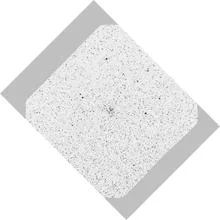
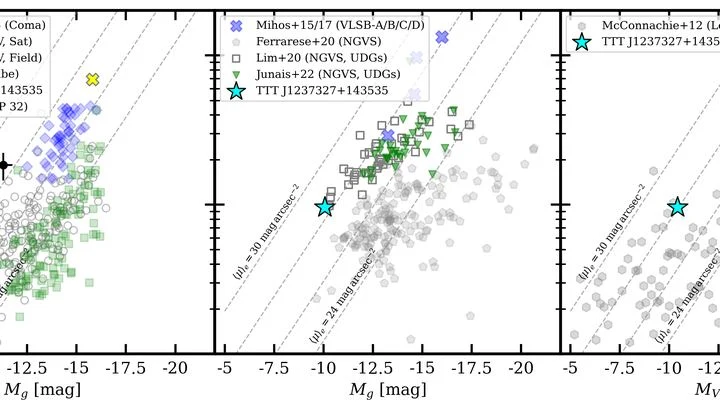
The night sky only looks black: telescopes reveal millions of galaxies, but some are so dim they blend into the background. Astronomers caught just such a "nearly invisible" one by chance while observing the Virgo Cluster with the two-meter telescope at Teide Observatory.
The galaxy is named TTT J1237327+143535.
The galaxy cluster RXC J0528.9−3927 is like a city shrouded in fog: at its center, a radio halo shines brightly, but farther out, beyond the usual boundaries, astronomers have spotted a barely visible glow. It stretches for two million light-years — three times farther than the halo itself.
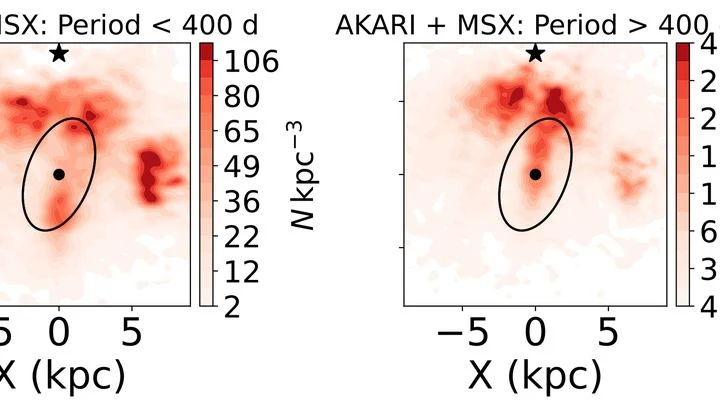
Red giants in the center of the Milky Way resemble distant lighthouses that brighten and dim. Their light pierces through dense dust, but standard distance-measuring methods fail here: the stars are too bright and unstable, and dust distorts the picture.
Astronomers found a workaround.
A dance floor where couples whirl. At the center, an invisible master of ceremonies sets the rhythm. This is the supermassive black hole at the heart of the Milky Way, and the couples are stars whose orbits astronomers have tracked for years. But what if the master himself is wrapped in a fluffy fur coat of tenuous matter?
Imagine a huge stadium packed with people dressed in black. You're standing outside, trying to figure out what's happening inside, even though you can't see a single person. But if two people bump into each other and exchange bright T-shirts, you'd spot a flash of color.
The calm surface of a lake suddenly ripples — somewhere in the depths, an underwater cliff has collapsed. The water trembles almost imperceptibly, and the circles spread wider and wider until they reach a bobber near the shore.
A distant light in the fog looks tiny and reddish: you'd think it's miles away. But then the light shifts sideways, and it becomes clear: it's a cyclist twenty steps away, just with a nearly dead rear light. That's how, in 2025, astronomers stumbled upon 'Capotauro'—a compact red source in images from the James Webb Space Telescope.
In the dark outskirts of our Galaxy, far from bright star clusters, millions of black holes lurk. They are invisible: they don't shine and don't noticeably accrete matter. Conventional search methods, designed for dense stellar fields, are useless here. A different approach is needed.
Astronomers have proposed using the very fabric of space as a detector.
At the heart of our Galaxy lives the supermassive black hole Sagittarius A*. If an invisible companion orbits nearby, their dance can be spotted through the light of other stars. The pair's gravity works like a lens: as the black holes pass in front of a background star, its light briefly brightens and splits into two.
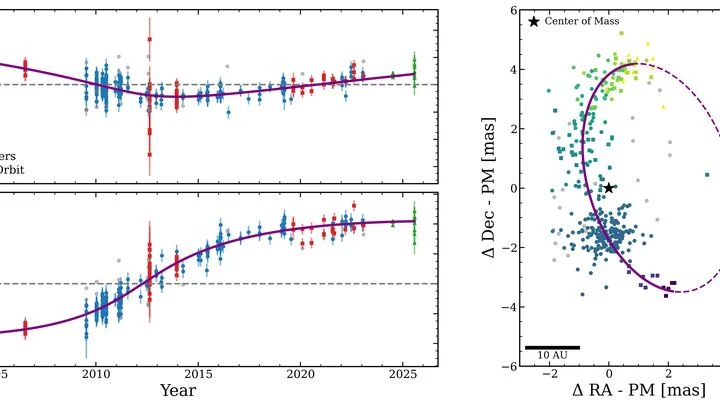
At the very heart of the Milky Way, stars whirl around an invisible supermassive black hole. One of them, S301, completes an orbit in just 8.7 years. Its path is a highly squashed ellipse: sometimes it grazes the black hole, sometimes it shoots far away. At closest approach, the distance to the black hole is tiny by cosmic standards.
1799 kilometers per second — that's the speed at which star S5-HVS1 is permanently leaving the galaxy. 4.8 million years ago, it was ejected from the center of the Milky Way during a close encounter with the supermassive black hole Sgr A*.
The temperature at the center of a galaxy cluster reaches a hundred million degrees. These largest gravitationally bound systems are natural laboratories where nature hides 85% of its mass in invisible dark matter.
At the heart of the giant galaxy Hydra-A, there's a hive of activity. A supermassive black hole shoots out two powerful plasma jets. They punch through the surrounding cloud of hot gas and inflate giant bubbles within it.
For decades astrophysicists painted a neat picture: a galaxy, like a giant carousel, spins in a unified rhythm, and the supermassive black hole at its center inherits that dance.
The cosmic spectacle unfolds on the stage of Galaxy галактики Centaurus A. In the lead role: a supermassive сверхмассивная чёрная дыра with a powerful jet that pierces space for hundreds of thousands of light-years.
At the center of the Milky Way, where the supermassive black hole Sagittarius A* reigns supreme (its metric first derived by Karl Schwarzschild), star S4714 makes a dizzying voyage.
In 1933, Fritz Zwicky first spoke of an invisible mass holding galaxy clusters together. Decades later, Vera Rubin mapped galactic rotation, revealing the ghostly presence of dark matter. Today we know it pervades the cosmos, but its particle nature remains elusive.
For 23 years, Hubble and James Webb have peered into the heart of Omega Centauri, a globular cluster where millions of stars crowd into a space just 150 light-years across. In this stellar beehive, the motion of the stars betrayed an invisible partner: a main-sequence star (one that has not yet left the main evolutionary branch) seemed to be tugged in a dance with an unseen weight.
A giant cloud of invisible matter acts like a funhouse mirror — distorting the light from a distant galaxy. From these distortions, astronomers can weigh the cloud and peer into its depths.
At the center of the Milky Way, like a matryoshka doll within a matryoshka doll, lies a supermassive black hole, surrounded by a swarm of stars and an invisible shell of dark matter. This shell, or "spike," is expected to be extremely dense right at the horizon.
A giant city of thousands of galaxies is shrouded in an invisible cloud of scorching gas. This gas is like the air in a room: it can be calm, or it can churn with drafts. Astronomers aimed the latest X-ray "thermometer" at such a city — the cluster Abell 1795—and measured how fast the gas moves there.
Cosmic black holes at the centers of galaxies are like giant banyan trees: their aerial root‑filaments stretch for kiloparsecs to harvest nourishing matter. For decades astronomers have debated: how does cooling gas from cluster atmospheres fall into the sphere of influence of a supermassive hole?
Imagine a giant inflatable balloon with galaxies painted on it. As it inflates, the pattern stretches and neighboring dots move apart. The rate of that stretching is the Hubble constant. Astronomers usually catch light from distant stars and see how much it has reddened due to the stretching of space.
At the heart of our stellar metropolis — the Galaxy — lurks the supermassive black hole Sagittarius A*. Around it, star S2 whirls in a swift dance. But its movements reveal more than just the hole's pull: an invisible partner joins the dance — dark matter.
A city at night from above: bright streetlights, glowing windows, car headlights. Astronomers see the center of our Galaxy in much the same way — only not in ordinary light but in gamma rays. And there, among the familiar lights, a strange, uniform glow emerges. It cannot be attributed to any known source. This excess is called the Galactic-center excess (GCE).
Black holes come in two types: tiny ones — the remnants of supernova explosions, and giants in the cores of galaxies. But where are the intermediate ones, with hundreds and thousands of solar masses? The answer may lie in star swarms, where black holes collide like balls on a billiard table and, merging, bulk up.
A giant cauldron that barely smolders most of the time, but occasionally spits out showers of sparks. That is roughly how the supermassive black hole at the center of our galaxy — Sagittarius A*—behaves. It weighs four million times as much as the Sun and lies 26,000 light-years away.
The cosmos is full of mimicry. The clearwing moth wears a wasp's mask, a harmless fly buzzes like a bee. And in the world of gravity, the role of impersonator is perhaps played by boson stars — colossal clumps of scalar field, indistinguishable from black holes.
Light from the distant Dragon Galaxy has been traveling toward us for more than seven billion years. On its way, it passes by a huge galaxy cluster whose gravity bends the path of light like a lens. As a result, the galaxy appears brighter and larger than it really is, just as a magnifying glass enlarges fine print.
At the center of the Milky Way lurks something invisible but extremely massive — about four million times heavier than the Sun. It is usually called a black hole and designated Sagittarius A*. But astronomers are not letting their guard down: what if it is not a hole but something more exotic, like a giant ball of ultralight particles — a boson star?
At the very heart of the Milky Way, something is continuously glowing in gamma rays. This light is special: its energy is exactly 511 thousand electronvolts. Such energy is produced when an electron meets its antimatter counterpart, a positron, and they annihilate, leaving behind a flash of light.
About 11 billion years ago, the Milky Way suffered a head-on collision. Not with an asteroid, but with an entire smaller galaxy. It slammed into ours and was torn apart like a puff of flour hit by a fist. Astronomers call this cosmic scar Gaia-Sausage-Enceladus (after the shape of the orbits of its remaining stars).