Fuzzy dark matter is a hypothetical form of dark matter composed of ultralight bosons, with masses around 10^-22 eV (roughly a billion billion times lighter than an electron). At these masses, the de Broglie wavelength of the particles is comparable to the size of a dwarf galaxy, so quantum wave-like effects become important on astrophysical scales. Instead of behaving like discrete particles, fuzzy dark matter forms a coherent wave that can suppress small-scale structure formation, potentially solving the 'missing satellites' problem in cosmology.
History
The idea was proposed in the early 2000s, with influential papers by Wayne Hu, Rennan Barkana, and Andrei Gruzinov (2000) and later by Lam Hui and collaborators (2017) who coined the term 'fuzzy dark matter'.
How it works
The ultralight bosons obey the Schrödinger equation, and their collective behavior is described by a scalar field. On scales larger than the de Broglie wavelength, the field behaves like classical cold dark matter, but on smaller scales, quantum pressure prevents gravitational collapse, smoothing out density fluctuations. This leads to a characteristic suppression of the matter power spectrum below a certain scale, and the formation of solitonic cores in the centers of dark matter halos.
In practice
It is a research topic in cosmology and astrophysics, guiding observational searches for signatures in the cosmic microwave background, galaxy surveys, and pulsar timing arrays.
Fun fact
If fuzzy dark matter exists, a single 'particle' could have a wavelength as large as a galaxy, making it the most quantum object in the universe.
An old stellar ball that has gathered hundreds of thousands of suns has been circling the edge of a dwarf galaxy for billions of years. By all calculations, it should have long ago plunged into the center like a heavy stone into jelly. But the ball holds its ground, and this fact has been nagging astrophysicists for several decades.
Eight bright spots on the radio sky. They are all the same quasar HS 0810+2554, whose light passed through a gravitational lens — a massive foreground galaxy.
Inside a supercomputer, fifteen stable wave clumps — solitons — collide to form a halo of dark matter. These waves obey an equation that Erwin Schrödinger derived for electrons at the beginning of the 20th century, but now they paint a portrait of a giant galactic cocoon.
Ever since Fritz Zwicky noticed that galaxy clusters were moving too fast, and Vera Rubin measured the rotation of spiral arms, dark matter has remained cosmology's greatest mystery.
The early universe at redshift z>7 was an arena of rampant growth: black holes with masses up to a billion solar masses already blazed as quasars, devouring gas at monstrous rates. How these giants managed to grow in such a short time is one of astrophysics' sharpest puzzles.
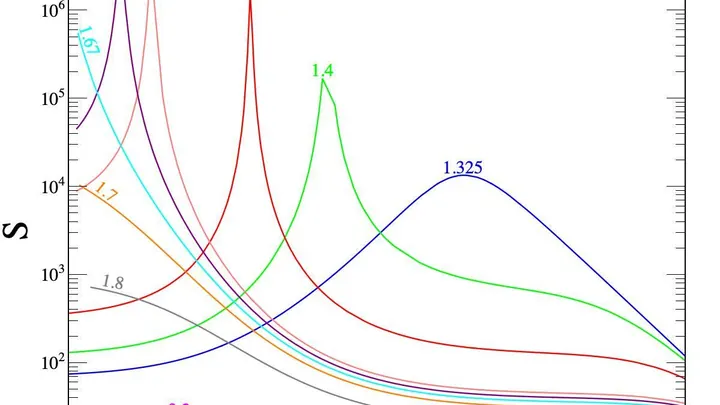
When two dark matter particles approach each other, they can attract more strongly than expected. This phenomenon is called Sommerfeld enhancement — it works like an invisible spring that compresses before impact. For a long time, it was believed that the spring compresses more strongly the slower the particles approach each other.
Dark matter is an invisible substance that reveals itself only through gravitational effects: it bends the light of distant galaxies, much like an unseen window that alters the path of light rays.
Frozen cake batter is dotted with tiny raisins. If the batter is uniform, all the raisins will puff up evenly, and the cake will be smooth. But if the batter has denser spots (some sweeter, some more bland) the raisins will be distributed unevenly: dense in some places, sparse in others.
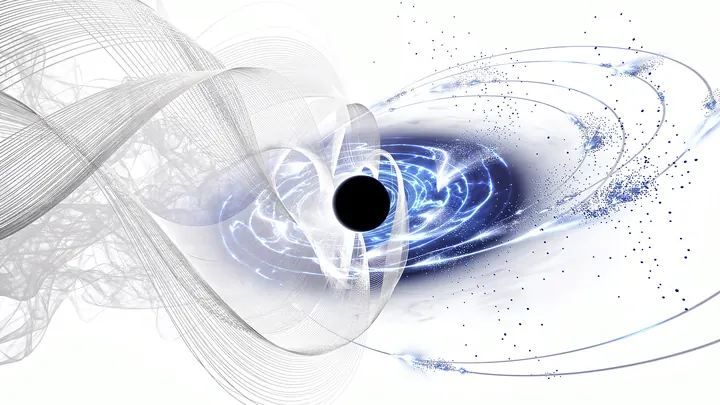
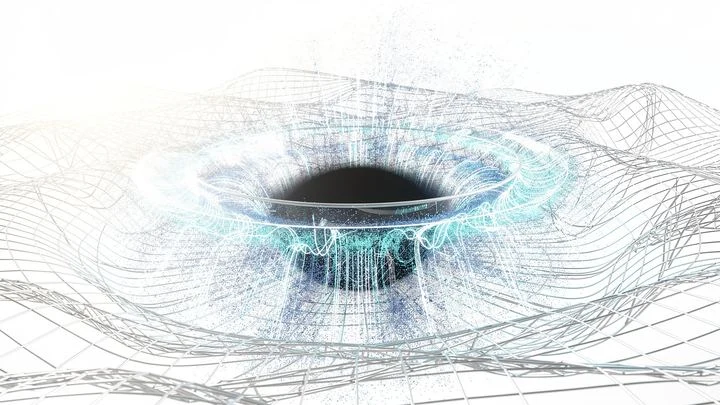
A dying star is not just fading away. In its final moments, the core, starved of fuel, collapses into itself at colossal speed. Classical gravity leaves no choice: if the mass is large enough, a black hole is born — a region from which not even light can escape.
Two heavy balls orbit on the surface of a pond. Ripples spread from them: these are gravitational waves. As the balls spiral closer, the waves carry away energy, and the ripples become more frequent.
The universe is permeated by an invisible substance, dark matter, whose gravitational influence is obvious, but whose composition remains a mystery. One hypothesis suggests it consists of ultralight particles so light that they exhibit wave-like behavior, forming a kind of cosmic ripple.
In the first moments after the Big Bang, the cosmos resembled a giant cooling pond. Just as water, when freezing, becomes covered with a network of cracks, so the cooling universe could have cracked — not into ice, but into the thinnest filaments of pure energy. These filaments are called cosmic strings.
Dark matter is the invisible substance that holds galaxies together, yet it has so far escaped direct detection. The BULLKID-DM detector is designed to catch candidate particles with a mass around 1 GeV (roughly that of a proton) and an extremely weak interaction with ordinary matter — a…
The James Webb telescope spotted “red dots” in the early Universe — dense objects tens of light-years across. Spectroscopic analysis of their light revealed the hue of hydrogen. Yet in X-rays they are nearly invisible, like a powerful spotlight wrapped in layers of gas curtains.
NGC 3627, a spiral beauty in the constellation Leo, harbors a trail that fits no standard scenario. A narrow band of cold gas, a molecular trail, stretches more than 8 kiloparsecs (thousands of parsecs, each about 3260 light-years) with a width of about 200 parsecs. That is like a thread as long as a football field and as thick as a pencil.