Dark matter is the invisible substance that makes up about 27% of the universe's mass-energy content. Unlike ordinary matter, it does not emit, absorb, or reflect light, making it detectable only through its gravitational effects. The study of dark matter's properties focuses on what it is made of, how it interacts with itself and with normal matter, and how it behaves under extreme conditions.
History
The concept of dark matter was first proposed by Fritz Zwicky in 1933, who noticed that galaxies in the Coma cluster were moving too fast to be held together by visible matter alone. Later, Vera Rubin's observations of galaxy rotation curves in the 1970s provided strong evidence for its existence.
How it works
Scientists investigate dark matter through several complementary approaches. Particle physics experiments search for weakly interacting massive particles (WIMPs) that might collide with atomic nuclei in detectors. Astrophysical observations look for signs of dark matter annihilation, where two dark matter particles could produce gamma rays or other particles. Gravitational lensing and galaxy rotation curves provide indirect measurements of dark matter's distribution and density.
In practice
Understanding dark matter properties is crucial for interpreting cosmological observations and for designing experiments to detect it directly, such as those in underground laboratories or space-based detectors.
Fun fact
Dark matter is so diffuse in our solar system that the total amount passing through Earth each year is estimated to be less than a kilogram.
No one has ever seen dark matter, but it should pass through detectors like wind through leaves. Sometimes, very rarely, a dark matter particle bumps into an atomic nucleus, and then the detector must catch that jolt. The trouble is that light dark matter particles can hardly move heavy nuclei: it's like trying to knock down a bowling pin by throwing a feather at it.
Imagine a huge stadium packed with people dressed in black. You're standing outside, trying to figure out what's happening inside, even though you can't see a single person. But if two people bump into each other and exchange bright T-shirts, you'd spot a flash of color.
The cosmological standard model is like a recipe for a cake where everything is strictly measured: dark matter is like flour without a single lump (zero pressure), and dark energy is like the perfect leavening agent (equation of state exactly minus one). But what if the flour is a bit damp and the leavening agent has lost its oomph?
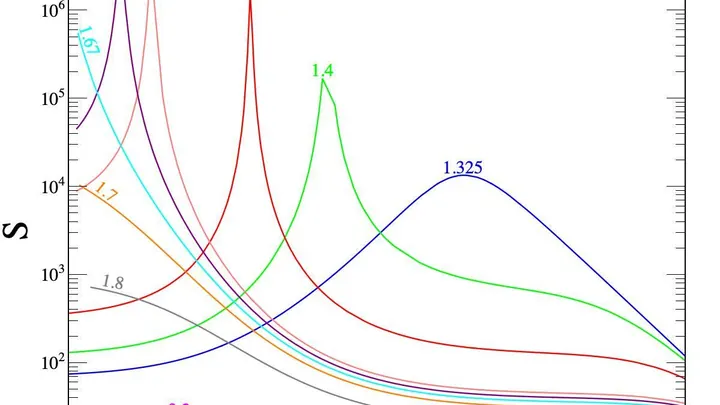
When two dark matter particles approach each other, they can attract more strongly than expected. This phenomenon is called Sommerfeld enhancement — it works like an invisible spring that compresses before impact. For a long time, it was believed that the spring compresses more strongly the slower the particles approach each other.
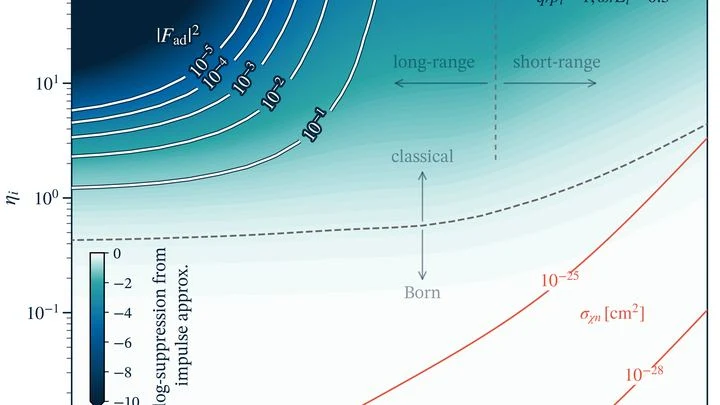
A billiard ball slams into another. Impact, and the balls scatter. But if the push is not sharp but very gentle, the balls just roll together without bouncing. An atom behaves much the same way when hit by a dark matter particle.
A black hole is not just a void but a massive object that warps the space around it. If it finds itself in a cloud of invisible dark matter, matter that emits no light but makes itself known through gravity, its behavior changes.
At the edge of the solar system, far beyond Neptune's orbit, something is knocking icy chunks off their paths. Their orbits are stretched and tilted in the same way, as if an invisible hand arranged them in a pattern.
Although invisible, dark matter’s gravity governs the motion of stars and galaxies. It was first proposed by Fritz Zwicky in the 1930s, and later confirmed by Vera Rubin. Scientists have long suspected it accumulates around black holes, but direct proof was lacking.
The cosmos is filled with invisible dark matter, which betrays itself only through gravity. Its existence was suspected by Fritz Zwicky and confirmed by Vera Rubin.
Supermassive bodies warp space, turning into a lens that bends light from distant objects. Such spacetime curvature allows astronomers to see the invisible. Recently, this method helped detect a hidden clump with the mass of a million Suns.
The enigma of dark matter was already studied by Fritz Zwicky and Vera Rubin. For decades, it was depicted as a cold, listless skeleton that only draws galaxies together.
Astronomers have found an invisible object in the Universe weighing just a million Suns — for cosmic scales, that’s a mere trifle, a hundred times lighter than anything they’ve been able to “weigh” at such distances. The object itself doesn’t shine, but it gave itself away by bending the light from an even more distant galaxy.