A dimensionless parameter is a quantity that has no physical units, meaning it is a pure number. Such parameters often emerge from ratios of physical quantities that cancel out their dimensions, and they play a crucial role in characterizing the behavior of systems across different scales. For example, the Reynolds number in fluid dynamics, which compares inertial forces to viscous forces, determines whether flow is laminar or turbulent, regardless of the specific fluid or pipe size. Dimensionless parameters are the backbone of scaling laws, allowing scientists to apply results from small-scale models to large-scale phenomena, from laboratory experiments to astrophysical objects.
History
The systematic use of dimensionless parameters in physics and engineering dates back to the late 19th and early 20th centuries, with figures like Osborne Reynolds (Reynolds number, 1883) and Ludwig Prandtl (Prandtl number, early 1900s). The formal theory of dimensional analysis was developed by Edgar Buckingham in 1914 with his π theorem.
How it works
Dimensionless parameters arise when you combine physical quantities in a way that their units cancel. For instance, in the context of the articles listed, a parameter like the ratio of a system's size to some characteristic length scale can be dimensionless. These parameters often represent the relative importance of competing effects—such as gravity versus surface tension, or quantum effects versus thermal fluctuations. By varying a single dimensionless parameter, one can explore a whole family of systems that behave identically when scaled appropriately, a principle known as similarity or self-similarity. This is why they are so powerful: they reduce the complexity of a problem by collapsing many variables into a few key numbers.
In practice
Dimensionless parameters are used in wind tunnel testing of aircraft, in modeling ocean currents and atmospheric circulation, in designing chemical reactors, and in understanding phase transitions in condensed matter physics, as hinted by the titles about scaling and critical phenomena.
Fun fact
The fine-structure constant, a dimensionless number approximately equal to 1/137, is so fundamental that it determines the strength of electromagnetic interactions between charged particles, and its value cannot be predicted by current theory—it must be measured experimentally.
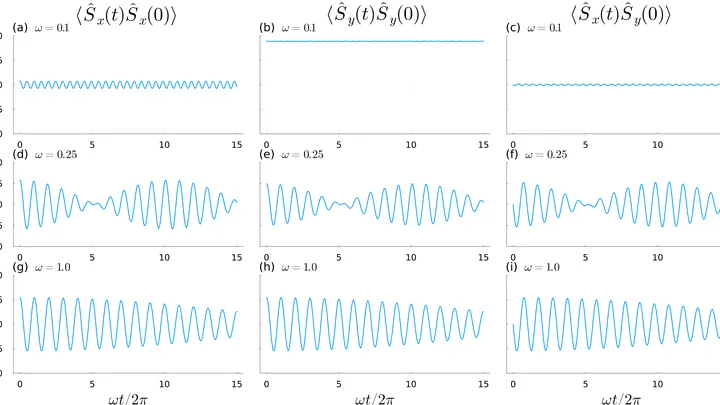
Quantum mechanics allows a particle to be in two places at once: this is called superposition. But massive objects, like a dust grain or a ball, don't behave that way: their position is always definite. Why? One idea is that it's an illusion: the particle is constantly "jittering" from random environmental kicks, and the blurred picture averages out.
Two cities with the same average population density. In one, a neat grid of blocks; in the other, a maze of narrow alleys and unexpected squares. On a global map they look like twins, but life inside flows quite differently.
A driver turns the steering wheel to make the car turn. The quantum world also has its own "steering wheels"—external parameters that are slowly varied to shuttle particles from one place to another.
If you check where an electron is every second, its quantum properties change. It's like a child playing hide-and-seek but constantly being called by name: they freeze and stop running. In the particle world, such a "caller" is a measurement. It prevents particles from freely forming a shared quantum state, or entanglement.
A balloon inflates on its own, even though no one is blowing it up. That's roughly how the accelerated expansion of the universe looks, and to explain it, scientists usually invoke dark energy, an invisible and poorly understood force. But what if the balloon expands because new air molecules are continuously appearing inside it?
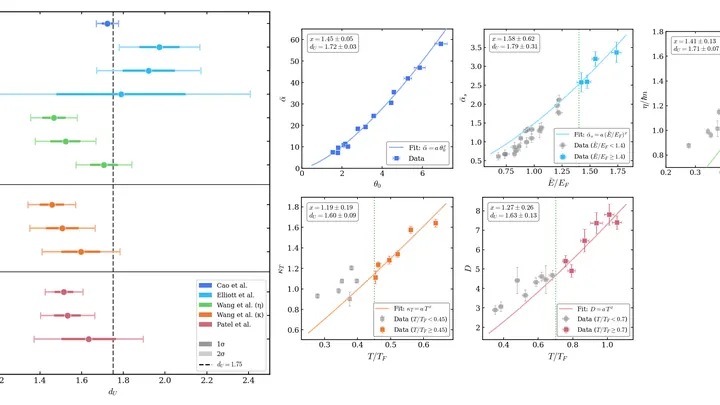
A stone drops into a pond. Ripples spread, fade, and soon the surface is smooth again. But what if the pond has no shores, no bottom, and no characteristic ripple size? That is the world, a scale-free world, where quantum systems live when surrounded by an environment that picks out no particular length or energy.
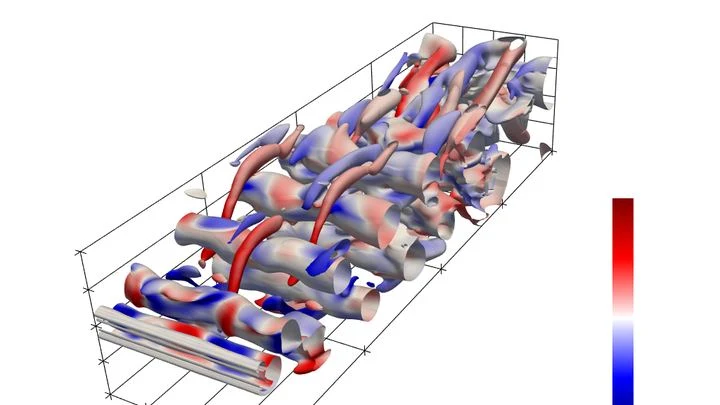
A thin plate stands across a flow of water or air. Behind it, a wake forms — a region where the flow becomes tangled and mixed. Usually, such a wake becomes turbulent when the flow speed is high enough, quantified by the Reynolds number.
There's no tool to measure distances to faraway galaxies, but nature left a clue: after the Big Bang, sound waves created rhythmic clumps of matter. Today, this is noticeable as a slight preference for galaxies to be at a certain distance from each other — a built-in ruler.
The enigma of dark matter was already studied by Fritz Zwicky and Vera Rubin. For decades, it was depicted as a cold, listless skeleton that only draws galaxies together.