Whisper of the First Stars: How Bayesian Algorithms Hear the Newborn Universe ✦
Original: "A Pixel-by-Pixel Path to Population III Discovery with JWST"
Pixel-by-pixel Bayesian analysis of JWST images transforms the hunt for metal-free Population III stars from mysticism into routine statistics — with a success rate of up to 90%.
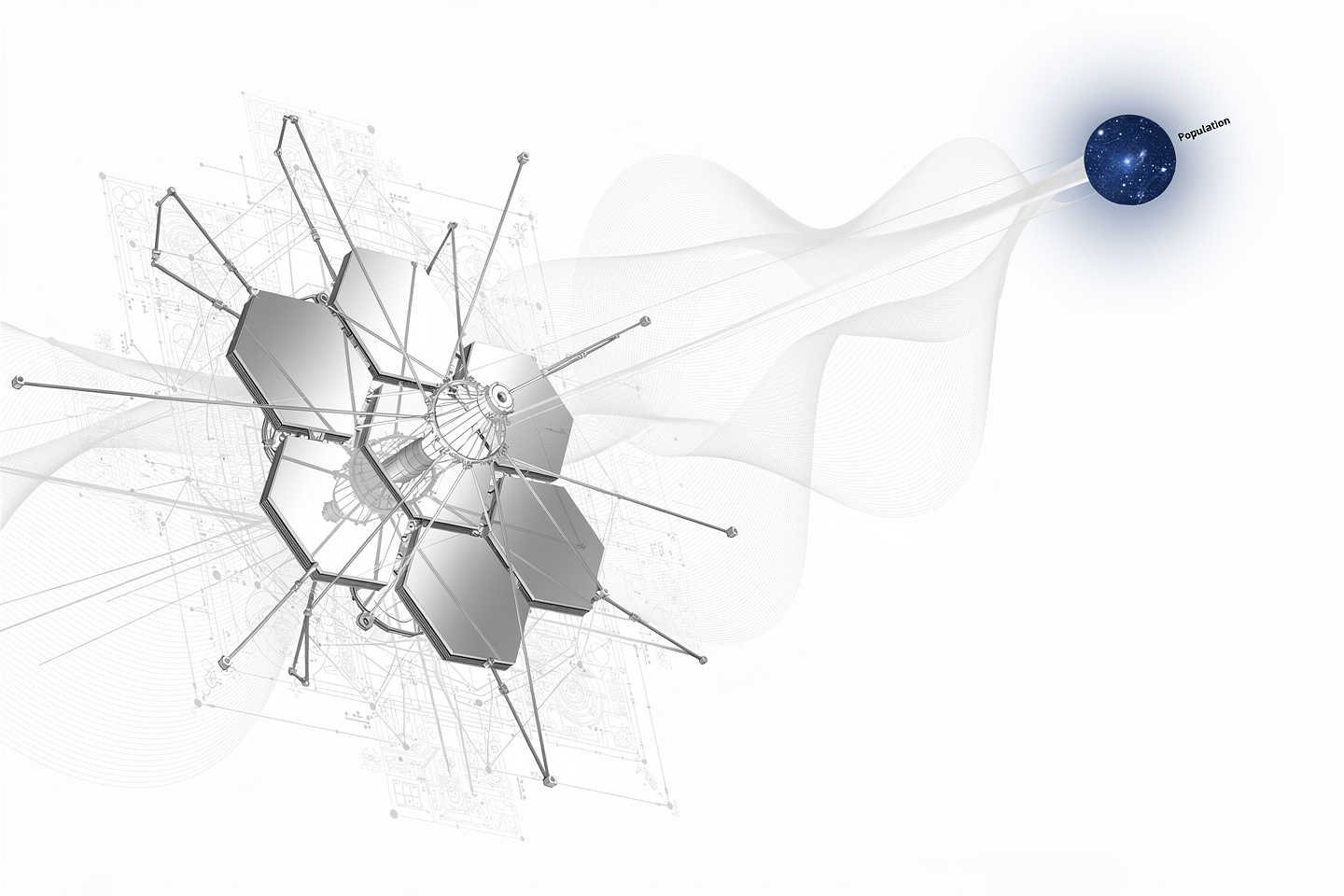
Links in the knowledge graph 1
The first stars exploded, seeding the Universe with the elements of life, but no one has ever seen them. Their light is a whisper, drowned out by the roar of their descendant galaxies. The new method, like a sensitive ear, plucks this whisper from each pixel of JWST, and the first candidates have already been found. Perhaps we are on the verge of discovering the era when the Universe first spoke with the voice of heavy elements.
🎯 The first stars could be hundreds of times more massive than the Sun and end their lives as hypernovae — explosions that outshine an entire galaxy. Yet, despite their piercing ultraviolet brightness, not a single confirmed representative has been found so far.
\lambda_{\rm max} = \frac{b}{T}
Wien's law: the hotter the star, the shorter the wavelength of its peak radiation. The first stars, heated to hundreds of thousands of degrees, shone mostly in the ultraviolet, which today is shifted into the infrared — exactly where JWST hunts.
v = H_0 d
Hubble's law: the farther a galaxy, the faster it recedes. Redshift stretches the light of the first stars, carrying their ultraviolet scream into an infrared whisper discernible to JWST.
Scientists
Christian DopplerD. B. McLaughlinDidier QuelozMichel MayorR. A. RossiterStephen Hawkingstar formation
JWST
photometry
spectroscopy
numerical simulation
Machine Learning
redshift
nebula
nucleosynthesis
black hole
metallicityLaws
Doppler effectHawking radiationgravitational lensingBekenstein-Hawking entropymass–energy equivalenceEinstein field equations