Whisper of the First Stars: How Bayesian Algorithms Hear the Newborn Universe ✛ ✦
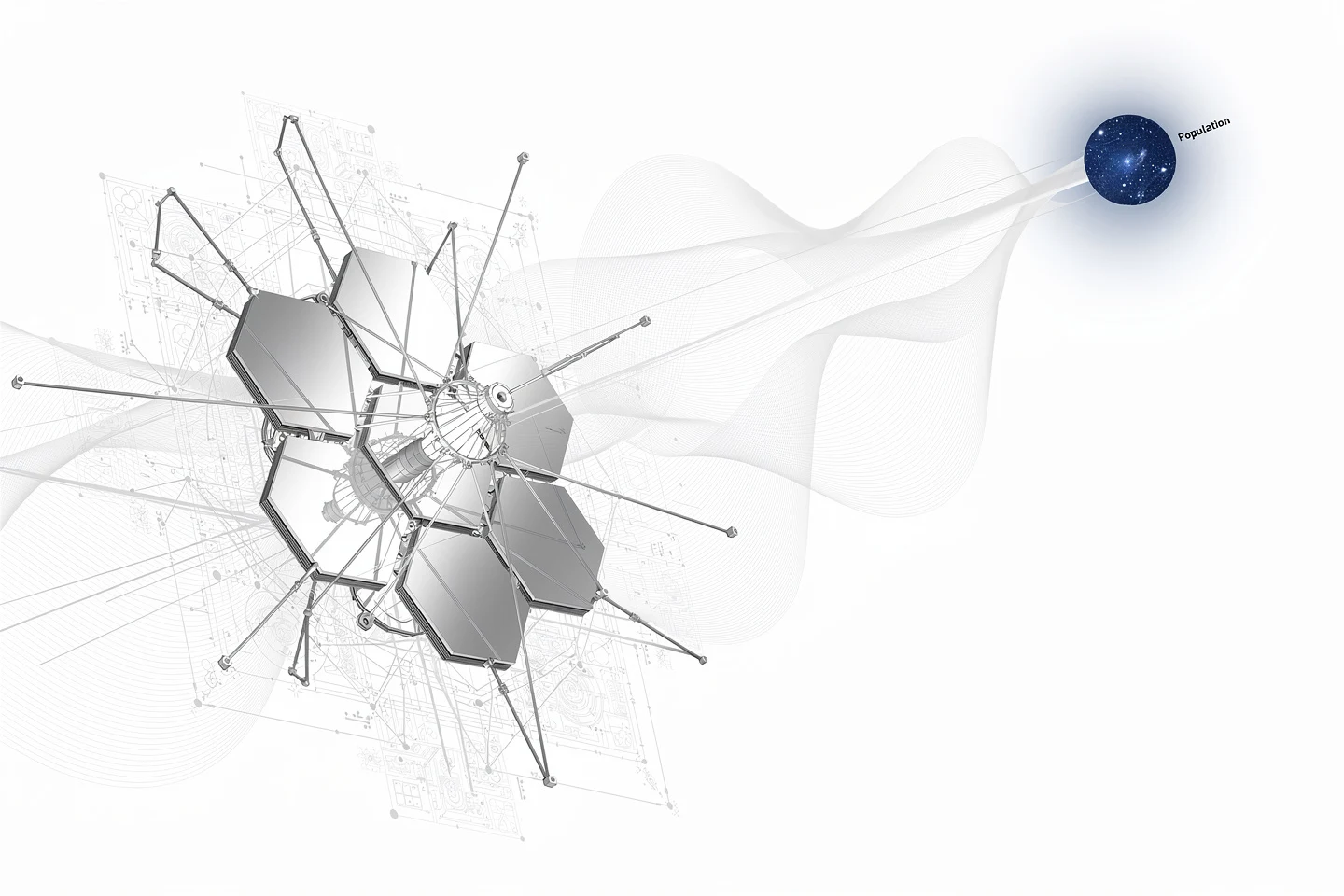
Right after the Big Bang, the Universe was a chemical desert — only hydrogen and helium, not a hint of metals. But moments passed (by cosmic standards), and the birth of the first stars — Population III — began. These colossi became the crucibles where nucleosynthesis first ignited: in their fiery cores, carbon, oxygen, iron — all the elements that later formed planets and us — were forged. They lived dazzlingly and died young, illuminating the Universe for just a few hundred million years. To catch their light today is like trying to hear a whisper of a person standing on a rooftop across the street in a roaring metropolis: the signal is there, but it's masked by the din of the city-galaxy.
For a long time, astronomers tried to capture this whisper by summing the light of entire galaxies — but the voice was lost in the chorus. The new method, nurtured on numerical simulations and machine learning, acts with greater finesse. Imagine placing thousands of super-sensitive microphones all over a concert hall. Each pixel of a James Webb image is such a microphone; a Bayesian algorithm, trained on millions of synthetic images, listens to it and in a split second delivers a verdict: with what probability did this quantum of light come from a star with zero metallicity rather than an ordinary galaxy. The key insight: a young cluster of primordial stars on the outskirts of a massive galaxy is almost invisible in the total flux, but it emerges in pixel-by-pixel photometry, like a face in a blurred photo if you know where to look. Under ideal conditions — a clump with a mass of more than a million suns, an age of up to a couple of million years, and pushed out to two effective radii — the algorithm yields a confident detection in 9 out of 10 cases.
This approach flips the search strategy. There's no need to painfully accumulate spectra of faint objects; it's enough to comb through the existing deep fields from Webb, looking for blue clumps on the outskirts of galaxies at redshifts greater than five. This paves the way for the first census of Population III and will allow us to reconstruct the history of nucleosynthesis — the very process whose physics was unveiled in the mid-20th century by Hans Bethe, Fred Hoyle, and Margaret Burbidge. Moreover, understanding the nature of the first stars sheds light on the birth of supermassive black holes: many of them could have grown from the collapses of primordial giants. In the coming years, the pipeline will be adapted for MIRI data for even greater distances, and then ground-based 30-meter telescopes will be connected for confirmatory high-resolution spectroscopy.
The first stars could be hundreds of times more massive than the Sun and end their lives as hypernovae — explosions that outshine an entire galaxy. Yet, despite their piercing ultraviolet brightness, not a single confirmed representative has been found so far.