The Hunt for the First Stars: How JWST and Machine Learning Search for Population III ✛ ✦
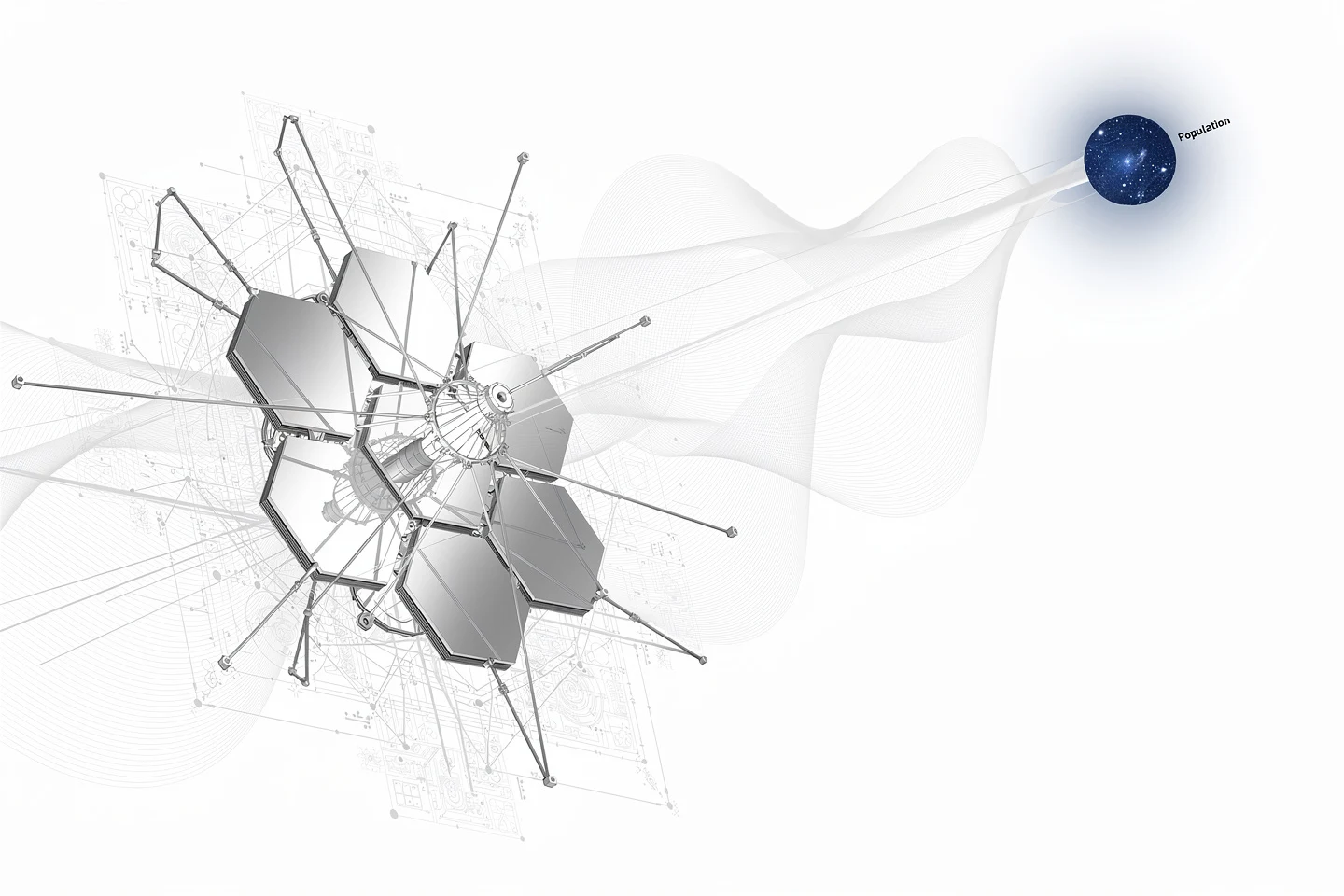
Context
After the Big Bang, matter consisted only of hydrogen and helium; star formation began in an era called the cosmic dark ages. The first luminaries—Population III stars—lacked heavy elements and initiated nucleosynthesis, giving rise to all subsequent generations. Their detection is critical for understanding how the universe became transparent and chemically diverse. Despite their expected brightness in the ultraviolet, their short lifetimes (just a few million years) and rapid pollution by metals make these objects elusive for ordinary telescopes. Only James Webb with its infrared sensitivity can peer into the epoch when they still existed.
Methods
The researchers built a complete modeling cycle from the physics of primordial stellar spectra to realistic JWST images, using the Yggdrasil code to create spectral templates for Population III with different mass functions and nebular covering. The key innovation is the application of simulation-based Bayesian inference via neural normalizing flows, trained on millions of synthetic observations; this allows posterior probabilities for each image pixel to be estimated in a fraction of a second without directly computing the likelihood function. Morphological experiments involved numerical simulation of compact Population III clumps that ram into their host galaxies, followed by convolution with the instrumental point spread function and addition of empirical noise reproducing the conditions of the JADES deep survey. By using Hubble's law to relate redshift to distance, along with Planck's law and Stefan-Boltzmann law for radiation calculations, the authors ensured the physical fidelity of the synthetic data. A detailed scenario of nucleosynthesis in stars was first calculated in the works of Hans Bethe, Fred Hoyle and Margaret Burbidge.
Results
The analysis showed that with the classical integrated approach, the light of even a massive ($10^6$ M⊙) and young (1 million years) Population III clump is completely lost against the host galaxy, and standard fiducial models are always preferred. However, with pixel-by-pixel photometry, the picture changes drastically: for clumps with mass >$10^6$ M⊙, age <2 million years, and located at a distance >2 effective radii from the center, the model recovers the primordial nature in up to 90% of cases. Interpretation via SHAP values revealed that the dominant factors are projected distance (contribution ≈35%), redshift (≈25%), and the mass ratio of the clump to the host (≈20%); clump age and host morphology play secondary roles. Notably, on the real candidate 'Blueberry' (z=5.124), the pixel-wise Bayesian battle confirmed: the central pixel of the companion is confidently described by a Population III spectrum, while the main galaxy 'Banana' remains fiducial. This is the first time that pixel-based Bayesian diagnostics independently picked out a real object previously suspected from helium lines. In both cases, the absence of metallicity is a defining characteristic, contrasting with enriched environments containing cosmic dust.
Implications
The results significantly change the search strategy for the first generation of stars: instead of spectroscopy of faint integrated sources, one should scan the already accumulated deep fields of Webb in search of spatially resolved blue clumps on the periphery of massive galaxies at redshifts >5. Such a morphological filter sharply reduces the number of false-positive candidates caused by young low-metallicity Population II, making systematic mapping of the fleeting era of primordial nucleosynthesis realistic.
Future development
Future development of the method involves replacing simplified Sérsic profiles with realistic morphologies from cosmological hydrodynamical simulations (e.g., FLARES), thereby eliminating biases associated with prior assumptions. A breakthrough will be the implementation of amortized Bayesian model comparison via a marginal likelihood estimator, directly outputting Bayes factors and eliminating the need for post-predictive checks. Concurrently, libraries of Population III spectra will be expanded to include scenarios of partial enrichment and multi-component nebular emission.
Impact
The work will directly influence the planning of future observing programs for JWST and the Roman Space Telescope, as well as set priorities for integral field spectroscopy on 30-meter telescopes. The pixel-wise Bayesian diagnostics method will also find application in other tasks requiring the isolation of a faint component against a complex background, from searching for tidal structures to analyzing supernova remnants.
Next steps
The immediate goal is to apply the pipeline to the entire JADES archive to build a statistically significant sample of candidates, then confirm their nature with high-resolution spectroscopy. Adaptation of the pipeline to MIRI data is also needed to reach higher redshifts.
Key open problems
The search for Population III is directly tied to the mysteries of the reionization era and the origin of black holes, since primordial stars could collapse into 'seeds' of supermassive objects. The results also refine the picture of nucleosynthesis and galactic evolution, providing constraints on top-heavy mass functions.
The knowledge machine's view
This section is addressed to the author of the paper and their colleagues. Neighbouring works were found by meaning-based search across our archive, not by word overlap. We do not review: we show the field around the work.
What the work does
The paper presents a method for finding Population III stars in JWST data: the authors model the spectra and images of such stars, then apply simulation-based Bayesian inference with neural normalizing flows trained on synthetic data. They show that with pixel-by-pixel analysis, the signal from compact clumps of Population III can be recovered in up to 90% of cases, whereas the integrated approach fails.
Where its strength is
The strong point is the combination of detailed Population III modeling with modern machine learning for fast posterior estimation, which allows efficient searches for rare objects in deep surveys.
Where it could go next
- It might be interesting to compare the method with recent JWST observations of Population III star candidates: the archive contains a review of work on red compact objects in the early Universe, where possible signatures of primordial stars are discussed.based on: Red Lanterns of the Cosmos: What Compact Objects from the Early Universe Conceal arXiv:2606.03522v1
- There is an approach that uses gravitational lensing to amplify the light of individual stars at high redshifts; combining it with pixel-by-pixel analysis could expand the sample.based on: Super-magnified stars: How ripples on the light ocean reveal dark matter's secrets arXiv:2607.14034
- The archive also contains a review of a model for massive galaxy formation with a non-standard initial mass function; comparing with such models could help refine the expected properties of Population III in early galaxies.based on: The Cosmic Hump: How a New Spectrum Creates Massive Galaxies at the Dawn of Time arXiv:2606.07357v1
Worth trying
- Apply the trained classifier to real JADES data and compare predictions with known Population III candidates.
- Use SHAP analysis on real images to identify the most informative pixels and correlate them with galaxy morphology.
- Test the method's robustness to different noise levels and instrumental effects by varying simulation parameters.
Why this may matter
If the method is confirmed on real data, it could become a standard tool for finding the first stars, paving the way to understanding early star formation and the chemical evolution of the Universe.
Nearby works in our archive
- First Stars: Fireworks Seen by Webbsimilarity 0.67
- Neural Network Discovers New Galaxies Without Any Guidancesimilarity 0.67
- Where Dwarfs Ignite Starssimilarity 0.65
- The Mystery of Massive Early Galaxies: A Solution in Motionsimilarity 0.64
- Red Lanterns of the Cosmos: What Compact Objects from the Early Universe Concealsimilarity 0.64
- Super-magnified stars: How ripples on the light ocean reveal dark matter's secretssimilarity 0.63
- The Cosmic Hump: How a New Spectrum Creates Massive Galaxies at the Dawn of Timesimilarity 0.63
The closest work in the archive sits at 0.67 by meaning — the usual level for our corpus.
Original abstract
as written by the authors arXiv:2606.30750
The identification of the first generation of metal-free stars, known as Population III (Pop~III), remains a primary goal of modern observational astronomy. While JWST has discovered an abundance of UV-bright galaxies at $$z > 10$$, distinguishing primordial stellar populations from early metal-enriched systems is a significant challenge. We present an end-to-end framework that combines physically motivated forward modelling from Yggdrasil primordial models with simulation-based inference (SBI) to test Pop~III detectability in JWST-like observations, from isolated sources to realistic overlap with enriched (Pop~II) hosts. Our analysis spans several Pop~III initial mass function (IMF) assumptions, nebular configurations, and Lyman-$$\alpha$$ transmission scenarios, while mocking the noise properties and filter coverage of the JWST Advanced Deep Extragalactic Survey (JADES). We find that unresolved or integrated analyses are strongly limited by host-galaxy contamination, whereas spatially resolved, pixel-based model comparison substantially improves recoverability. In our resolved experiments, detectability is highest for young and massive Pop~III clumps in nearly-quenched hosts at larger projected separations from their centres, reaching $$\sim 90\%$$ recovery in favourable configurations, while older and centrally embedded clumps are rarely recovered. Applying the framework to a literature candidate yields spatially differentiated behaviour: a compact blue companion is preferentially described by Pop~III-like models, while the host is better explained by fiducial Pop~I/II models. Our pipeline provides practical criteria for future searches and motivates imaging-first, spectroscopy-assisted strategies for identifying primordial stellar populations in JWST data.
Theoretical estimates suggest that a Population III star could be hundreds of times more massive than the Sun and explode as a hypernova, producing a flare brighter than an entire galaxy. Nevertheless, not a single confirmed representative has been found yet: their search is like chasing ghosts at the very edge of the observable universe.
Key numbers
- detection probability: up to 90% in optimal conditions
- characteristic clump mass: 104–108 M_sun
- maximum age: < 3 million years
- redshift range: 5–14
- typical pixel size: 0.03 arcsec