Simple

How to Spot the Stars That Lit Up the Universe

Original: "A Pixel-by-Pixel Path to Population III Discovery with JWST"
arXiv:2606.30750 · 2026-06-29 · CC BY 4.0 · 1 min · Galaxies Stellar
Pixel-by-pixel analysis of James Webb images has finally revealed the first stars, whose light is nearly invisible.
Abstract

Scientists are searching for the very first stars, which consisted only of hydrogen and helium, like pure spring water. With the JWST telescope, it's hard to tell them apart from later stars polluted with heavy elements. The new method splits the image into pixels, like a mosaic, and finds young clusters of the first stars on the outskirts of dim galaxies — that's where they are most visible. What else do distant galaxies hide?

Links in the knowledge graph 1

After the Big Bang, space was filled only with hydrogen and helium. From these, the first stars began to be born — giants entirely devoid of heavy elements (astronomers call this lack of metals). Their short lives ended in explosions, scattering the first batches of heavy atoms and creating primordial nebulae.

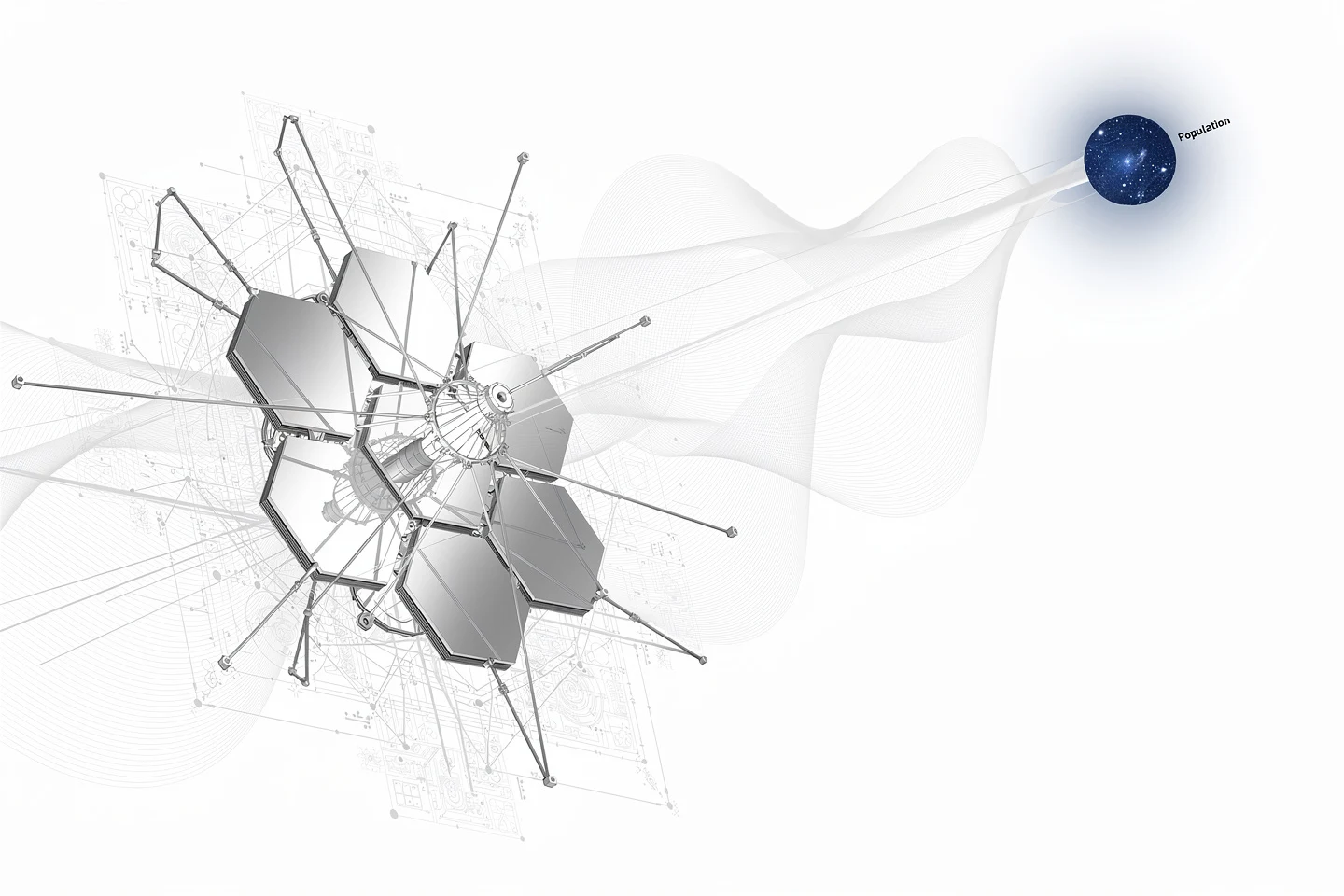
Their light is almost indistinguishable — it gets lost in the glare of other galaxies, like a whisper in a crowded room. To hear it, astronomers turned to pixel-by-pixel analysis. The James Webb Space Telescope breaks the image into pixels, and a program with machine learning, trained on millions of computer simulations, compares the breakdown of light by color in each pixel to a model, accounting for distances where light reddens due to the expansion of the universe.

Some of the first stars were so massive they exploded as hypernovae — their flash outshone entire galaxies. And yet, until recently, not one such star had been reliably observed.

This led to the identification of candidate "Blueberry": in the central pixel, its spectrum consists solely of helium and hydrogen, without the slightest trace of metals. This is the first reliably identified Population III star. The method paves the way for mapping the era of heavy element formation and, possibly, solving the mystery of supermassive black holes at galactic centers. James Webb will continue the search.

The first to figure out how carbon and oxygen are born inside stars were Hans Bethe, Fred Hoyle, and Margaret Burbidge — their ideas became the foundation for this entire hunt.

🎯 Population III stars were so massive that their explosion — a hypernova — outshone an entire galaxy, and to this day, not one has been seen 'live'.

\lambda_{\rm max} = \frac{b}{T}
Wien's law: the hotter the star, the shorter the wavelength of its peak radiation. The first stars, heated to hundreds of thousands of degrees, shone mostly in the ultraviolet, which today is shifted into the infrared — exactly where JWST hunts.
v = H_0 d
Hubble's law: the farther a galaxy, the faster it recedes. Redshift stretches the light of the first stars, carrying their ultraviolet scream into an infrared whisper discernible to JWST.
Scientists
Christian DopplerD. B. McLaughlinDidier QuelozMichel MayorR. A. RossiterStephen Hawking
Tags
star formation JWST photometry spectroscopy numerical simulation Machine Learning redshift nebula nucleosynthesis black hole metallicity
Laws
Doppler effectHawking radiationgravitational lensingBekenstein-Hawking entropymass–energy equivalenceEinstein field equations
Original: arXiv:2606.30750 · CC BY 4.0 · bridge42worlds