Mini

The Silence of the Interstellar Wanderer: The Hunt for Radio Signals from 3I/ATLAS
Original: "Periodic Radio Technosignature Search toward 3I/ATLAS with FAST"
arXiv:2607.01666v1 · 2026-07-02 · CC BY · ⏱ 1 min · Instrumentation Exoplanets Galaxies
The search for rhythmic radio messages from the interstellar body 3I/ATLAS ended in silence, but gave us a new method to untangle cosmic noise.
Links in the knowledge graph 1

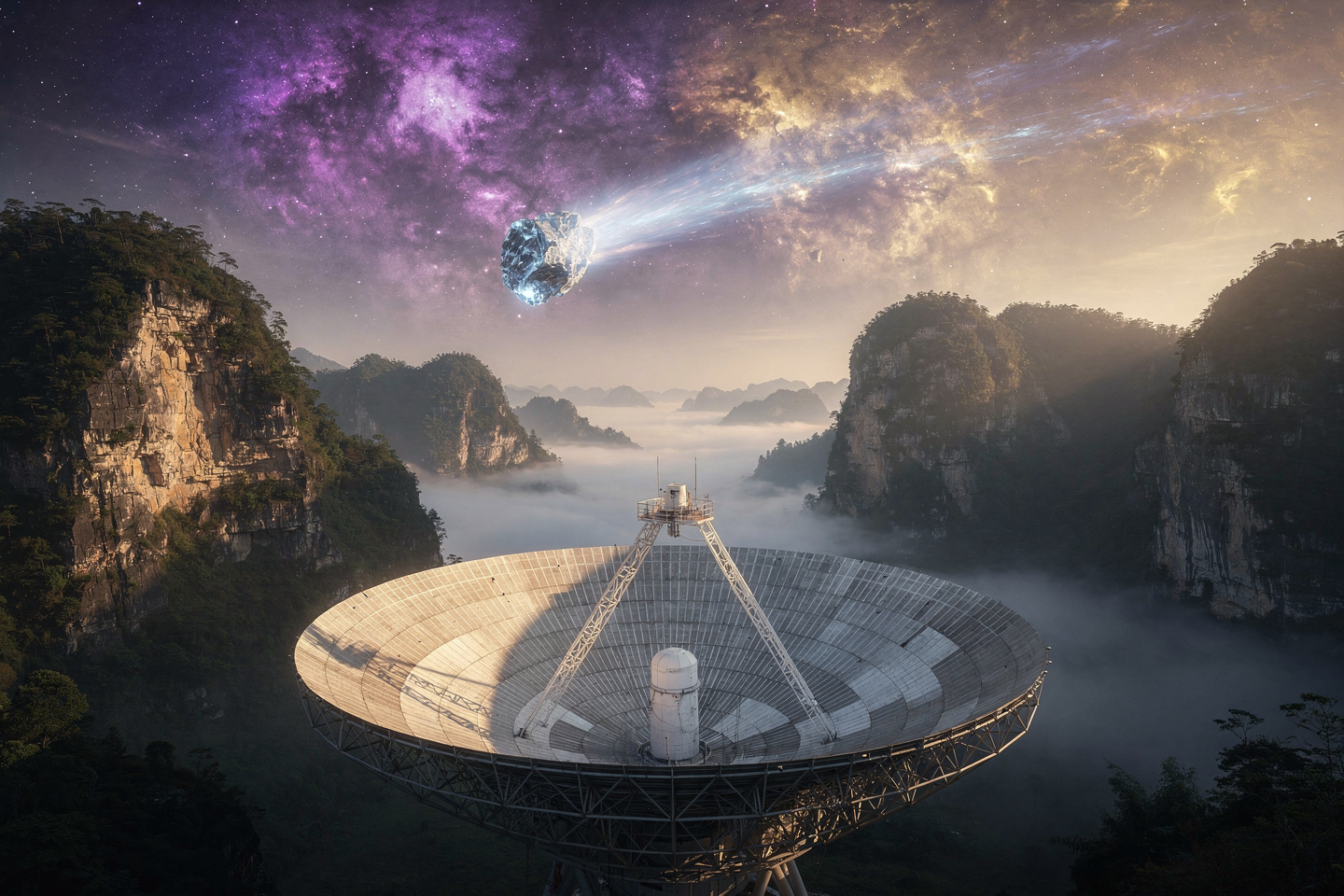
The interstellar object 3I/ATLAS is silent. The FAST radio telescope listened to its pulse in every detail — not a single artificial beat. Our algorithms untangled the noise into strands, like a comb unravels tangled hair, searching for a single lock of the right color. The upper power limit is a tiny 0.146 W. A silence that speaks louder than words: now we know how to find a whisper in a hurricane. The next step is to catch millisecond pulses from other stars. Perhaps that is where the rhythm lies hidden.

🎯 Canonical polyadic decomposition was first described in 1927, but its astronomical application became possible only in recent years thanks to the growth of computing power and the advent of multi-beam receivers.

🎬 The search for signals from 3I/ATLAS echoes the plot of Arthur C. Clarke's novel 'Rendezvous with Rama,' where humanity first encounters an interstellar object that turns out to be an alien spaceship. Alas, real observations have yet to detect even a radio beacon.

S_{\min} \approx \frac{(S/N)_{\min} \mathrm{SEFD}}{\sqrt{n_{\mathrm{pol}} \Delta\nu_{\mathrm{ch}} T_{\mathrm{obs}}}} \sqrt{\frac{\delta}{1-\delta}}
Minimum detectable flux density for a periodic signal. Here SEFD is the system equivalent flux density, (S/N)_min is the threshold signal-to-noise ratio, n_pol is the number of polarizations, Δν_ch is the channel width, T_obs is the observation time, δ is the signal duty cycle.
\mathrm{EIRP} = 4\pi d^2 S_{\min} \Delta\nu
Equivalent isotropic radiated power of the transmitter. Shows what power an isotropic transmitter at distance d must emit to produce the observed flux density S_min in bandwidth Δν.
Scientists
Christian DopplerD. B. McLaughlinDidier QuelozMichel MayorR. A. RossiterAlbert Einstein
Tags
hydrogen pulsar exoplanet comet spectroscopy entropy neutron star speed of light
Laws
second law of thermodynamicsDoppler effectprinciple of constancy of the speed of lightBekenstein-Hawking entropyKepler's third lawmass–energy equivalence
Original: arXiv:2607.01666v1 · CC BY · bridge42worlds