Why the Interstellar Visitor 3I/ATLAS Remains Silent on the Radio ✛ ✎
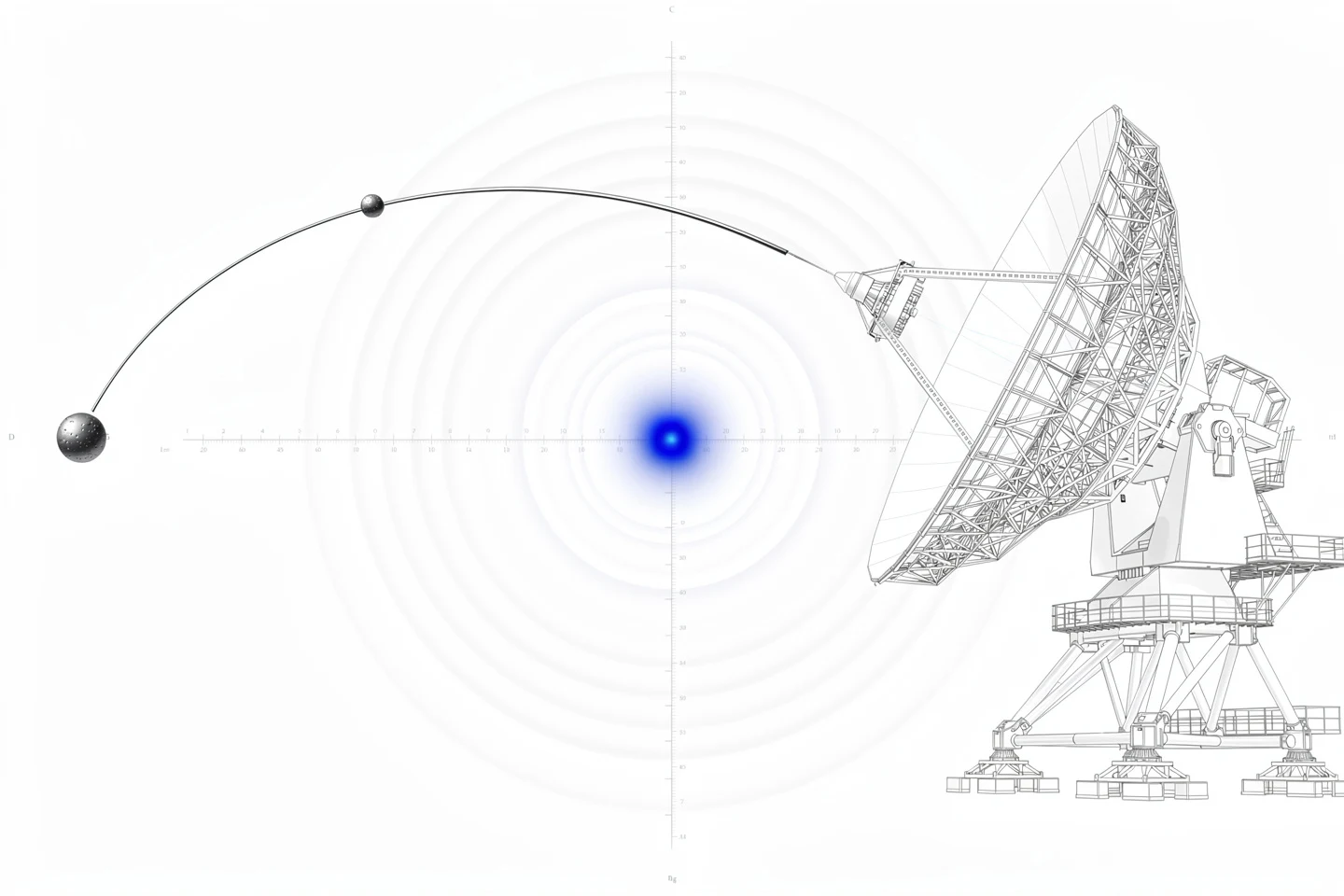
Imagine you're trying to hear a faint alarm clock from one room when an orchestra is playing loudly. If you set up several microphones, you can catch the difference: the alarm clock's sound will be louder in the nearest microphone. That's roughly how the method used to observe the interstellar object 3I/ATLAS worked — an unusual comet that flew in from another star system. The giant FAST radio telescope, with its multiple beams as 'ears', listened to the ether for a long time, and mathematical processing, akin to separating mixed voices in a recording, searched for rhythmic notes.
Alas, no artificial signals were found. Analysis based on entropy — a measure of how much energy is concentrated in the desired beam rather than smeared everywhere — showed that all suspicious bursts turned out to be either terrestrial interference or random noise. If there is a radio beacon operating on 3I/ATLAS, its power is no more than 0.146 watts — weaker than a flashlight bulb. The search was conducted at frequencies where hydrogen emits (21 centimeters) — this spectral fingerprint is considered a common language for interstellar communication.
A signal separation method, akin to breaking a cocktail down into its ingredients, was invented in 1927, but astronomers could apply it only with the advent of powerful computers.
The plot of Arthur C. Clarke’s novel ‘Rendezvous with Rama’ describes an encounter with an interstellar object that turns out to be an alien spaceship. The real 3I/ATLAS, alas, remains silent for now.