Radio Silence: Why No Periodic Signals from 3I/ATLAS Were Detected ✛ ✎
Context
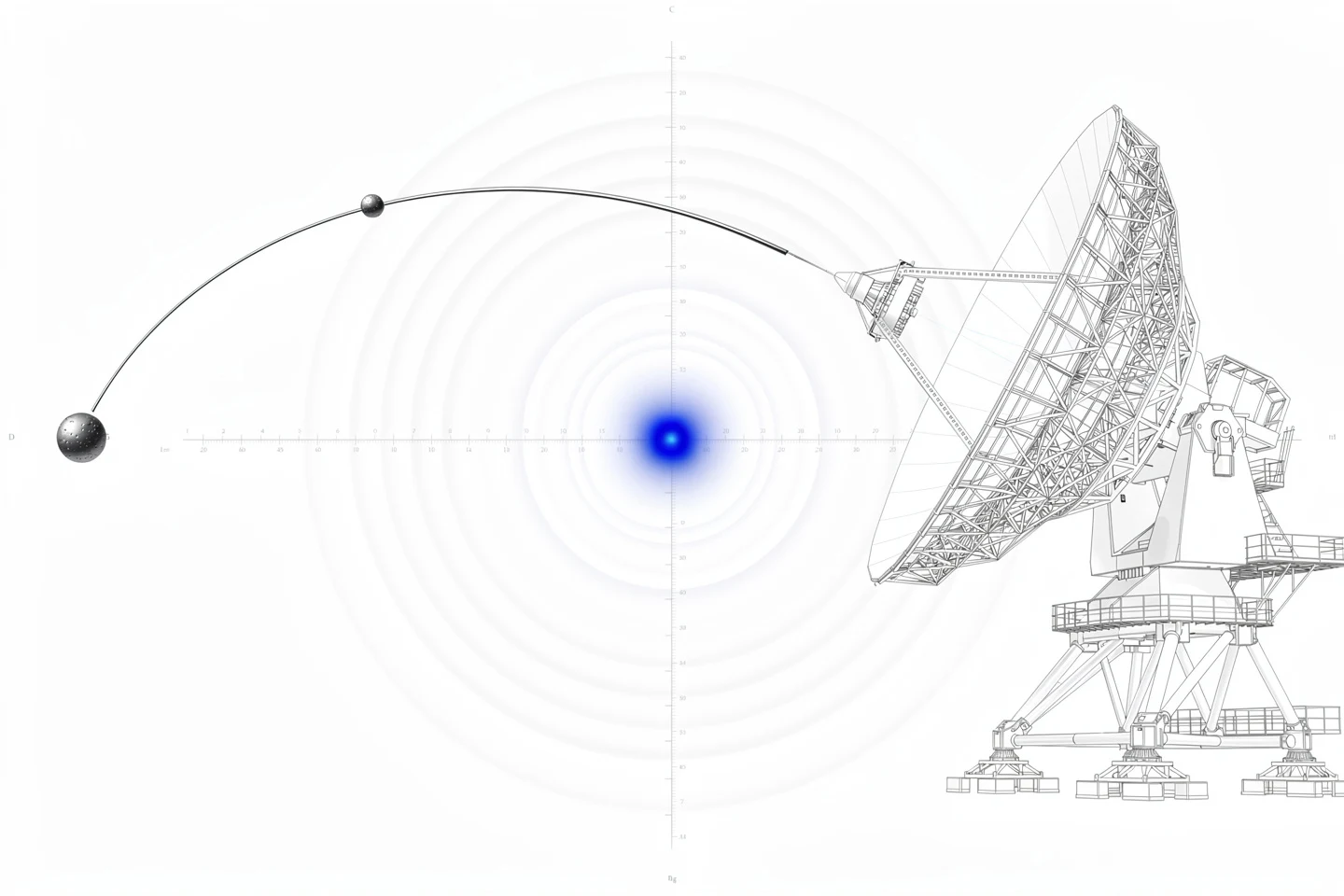
The hunt for technosignatures—observable manifestations of alien technology—has spent decades focused on narrowband drifting signals. Yet nature's own lighthouses, like pulsars (rapidly spinning neutron stars discovered by Jocelyn Bell Burnell), show that periodic radio pulses are a common cosmic beat. Artificial transmitters could also be rhythmic—due to planetary rotation, sky scanning, or beacon efficiency. Interstellar object 3I/ATLAS, similar to a comet and passing right through our solar system, became an ideal target. Unlike faraway exoplanets, it allowed for ultra-sensitive observations. Radio signals traveling from it at the speed of light would carry clues about possible technologies.
Methods
Data were collected with the multi-beam receiver of the FAST radio telescope in the L-band. To separate potential signals from Earth-based interference, dynamic spectra (intensity versus time and frequency) from multiple beams were arranged into a 3D tensor—a mathematical data cube. Then, Canonical Polyadic Decomposition was applied—a method that breaks the tensor into a sum of components, each with its own time, frequency, and beam profile, much like unmixing a blend by spectral fingerprints. To spot centrally dominant components, we calculated the entropy of energy distribution across beams: the lower the entropy, the more the signal is concentrated in the target direction. Periodicity was assessed using periodograms, and frequency structure via autocorrelation functions.
Results
A total of 1,965 components were extracted for each polarization. Of these, 2,753 components showed central-beam dominance, but only three passed the preliminary periodicity criteria. Two turned out to be linked to a calibration signal injected every 300 seconds, and the third lacked clear spectral localization. So, no candidate was confirmed as artificial. The search covered 1.05–1.45 GHz, which includes the hydrogen line (21 cm)—a frequency often considered a universal channel for interstellar communication. The upper limit on Equivalent Isotropically Radiated Power (EIRP) came out to 0.146 Watts, placing tight constraints on any possible transmitters on 3I/ATLAS.
Implications
This null result doesn't mean there are no alien civilizations—it just narrows the window for their radio leakage from this particular object. The real breakthrough is showing that CPD works for multi-beam SETI observations. The method cleanly teases out genuine signals from pervasive radio interference by using a beam-concentration entropy measure. That's especially valuable for future searches, where data volumes will only balloon.
Future development
In the future, the team plans to use microsecond-resolution data to expand the search to shorter periods, down to millisecond pulses—like those from millisecond pulsars. Moreover, the CPD approach could be applied to surveys of nearby exoplanets, where periodic signals remain an underexplored class of technosignatures.
Impact
The work impacts radio astronomy, multidimensional data processing, and SETI strategy by offering a universal tool to fish out directional periodic signals from heavy interference.
Next steps
Next steps include implementing tests for signal coherence over time to weed out random fluctuations, and using the full set of FAST beams for more robust directionality determination.
Key open problems
The study directly tackles the question of how common technological life is in the universe—one of modern science's biggest unsolved puzzles. Developing reliable methods to pull weak artificial signals out of natural noise brings us a step closer to an answer.
The knowledge machine's view
This section is addressed to the author of the paper and their colleagues. Neighbouring works were found by meaning-based search across our archive, not by word overlap. We do not review: we show the field around the work.
What the work does
The study analyzes data from the multibeam receiver of the FAST radio telescope in the L-band for the interstellar object 3I/ATLAS. Using canonical polyadic decomposition (CPD), the dynamic spectra were decomposed into components, from which those with central dominance by an entropy measure were selected. A search for periodic signals was conducted, but no candidate was confirmed as artificial; an upper limit of 0.146 W EIRP was established.
Where its strength is
The main strength is demonstrating the applicability of CPD to multibeam SETI observations: the method effectively separates target signals from radio frequency interference using an entropy-based concentration measure. This paves the way for automated analysis of large data volumes from multibeam receivers.
Where it could go next
- It might be interesting to compare this approach with methods for searching laser pulses, where similar criteria of periodicity and spatial localization are applied. In our archive, there is a review of a study on searching for laser pulsations from extraterrestrial civilizations.based on: Space Fireflies: Hunting for the Laser Pulse of Extraterrestrial Civilizations arXiv:2607.12106
- One could consider extending the search to other classes of interstellar objects, leveraging work on fast guests that may escape telescopes due to their high velocity. Adapting CPD to such objects might improve sensitivity.based on: Speed Filter of the Skies: How Swift Visitors Elude Telescopes arXiv:2606.05344v1
- It would be interesting to apply the method to observational data of other interstellar objects, for example, 2I/Borisov, and compare with the technosignature search results described in the work on interstellar guests.based on: Interstellar Visitors: Searching for Alien Technology arXiv:2508.16825
Worth trying
- Test CPD on synthetic data with injected periodic signals to assess detection probability as a function of parameters.
- Investigate the use of alternative concentration measures besides entropy to enhance robustness against interference.
- Apply the method to data from other radio telescopes with multibeam receivers, such as archival observations.
Nearby works in our archive
- Space Fireflies: Hunting for the Laser Pulse of Extraterrestrial Civilizationssimilarity 0.66
- Pulsars as Cosmic Antennas for Dark Matter Detectionsimilarity 0.63
- Wobbly Magnetars: The Secret Behind Bizarre Radio Flashessimilarity 0.63
- Interstellar Visitor Slims Down Before Our Eyessimilarity 0.63
- Radio Pulsars in the Crosshairs of a Space-Based Gravitational-Wave Detectorsimilarity 0.62
- Can life travel between stars on icy comets?similarity 0.62
- Interstellar Visitors: Searching for Alien Technologysimilarity 0.62
- Speed Filter of the Skies: How Swift Visitors Elude Telescopessimilarity 0.61
The closest work in the archive sits at 0.66 by meaning — the usual level for our corpus.
Canonical Polyadic Decomposition was first described back in 1927, but its astronomical application only became feasible recently thanks to soaring computational power and the advent of multi-beam receivers.
The search for signals from 3I/ATLAS echoes Arthur C. Clarke's novel 'Rendezvous with Rama,' where humanity encounters an interstellar object that turns out to be an alien ship. Real observations, alas, haven't turned up even a radio beacon yet.
Key numbers
- minimum detectable power (EIRP): 0.146 W
- distance to 3I/ATLAS at time of observation: 1.94 AU
- period search range: 0.7–1000 s
- duration of one observation: 3000 s
- number of analyzed components: 1965