The Silence of the Interstellar Wanderer: The Hunt for Radio Signals from 3I/ATLAS ✛ ✎
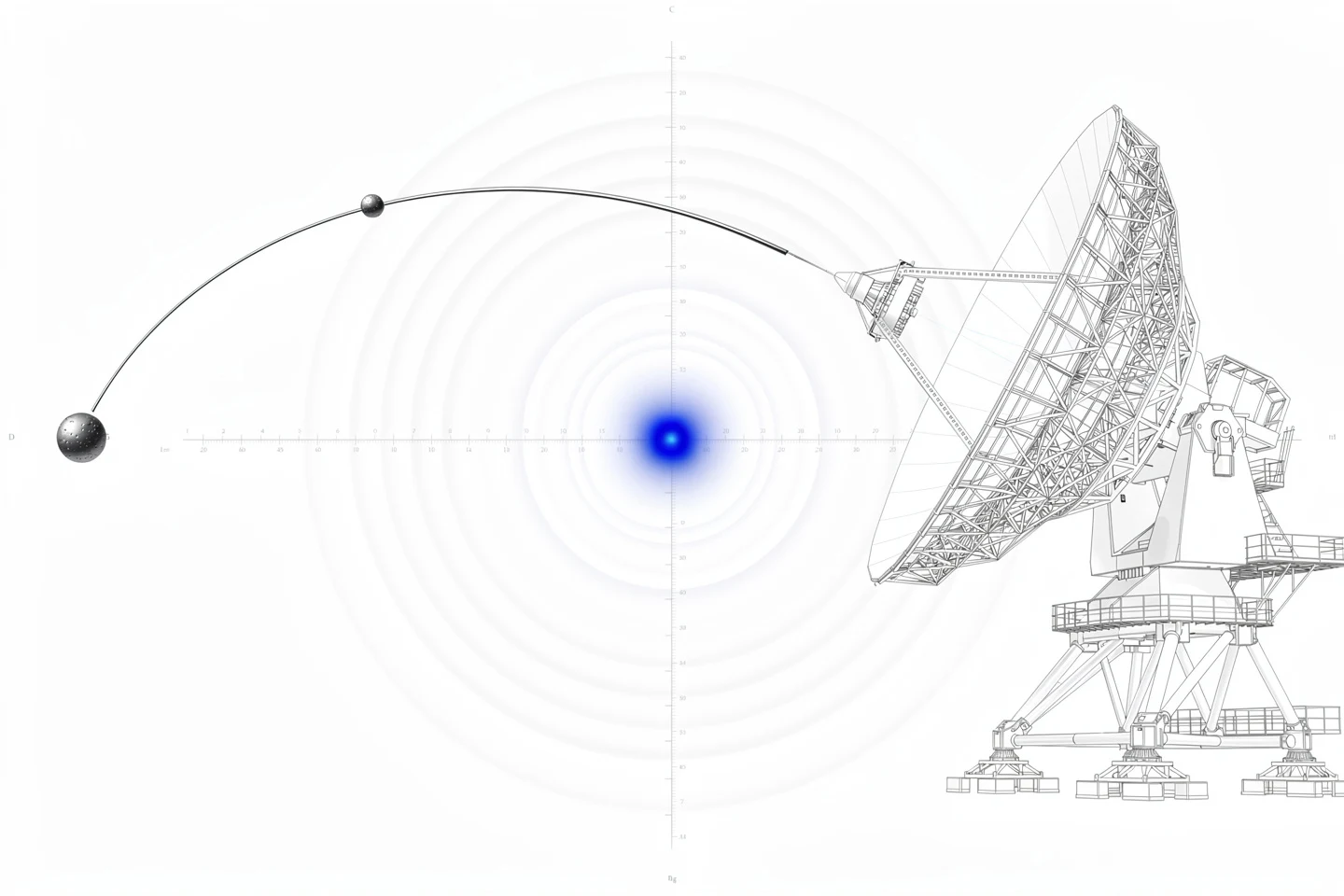
3I/ATLAS burst into the Solar System like an uninvited guest, a gift of fate for hunters of extraterrestrial intelligence. This comet-like wanderer from the depths of the Galaxy flew close enough to be heard in all its details — unlike distant exoplanets. Nature itself hints at rhythm: back in 1967, Jocelyn Bell Burnell discovered pulsars — rapidly spinning neutron stars whose radio bursts resemble a metronome. If the cosmos can keep a beat, why not search for similar rhythms from possible artificial transmitters? After all, the speed of light is a faithful postman, delivering any modulations, if they exist.
Imagine radio data as a tangled river of many streams. The multi-beam receiver of the FAST telescope looks at the sky in several directions at once: the central beam is aimed at 3I/ATLAS, the others slightly off, capturing terrestrial interference. Together, these flows form a three-dimensional tensor — a mathematical cube with axes of time, frequency, and beam number. This is where CPD, the universal untangler, steps in. It splits this cube into a sum of components, each with its own time, frequency, and beam profiles. Essentially, we separate the 'voice' of the central beam from the noise choir, using entropy as a measure of concentration: the lower the entropy, the more the signal clings to the center, just as a bright spotlight stands out against a scattered glare. This is how James Clerk Maxwell, who predicted the very existence of radio waves, might have imagined sorting the ghostly vibrations of the ether.
The search was conducted in the L-band, which includes the famous hydrogen line (21 cm) — a frequency many consider a universal channel for civilizations that have gone on air. Out of nearly two thousand extracted components, only three showed a hint of periodicity. Two turned out to be calibration signals from the telescope itself, and the third fell apart under spectroscopic inspection. Silence. A blank canvas without a single note. But this silence allowed them to impose a stringent limit: the power of any isotropic transmitter on 3I/ATLAS does not exceed 0.146 W. For comparison, a handheld walkie-talkie has tens of times more power. The calculation rests on an elegant formula: EIRP = 4π d² $S_{min}$ Δν, where d is the distance to the object, $S_{min}$ is the minimum detectable flux density, and Δν is the bandwidth. It reminds us that space is the greatest amplifier of loneliness: even a tiny transmitter would be noticeable, if it really existed.
A null result is not a fiasco, but a calibration of the instrument. The CPD method has proven its ability to clean the radio spectrum of interference in multi-beam observations, and this is a triumph of preparation for future battles. Plans are already underway to sift through data with microsecond resolution to catch pulses comparable to the trills of millisecond pulsars. Next — surveys of nearby exoplanets, where periodic technosignatures remain a blind spot. We are learning not just to listen to the sky, but to extract artificial rhythm from it — and each 'silence' brings us closer to answering the big question.
Canonical polyadic decomposition was first described in 1927, but its astronomical application became possible only in recent years thanks to the growth of computing power and the advent of multi-beam receivers.
The search for signals from 3I/ATLAS echoes the plot of Arthur C. Clarke's novel 'Rendezvous with Rama,' where humanity first encounters an interstellar object that turns out to be an alien spaceship. Alas, real observations have yet to detect even a radio beacon.