Gravitational Infancy: Record Orbits in the Cradle of HD 114082
Original: "The Longest-period Young Transiting Exoplanets. A Duo of Puffy Giants inside a Debris Disk"
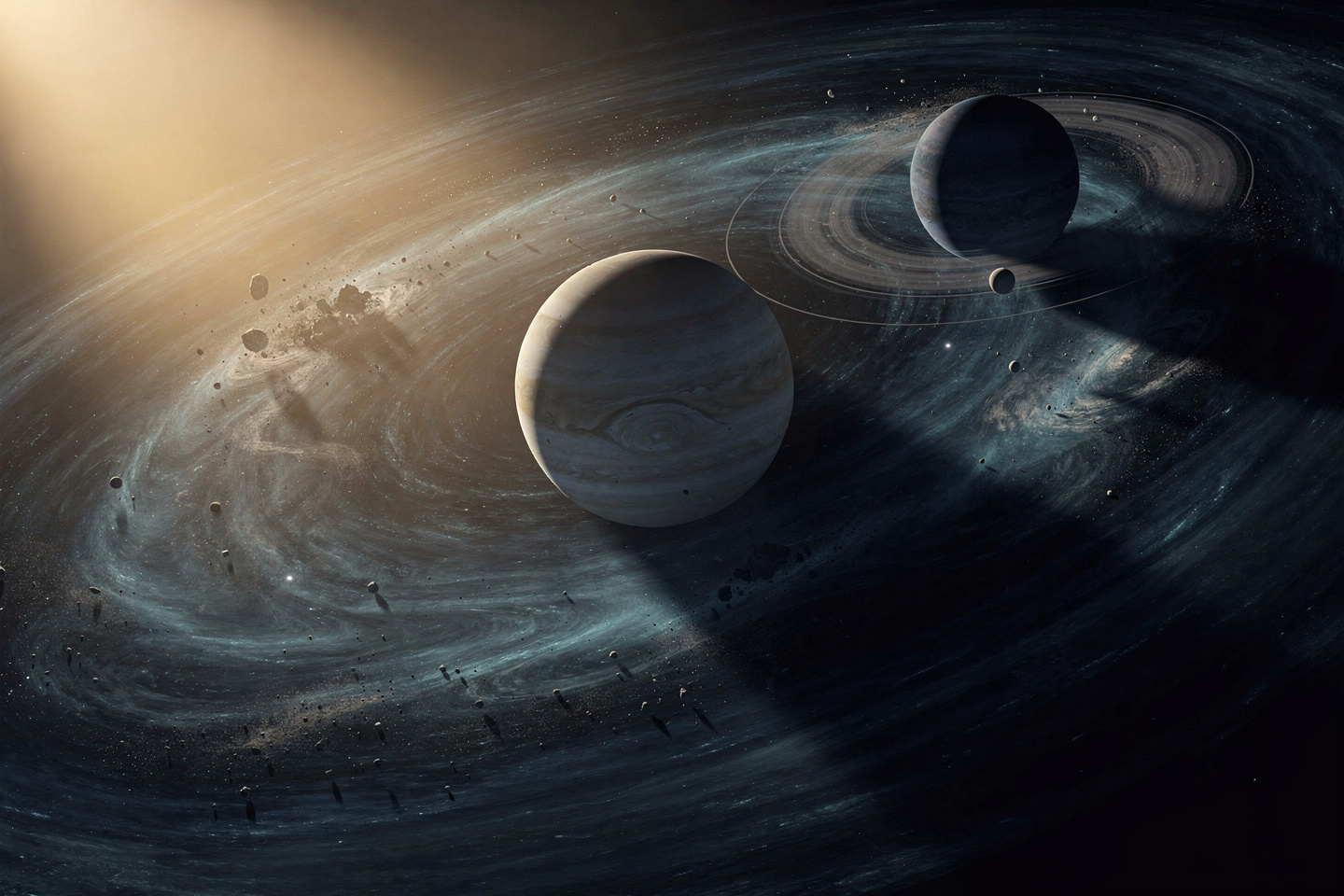
A remarkable pair of young gas giants with the longest periods among known transiting exoplanets orbits the star HD 114082, which is only 15 million years old.
Links in the knowledge graph 1
Two young gas giants circle a star a hundred times younger than the Sun. Their orbits—225 and 314 days—are the longest known for transiting teenage planets. Inside the system, there’s still plenty of dust and comet debris: this is not a finished architecture, but a moment of assembly. Perhaps this is exactly what the birth of order out of chaos looks like.
🎯 The star HD 114082 lies in the Scorpius–Centaurus OB association—the same group of young stars as the HR 8799 system, where exoplanets were first directly imaged.
P^2 = \frac{a^3}{M_*}
Kepler's law: the square of the period is proportional to the cube of the semi-major axis divided by the mass of the star. Since the periods are known, the planets' distances can be calculated.
\rho = \frac{M}{\frac{4}{3}\pi R^3}
Planetary density: knowing the radius and upper mass limit, we find that the planets are several times less dense than Jupiter, indicating their young 'puffy' status.