Suman Saha

5 articles · 30 co-authors · latest: 2026-07-02
76 citations · h-index 5 · 36 papersData: Semantic Scholar

We have retold 5 papers by this author. 2 of them with a full read. most often about: Hubble Space Telescope, methane, exoplanet atmosphere. 30 co-authors across our retellings.

Links in the knowledge graph
Titanate Clouds Above a Scorching Giant
The dayside of WASP-121b is scorching at 2358 kelvins, hotter than the surface of many stars. Here, in perpetual light, the atmosphere does not just boil: it melts rock and turns it into gas. But not all gas stays gaseous. Some condenses into clouds, and those clouds hide titanium the way a trap hides its prey.

Exoplanets2025-10-061 minarXiv:2510.04863express
The Invisible Planet in a Carbon Cocoon: How a Hot Neptune Cheated Death
Astronomers couldn't understand why the 'hot Neptune desert' — a region right next to stars — has almost no Neptune-sized planets. It was thought that there they are doomed: the star's proximity boils off the atmosphere, leaving a bare rocky core. But the exoplanet LTT-9779 b, 29 times heavier than Earth and with a 19-hour orbit, survived.
Exoplanets2026-01-142 minarXiv:2601.09438express
Three Teenage Planets Around Star TOI-451
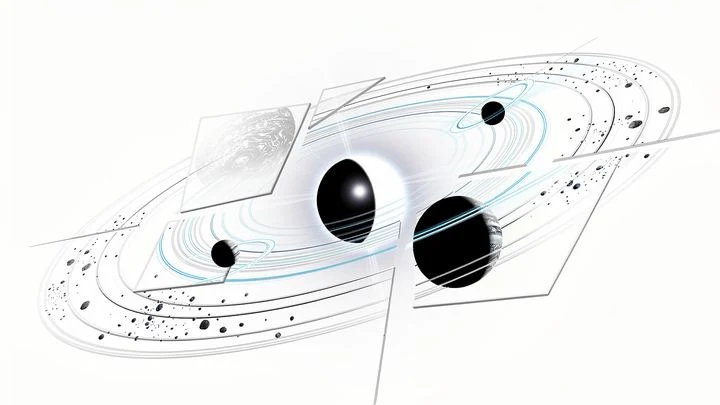
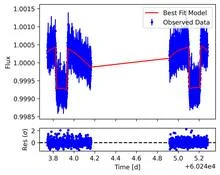
The young star TOI-451 wobbles slightly as three planets circle it. Each wobble is like the tremor of a spiderweb when a tiny spider crawls across it. Astronomers caught this tremor to learn how heavy the planets are. They watched the star for several months using telescopes on Earth. The planets kept passing in front of the star, briefly dimming its light.
Exoplanets2026-06-241 minarXiv:2606.26075express
A Mirror Planet in the Neptunian Desert
Hundreds of light-years away, there's a planet that looks like a giant mirror. LTT9779b reflects most of the light that hits it — far more than you'd expect from a Neptune-sized body. Astronomers have long debated what makes it so shiny: a thick carbon-rich haze or a layer of clouds. The James Webb Space Telescope has helped settle the debate.
Gravitational Infancy: Record Orbits in the Cradle of HD 114082
In deep space, 95 parsecs from Earth, nature is assembling a planetary clock. The model HD 114082 is a prototype, only 15 million years old. Two massive pendulums — exoplanets b and c — are already swinging with periods of 225 and 314 days, but the whole mechanism is still covered in the construction dust of a debris disk.