Gravitational Infancy: Record Orbits in the Cradle of HD 114082 ✛
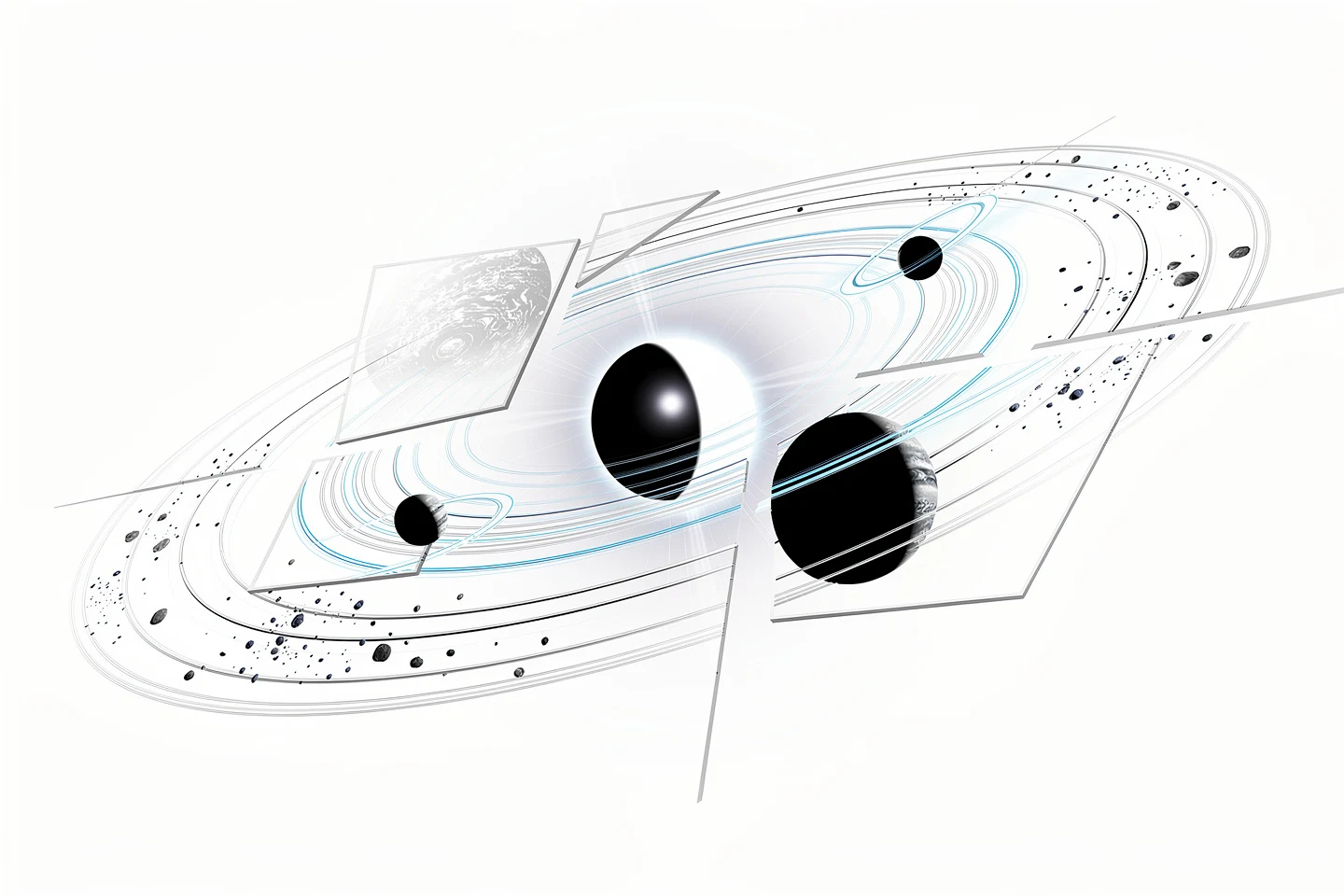
In deep space, 95 parsecs from Earth, nature is assembling a planetary clock. The model HD 114082 is a prototype, only 15 million years old. Two massive pendulums — exoplanets b and c — are already swinging with periods of 225 and 314 days, but the whole mechanism is still covered in the construction dust of a debris disk. These are the most leisurely transiting worlds ever found around such a young sun — a real find for those studying the gravitational childhood of giants.
The difficulty of the observations resembled trying to count seconds on a rusty dial through smoked glass. The young star HD 114082 seethes with activity; its rotation and magnetic spots constantly confuse detectors, mimicking planetary signals. To separate the true transits from phantom 'aliases,' the team of astronomers synchronized data from the TESS and CHEOPS space telescopes with readings from a dozen ground-based observatories, like a watchmaker comparing chronometers, catching the brief moment when a planet's shadow falls on the sensor. The key to the puzzle was the transit method combined with high-precision spectroscopy, which made it possible to rule out false signals from stellar activity and accurately reconstruct the orbits.
But the mechanism of these gravitational clocks is not a chaotic jumble of parts. The planets' orbits are nearly resonant: they are close to a 7:5 or 3:2 ratio, indicating long-term dynamical interaction. Alongside them rotates a debris disk with a warm inner and cold outer belt, where dust particles constantly collide, generating new comet nuclei. The planets' orbits are tilted about 7° relative to the plane of the outer disk — a quiet hint of a turbulent past, where an invisible hand of migration pushed them off their original axis.
Peering into the childhood of giant planets, we test models trying to explain the paradox of 'puffy' exoplanets. Perhaps all gas giants go through a bloated stage, and radius is just a temporary marker on the path of cooling. Future measurements with next-generation telescopes will refine the masses and capture the lines of evaporating water vapor, as well as relic hydrogen and helium. In this way, we will read the history of these worlds, and perhaps understand how our Earth got its primordial ocean from comet showers. In essence, looking at the 'clock' of HD 114082, we see a reflection of our own past — a time when the Solar System was still just feeling out its gravitational rhythm.
The star HD 114082 lies in the Scorpius–Centaurus OB association — the same group of young stars as the HR 8799 system, where exoplanets were first directly imaged.