Simple

The Slow Dance of Two Young Gas Giants

Original: "The Longest-period Young Transiting Exoplanets. A Duo of Puffy Giants inside a Debris Disk"
arXiv:2607.02685v1 · 2026-07-02 · CC BY 4.0 · ⏱ 2 min · Exoplanets Stellar
Two record-slow, puffy planets discovered around a very young star.
Abstract

Astronomers have found two giant planets around a young star. They're far from the star—a year there lasts more than 200 Earth days. These are the youngest transiting planets with the longest periods known. They likely formed far out, beyond the snow line, and then moved closer to the star, like skaters pulling in their arms. How did that change their fate?

Links in the knowledge graph 1

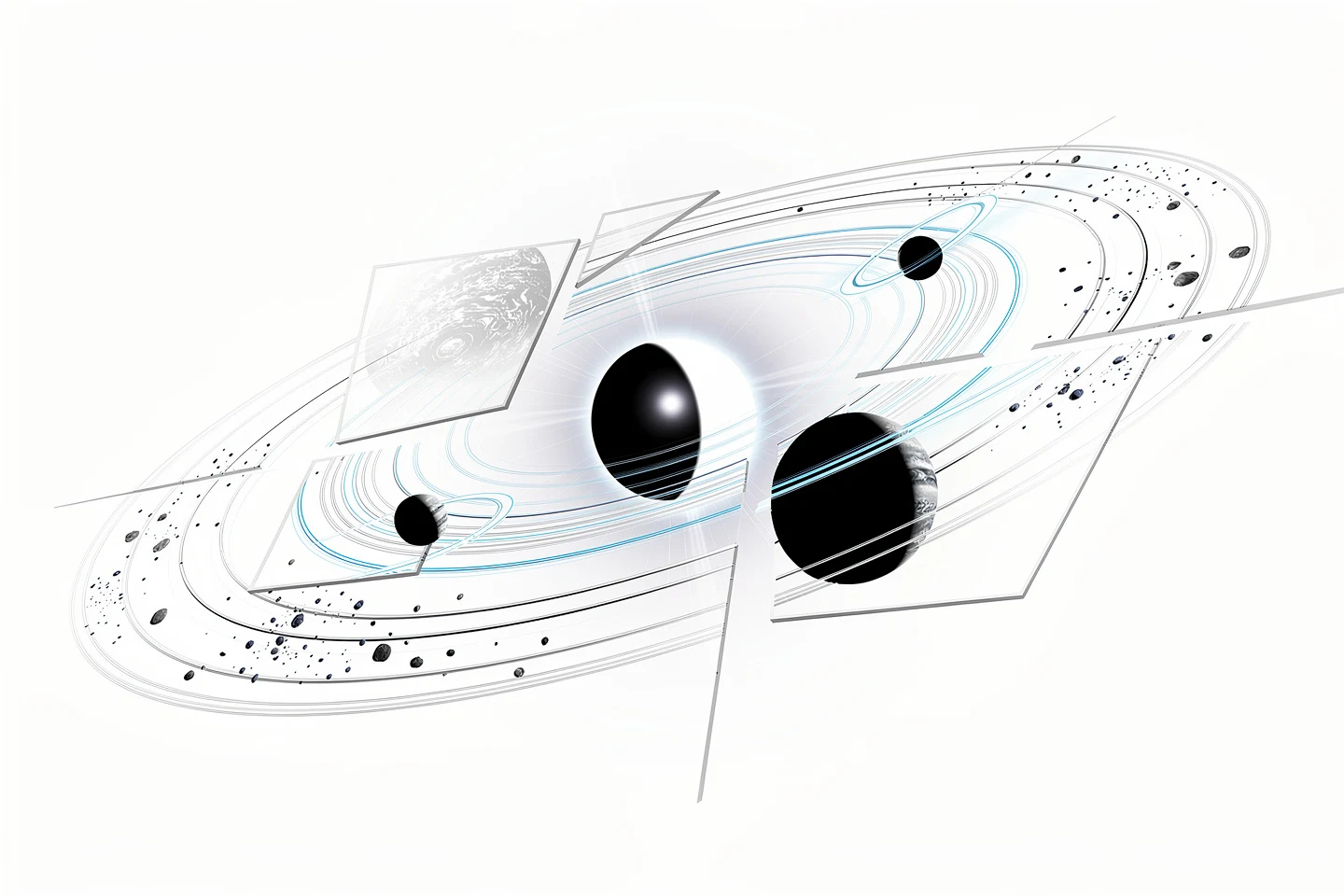
Astronomers have found two unusual exoplanets orbiting the star HD 114082. This star is only 15 million years old — by cosmic standards, it's barely out of infancy, like a newborn baby. The giant planets circle it very slowly: one takes 225 days to complete an orbit, the other a full 314 days. Among young planets of similar sizes, these are record-long "years". The planets themselves are still hot and "puffy" — their material hasn't had time to cool and contract. Imagine two vast clouds of gas drifting unhurriedly around a star-lantern.

These planets were spotted by noticing tiny dimmings: when a planet passes in front of its star, the star's light dips ever so slightly. This transit method first enabled the mass discovery of distant worlds thanks to the Kepler mission, inspired by the ideas of William Borucki.

The fact that stars are mostly made of hydrogen and helium is well-known, first established by Cecilia Payne-Gaposchkin. By studying a star's light through spectroscopy (breaking light into a rainbow of colors), astronomers can deduce how fast it spins and whether any massive bodies orbit nearby. Dark lines appear in these rainbow strips — the fingerprints of chemical elements. For instance, the hydrogen lines were first systematized by Johann Jakob Balmer. But a young star is hyperactive — it flickers and seethes constantly, drowning out the faint signal of planets. Scientists had to be quite inventive to filter out the noise and precisely calculate the orbits.

An enormous disk of dust and debris has also been detected around the star — a sort of cosmic construction site. It likely contains many icy comets, and at a certain distance where temperatures drop, water freezes into ice. This "snow line" may have played a key role in the birth of the planets.

This discovery matters because it lets us peer into the "teenage" years of giant planets. Until now, such young and far-out planets were almost completely unknown. By watching how they cool and interact with the dust disk, scientists can test models of how planetary systems form. For example, they can understand why some planets migrate closer to their star while others stay put. Ultimately, this will help us better understand the history of our own cosmic home.

🎯 The star HD 114082 belongs to the same young stellar group as HR 8799 — that's where exoplanets were first directly photographed.

P^2 = \frac{a^3}{M_*}
Kepler's law: the square of the period is proportional to the cube of the semi-major axis divided by the mass of the star. Since the periods are known, the planets' distances can be calculated.
\rho = \frac{M}{\frac{4}{3}\pi R^3}
Planetary density: knowing the radius and upper mass limit, we find that the planets are several times less dense than Jupiter, indicating their young 'puffy' status.
Scientists
Christian DopplerD. B. McLaughlinDidier QuelozMichel MayorR. A. RossiterDavid Charbonneau
Tags
exoplanet transit method spectroscopy hydrogen helium Water comet
Laws
Doppler effectKepler's third lawCoulomb's lawMaxwell's equationsPlanck's lawPlanck–Einstein relation
Original: arXiv:2607.02685v1 · CC BY 4.0 · bridge42worlds