Mini

Quasi-interstellar objects: when the Solar System meets its own exiles
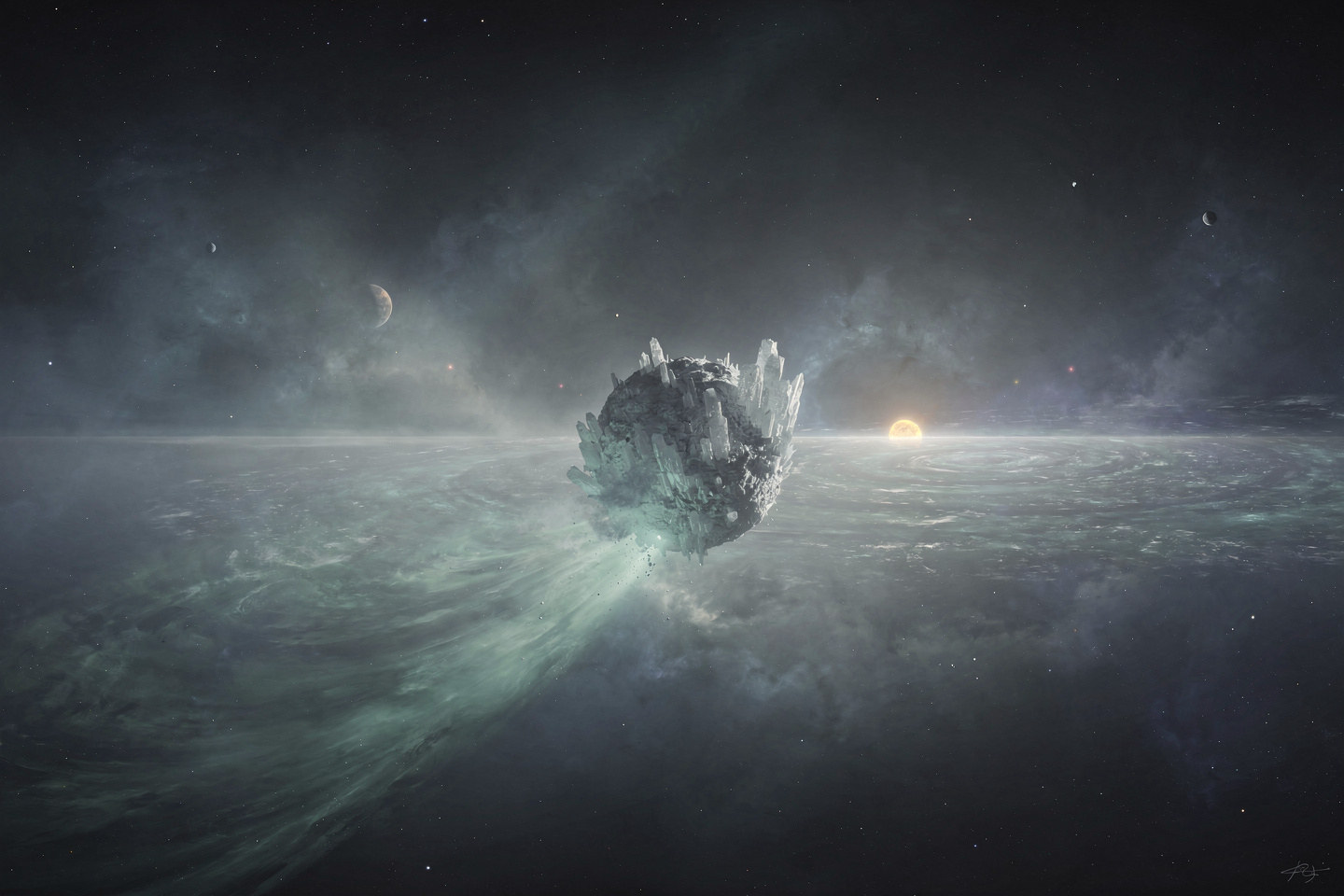
Original: "There and back again: the quasi-interstellar objects"
arXiv:2607.04216v1 · 2026-07-05 · CC BY 4.0 · ⏱ 1 min · Galaxies Exoplanets
Simulations show that comets ejected from the Oort cloud can return at negligible speeds, creating a unique class of objects distinguishable from true interstellar wanderers.
Links in the knowledge graph 1

The galactic tide carries comets out of the Oort cloud like splinters from a shore. Millions of years of wandering — and one or two in a billion return barely perceptibly, almost freezing at the doorstep of their native home. Their speed is less than 0.1 km/s. Finding such a ‘returnee’ is like finding a bottle thrown into the ocean in the Jurassic period. Such discoveries will reveal how turbulent the Solar System's past was, and perhaps hint at whether we are alone in the darkness.

🎯 The fastest known interstellar object, 1I/‘Oumuamua, had an excess speed of about 26 km/s — 260 times higher than the predicted speed of quasi-interstellar bodies. If such a slow body entered the Solar System, its orbit would be almost impossible to distinguish from the orbits of ordinary Oort cloud comets.

\sin \theta_c = \frac{q}{r} \sqrt{ \frac{1 + 2GM_{\odot}/(q v_{\infty}^2)}{1 - 2GM_{\odot}/(r v_{\infty}^2)} }
θ_c — the maximum angle between the velocity vector and the direction from the Sun on a sphere of radius r, at which an object with speed v_∞ will have a pericenter q less than a given threshold.
Scientists
Christian DopplerD. B. McLaughlinDidier QuelozMichel MayorR. A. RossiterAlbert Einstein
Tags
comet Sun galaxy dark matter carbon Water exoplanet JWST spectroscopy
Laws
Doppler effectgravitational lensingKepler's third lawMaxwell's equationsPlanck's lawPlanck–Einstein relation
Original: arXiv:2607.04216v1 · CC BY 4.0 · bridge42worlds