Simple

Boomerang Comets: The Exiles That Came Back

Original: "There and back again: the quasi-interstellar objects"
arXiv:2607.04216v1 · 2026-07-05 · CC BY 4.0 · ⏱ 1 min · Galaxies Exoplanets
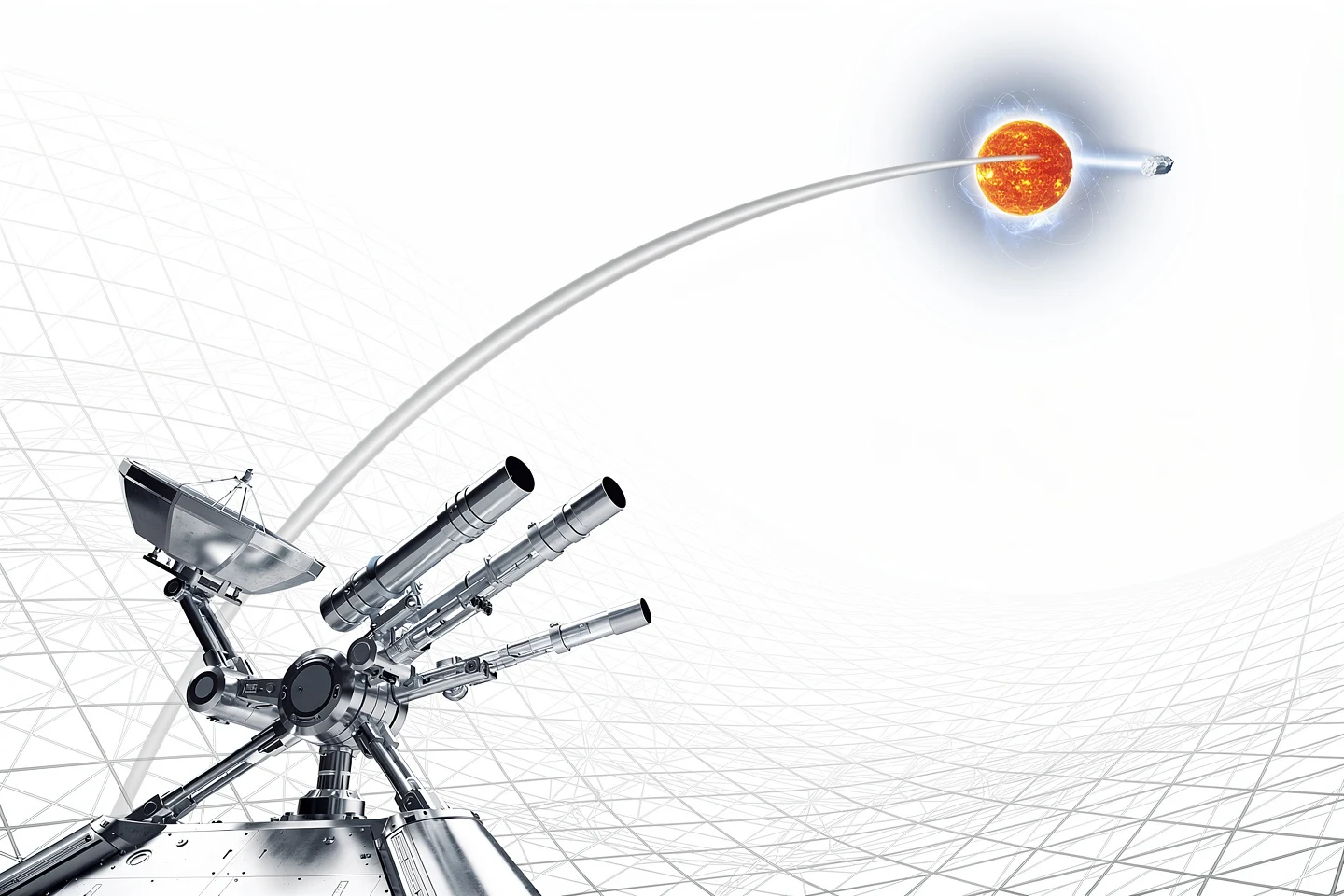
Scientists have found that some comets, ejected from our Solar System, can return and appear as visitors from other stars.
Abstract

Our solar system not only welcomes interstellar guests but can also eject objects into the galaxy. Some of these 'boomerangs' come back after millions of years, but they are easy to identify by their slow speed. How many of these long-lost relatives do you think we can spot?

Links in the knowledge graph 1

Far beyond the planets, in the icy Oort Cloud, billions of comets are stored. Sometimes the tidal forces of our Galaxy — its vast but invisible dark matter, discovered by Vera Rubin and Fritz Zwicky — fling them away. Imagine a balloon you accidentally let go of: the wind carries it far, far away, and years later, deflated, it quietly drifts back through the window. That's exactly how some 'quasi-interstellar' comets behave: they return to the Sun after tens of millions of years, sneaking back almost unnoticed.

Genuine interstellar objects, like the famous 'Oumuamua, race along at tens of kilometers per second. But these are real slowpokes, their speed less than a walking pace, just one-tenth of a kilometer per second.

Such a leisurely wanderer, caught by the James Webb telescope, will allow scientists to spread its light into colors — that's called spectroscopy — and find out how much water and carbon it contains. These substances hint at how other planetary systems formed around distant stars. By comparing them with our Sun and its surroundings, we can understand what raged here in the past — for example, whether another star flew nearby and scattered the Oort Cloud. And most importantly, such comets are very rare: if we're lucky, we'll see them no more than once every few decades.

🎯 A typical such comet takes about 60 million years to make the round trip — it was ejected back in the time of the dinosaurs, and it may only be returning now.

\sin \theta_c = \frac{q}{r} \sqrt{ \frac{1 + 2GM_{\odot}/(q v_{\infty}^2)}{1 - 2GM_{\odot}/(r v_{\infty}^2)} }
θ_c — the maximum angle between the velocity vector and the direction from the Sun on a sphere of radius r, at which an object with speed v_∞ will have a pericenter q less than a given threshold.
Scientists
Christian DopplerD. B. McLaughlinDidier QuelozMichel MayorR. A. RossiterAlbert Einstein
Tags
comet Sun galaxy dark matter carbon Water exoplanet JWST spectroscopy
Laws
Doppler effectgravitational lensingKepler's third lawMaxwell's equationsPlanck's lawPlanck–Einstein relation
Original: arXiv:2607.04216v1 · CC BY 4.0 · bridge42worlds