Quasi-interstellar objects: when the Solar System meets its own exiles ✛
Context
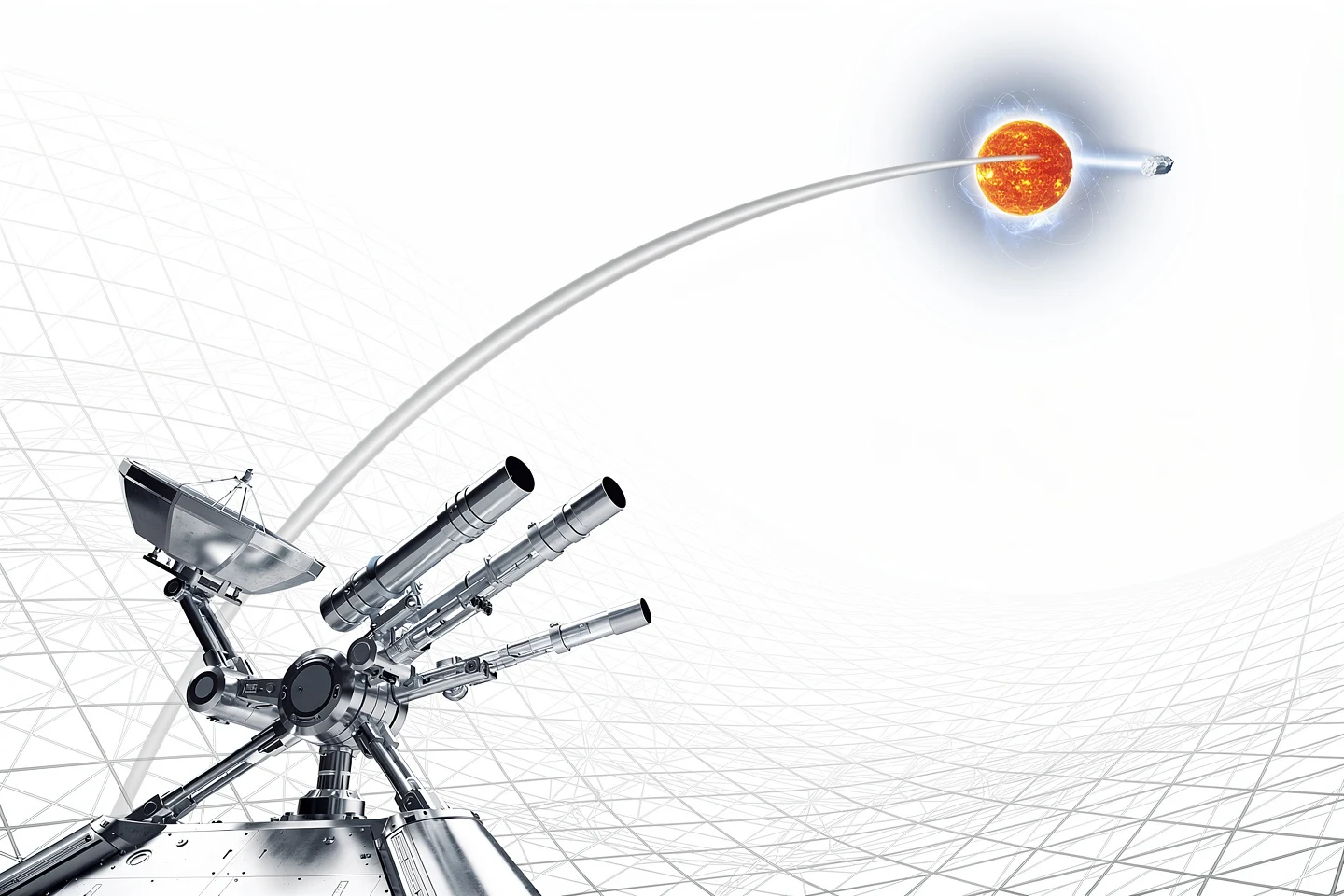
Since the discovery of comet 1I/‘Oumuamua, the first confirmed interstellar object, scientists have wondered: could some of these bodies actually originate from our own Oort Cloud? Although 1I/‘Oumuamua’s orbit was solidly hyperbolic and unbound from the Solar System, in principle comets ejected from the Oort Cloud by the tidal forces of the Galaxy and stellar close encounters could, after a long journey, meet the Sun again. The catch is that these “quasi-interstellar objects” could skew the statistics of genuine interstellar visitors if we can’t tell them apart. Understanding this phenomenon requires not only the dynamics of ejection but also the long-term orbital evolution in the Milky Way’s potential, which, as Vera Rubin and Fritz Zwicky showed, is largely shaped by dark matter.
Methods
To estimate the return probability, researchers simulated the ejection of “packets” of particles at low speeds (around 0.1 km/s) from a sphere of radius 1.5 parsecs around the Sun in the past, at intervals from 1 to 800 million years ago. Each particle’s motion, along with the Sun’s, was tracked in the smooth potential of the Galaxy, including the contribution from the dark halo, with an added stochastic “heating”—either white noise or correlated perturbations mimicking encounters with giant molecular clouds. Then, for each simulation, the probability density in phase space was computed, and an adaptive kernel estimate was used to determine the flux of returning particles through a sphere of 0.1 pc radius, limited by the condition of a pericenter less than 5 AU. Three models of Oort Cloud erosion were employed in parallel: simple exponential losses, data from N-body simulations, and a Monte Carlo method to account for stellar flybys—all to weigh the contributions from different ejection epochs.
Results
It turned out that the return probability for a single random particle is vanishingly small—no more than a few times $10^{-14}$ per year. The main contribution to the quasi-interstellar population comes from comets lost by the Oort Cloud over the last 500 million years, and those ejected around 60 million years ago are the most efficient at coming back. Their hyperbolic excess speeds are almost always below 1 km/s, with typical values around 0.1 km/s—hundreds of times slower than known interstellar objects. The radiants (incoming directions) on the celestial sphere cluster near the plane of the Galaxy at longitudes ~45° and ~225°, rather than toward the Sun's motion apex, where genuine interstellar objects predominantly aim. The absolute occurrence rate of quasi-interstellar bodies strongly depends on normalization: under the optimistic assumption that the Oort Cloud originally contained around 5×$10^{14}$ 1I-sized objects, one might expect about two close passages per decade within 5 AU. But more conservative estimates drop that number to one event every few decades or even centuries. In any case, quasi-interstellar objects turn out to be rare and easily distinguishable by their kinematics.
Implications
These results mean that quasi-interstellar bodies will not create a significant “foreground” for future interstellar object surveys, since their low speeds and specific radiants immediately betray their origin. On the other hand, if such an object is ever detected—say, with JWST or the LSST survey—it would point to unusually intense erosion of the Oort Cloud in the past, possibly triggered by a close stellar flyby 10–300 million years ago. That would place a unique constraint on the dynamical history of the Solar System, one inaccessible by other methods. Moreover, studying the composition of returning comets through spectroscopy could shed light on the amounts of carbon and water ice in primordial planetesimals, as well as on the differences between our system and exoplanetary systems.
Future development
Further progress in understanding the quasi-interstellar population will come from refining the potential of the Galaxy, including the contribution of dark matter, and from building more detailed Oort Cloud erosion models using real stellar encounter data from the Gaia mission. New sky surveys, such as LSST, will significantly expand the statistics on long-period comets and interstellar bodies, allowing us to test predictions about the frequency and incoming directions of quasi-ISOs. It would also be fascinating to explore the possibility of capture of such objects by giant planets and their subsequent evolution.
Impact
This work spans several fields at once: the dynamics of small bodies in the Solar System, modeling of the galactic potential and dark matter, and the interpretation of data from future surveys, including spectroscopic studies of interstellar object composition with JWST.
Next steps
Next steps include running more detailed simulations that account for the chemical composition of ejected bodies and their possible fragmentation, as well as incorporating real stellar trajectories from Gaia catalogs into the models to accurately estimate the rate of disruptive close encounters.
Key open problems
The quasi-interstellar object problem is closely tied to uncertainties in the initial mass function of planetesimals and the Oort Cloud’s loss history—key issues in the formation and evolution of the Solar System. It also resonates with the challenge of mapping the distribution of dark matter in the local Galaxy, since the gravitational potential governs the scattering of stellar streams.
The knowledge machine's view
This section is addressed to the author of the paper and their colleagues. Neighbouring works were found by meaning-based search across our archive, not by word overlap. We do not review: we show the field around the work.
What the work does
You modeled the ejection of particles from the Oort cloud and their subsequent evolution in the galactic potential, estimating the probability of their return as quasi-interstellar objects. You showed that the returning bodies are mostly recently ejected ones with small hyperbolic excess velocities and a characteristic distribution of radiants.
Where its strength is
This work provides a quantitative estimate of the returning population and highlights their observational differences from truly interstellar objects, which could aid in interpreting future discoveries.
Where it could go next
- It might be interesting to compare your predictions for velocities and radiants with the results of observational selection simulations to assess which quasi-interstellar objects are actually detectable by existing surveys.based on: Speed Filter of the Skies: How Swift Visitors Elude Telescopes arXiv:2606.05344v1
- A related work also considers the return of objects ejected from the solar system; comparing approaches to accounting for orbital evolution and Oort cloud erosion could refine uncertainties in frequency estimates.based on: Return of the Galactic Ghosts: Our Own Among Strangers arXiv:2607.04216
Worth trying
- Test how the predictions change if realistic stellar flybys are included in the model instead of stochastic heating.
- Estimate what fraction of returning objects could be active comets, using the sublimation model from [2606.01377].
- Consider the possibility of a mission to intercept a quasi-interstellar object, building on concepts from [2512.00492].
Why this may matter
If quasi-interstellar objects are detected, their properties would allow us to reconstruct the loss history of the Oort cloud and possibly point to recent perturbations in the Sun's galactic neighborhood.
Nearby works in our archive
- Return of the Galactic Ghosts: Our Own Among Strangerssimilarity 0.65
- Stellar Droplets from Quark Soupsimilarity 0.61
- How Comets Revealed Dark Matter's Secretsimilarity 0.60
- Interstellar Visitor Slims Down Before Our Eyessimilarity 0.60
- Speed Filter of the Skies: How Swift Visitors Elude Telescopessimilarity 0.59
- Mission: Catch a Guest from Another Star Systemsimilarity 0.59
The closest work in the archive sits at 0.65 by meaning — the usual level for our corpus.
Original abstract
as written by the authors arXiv:2607.04216v1
A population of interstellar objects (ISOs) exist that originate from the Solar System, rather than from other stars. Such a foreground could challenge straightforward analysis of the ISO sample expected to be gathered by upcoming sky surveys. We assess whether small bodies unbound from the Solar System can experience dynamical evolution in the Galactic potential that places them on re-encounter trajectories. We find that these 'quasi-interstellar objects' (quasi-ISOs) primarily depart the Solar System through erosion of the outer Oort cloud in the past few hundred Myr, excluding the most recent ~10 Myr. After orbiting in the Milky Way potential nearby the Sun but beyond the tidal radius, those ejected on certain orbits can re-encounter the Solar System. Meanwhile, the larger population of ISOs produced by the Solar System early in its life will be too spread-out in the Galaxy to contribute significantly to the observed sample. We predict that quasi-ISOs will be intrinsically rare and have $$v_\infty$$ values of order 0.1 km s$$^{-1}$$, easily distinguishable from ISOs from other stars, meaning that the observed ISO sample will be truly Galactic. The detection of a quasi-ISO would imply larger-than-expected losses from the Oort cloud, or a particularly catastrophic erosion event 10-300 Myr ago that would not be detectable any other way.
The fastest known interstellar object, 1I/‘Oumuamua, had an excess speed of about 26 km/s—260 times faster than the predicted speed of quasi-interstellar bodies. If such a sluggish object entered the Solar System, its orbit would be almost impossible to distinguish from those of ordinary Oort Cloud comets.
Key numbers
- typical excess speed of quasi-ISOs: ~0.1 km/s
- return probability per comet per year: less than 3×10-14
- predicted events per decade (optimistic): ~2 within 5 AU
- number of Oort Cloud objects >100 m: ~5×10¹²
- typical speed of genuine interstellar objects: ~60 km/s