Quasi-interstellar objects: when the Solar System meets its own exiles ✛
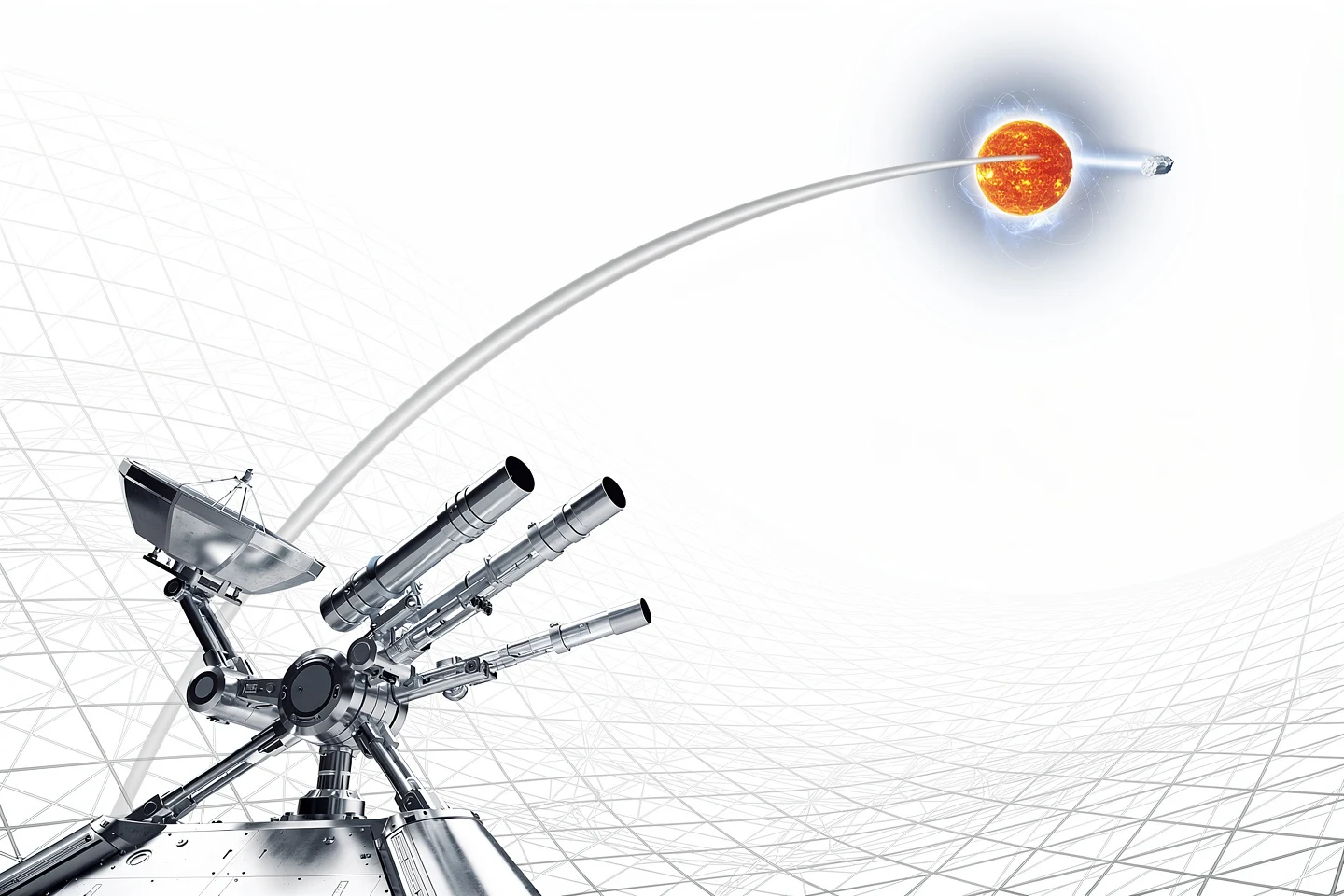
Remember the sensational comet 1I/‘Oumuamua — the first object to come to us from another star? Its hyperbolic trajectory left no doubt: it was a wanderer from the interstellar void. But astronomers wondered: could some of these visitors not be strangers at all, but our own, escaped from the Solar System millions of years ago? Picture an ocean, where the galactic tide, driven by invisible dark matter, plays with distant Oort cloud comets like pebbles on a shore. Some stones it carries out to the open sea, but after ages, a vanishingly small fraction returns to their native shores — silent, almost frozen.
Calculations based on simulations of billions of particles moving in the Milky Way's gravitational field show that the chance of a single ejected comet returning is no more than 3×$10^{-14}$ per year. But given the countless number of such objects — estimates suggest the Oort cloud could hold up to 5×$10^{12}$ bodies larger than a hundred meters — the rarest returns add up to a noticeable population. The most striking thing is that their radiants cluster near the plane of the Galaxy at longitudes ~45° and ~225°, not in the direction of the Sun's motion, where true interstellar objects are aimed. This kinematic signature immediately betrays the wanderer's origin.
At the heart of this celestial mechanics is the critical entry angle, described by the formula: \[ \sin \theta_c = \frac{q}{r} \sqrt{ \frac{1 + 2GM_{\odot}/(q v_{\infty}^2)}{1 - 2GM_{\odot}/(r v_{\infty}^2)} } \] Here \( \theta_c \) is the maximum angle between the velocity vector and the direction to the Sun at which an object with speed \( v_\infty \) will still enter the specified vicinity. For quasi-interstellar candidates, \( v_\infty \) is negligible, and the angle turns out to be so small that they arrive as if through a narrow tunnel, not from the broad sky.
Discovering just one such ‘returnee’ would be a paleontological find in astronomy. It would point to a powerful catastrophe in the past — a close stellar flyby that stirred the Oort cloud 10–300 million years ago, in the age of dinosaurs or even earlier. This isn't just a curiosity: it opens up a method to reconstruct the dynamical history of the Solar System, inaccessible by any other means. Work continues — refining the role of dark matter, which Vera Rubin and Fritz Zwicky suspected on galactic scales, now descends to the neighborhood of our humble home. Each slow visitor is a drifting bottle with a message from our own past, and one day we will be able to read it.
The fastest known interstellar object, 1I/‘Oumuamua, had an excess speed of about 26 km/s — 260 times higher than the predicted speed of quasi-interstellar bodies. If such a slow body entered the Solar System, its orbit would be almost impossible to distinguish from the orbits of ordinary Oort cloud comets.