A Quantum Twist at the Heart of a Black Hole express
A black hole is where the usual rules break down. At its center, according to classical physics, lurks a singularity: a point of infinite density where everything that falls in gets crushed. Quantum theory was supposed to soften this picture. Many hoped that quantum effects would smear out the singularity, like waves erasing a pattern in the sand. New work shows that inside a Schwarzschild hole, it's quite the opposite.
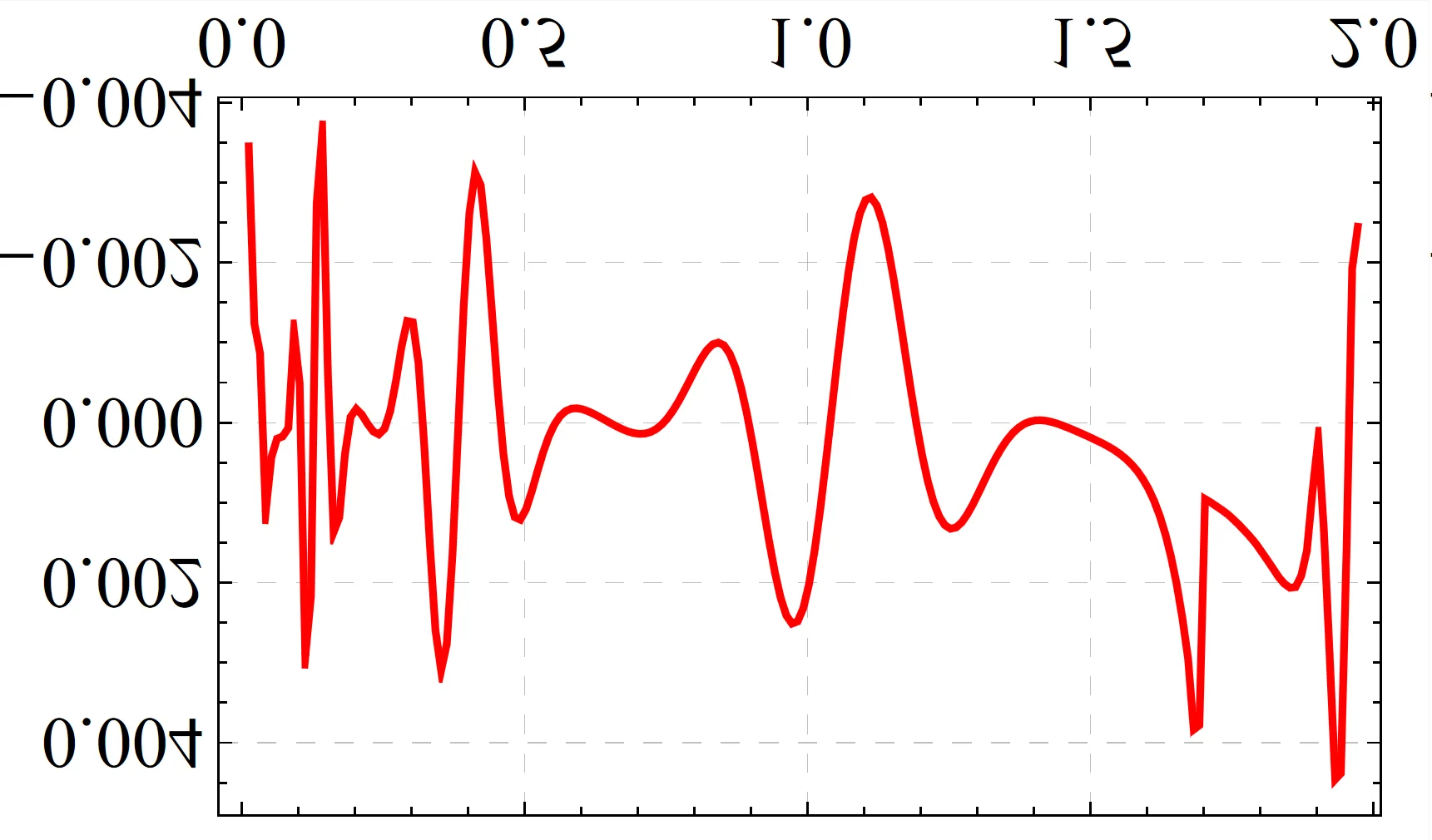
The authors have, for the first time, computed the full set of quantum stresses, the stress-energy tensor (a quantity describing pressure and energy density), for a massless scalar field throughout the entire interior of a black hole. They considered two quantum states: one describes a hole evaporating in empty space, the other a hole in thermal equilibrium with its surroundings. For the calculations, they used a clever "angular splitting" technique and high-precision subtraction to sidestep infinities. The result was checked against conservation laws and the trace identity — everything matched.
What does this mean for the fate of an infalling observer? The quantum pressure near the singularity grows as (r/M)⁻⁶, where r is the distance from the center and M is the hole's mass. In everyday terms: when you halve the distance to the singularity, the stress jumps by a factor of 64. That's a ferociously rapid amplification. But the most surprising part is that this pressure doesn't push things apart: it focuses them. It violates the "strong energy condition" yet satisfies the "null" one. In the equations of gravity, such a source acts like an extra lens, gathering matter into a point. The quantum world doesn't resist collapse; it aids it.
So much for the hope of a "quantum trampoline" that would gently bounce matter back. Instead, we see a quantum press, squeezing space even harder. Still, the final verdict will require accounting for the backreaction of this pressure on the geometry itself, a problem yet to be solved.
If a black hole with the mass of the Sun were compressed to the size of a large city, quantum stresses near its center would grow by billions of times in a billionth of a second.
In Peter Watts's novel Blindsight, a ship's crew encounters an inscrutable intelligence hidden in a black hole, as if the singularity itself had gained a will.