object

remnant

A small, stable object left over after a black hole has almost completely evaporated.
74 related articles

Description

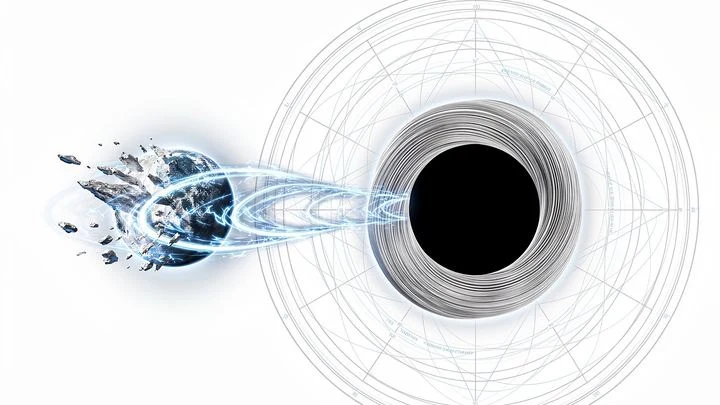
A remnant is a hypothetical small, stable object left behind after a black hole has almost completely evaporated through Hawking radiation. In standard semiclassical gravity, a black hole should shrink until it disappears entirely, leaving nothing behind. However, quantum gravity considerations suggest that the final stages of evaporation might not proceed to a singular endpoint; instead, a tiny, massive object could remain, carrying the information that fell into the black hole.

History

The concept of black hole remnants emerged in the late 20th century, notably in discussions by Yakov Zeldovich and later by G. 't Hooft and others, as a possible resolution to the information loss problem. However, the idea remains speculative and has not been confirmed.

How it works

As a black hole radiates Hawking particles, it loses mass and shrinks. When it approaches the Planck scale (around 10^-35 meters), quantum gravitational effects become dominant. These effects may halt further evaporation, leaving a compact remnant with a mass around the Planck mass (about 2.18 × 10^-8 kg). The remnant would be stable or extremely long-lived, and its existence would resolve the black hole information paradox by storing the quantum information of everything that fell in.

In practice

Remnants are primarily a theoretical construct, but they influence models of quantum gravity and cosmology, such as cyclic universe scenarios where black holes might seed new expansion cycles.

Fun fact

If remnants exist, they would be extremely dense—a Planck-mass remnant would be about the size of a Planck length, making it a tiny speck with the mass of a human eyelash.

Concept graph →

Related articles · 74

HEP Theory2026-08-102 minarXiv:2608.09797express
Black Hole Rings Like a Hot Bell
Drop a pebble into a pond, and ripples spread across the water. Something similar happens when a black hole merges with another: it emits gravitational waves that resemble the fading ring of a bell.
HEP Phenomenology2026-08-082 minarXiv:2608.08144express
Black Holes That Didn't Evaporate
A campfire that doesn't go out all at once but smolders for hours because the wood inside still holds the heat of the past flame. That's roughly how the memory effect works for black holes. Normally, a tiny black hole with the mass of a mountain should evaporate in fractions of a second, scattering particles like sparks.
General Relativity2026-08-071 minarXiv:2608.07182express
Black Hole Cools Down and Freezes
A boiling kettle on the stove eventually boils dry — and so, according to the classical picture, a black hole should gradually vanish in a hiss of radiation. But what if you add a special ingredient to the kettle?
General Relativity2026-08-051 minarXiv:2608.04346express
Tiny Black Holes and Their Charge Jitter
A black hole is not an eternal vacuum cleaner. It slowly loses mass by emitting particles, much like a heated stone cooling as it radiates heat. This process, discovered by Stephen Hawking, is barely noticeable for large holes, but for tiny ones, with masses comparable to a mountain, it becomes a violent evaporation.
General Relativity2026-08-042 minarXiv:2608.03538express
Black Hole Turns Inside Out into a White Fountain
A black hole that swallows matter might not just evaporate over billions of years: it could pop like a soap bubble and turn into its opposite: a white hole. This scenario emerged from numerical experiments in semiclassical gravity.
General Relativity2026-08-021 minarXiv:2608.00934express
Black Hole Collisions: What Remains After the Merger
Two black holes circle in a cosmic dance, spiraling closer together. In the end, they merge into one, and that moment unleashes a powerful burst of gravitational waves, ripples in spacetime itself. But what remains after the merger?
High Energy2026-07-281 minarXiv:2607.26137express
A Hidden Black Hole Lurks After a Cosmic Meal
In a distant galaxy about 290 million light-years away, the object HLX-1 lies hidden. It once flared brighter than hundreds of billions of suns, but now it has quieted down. From 2018 to 2022, the Hubble, Chandra, and Swift space telescopes tracked its fading.
HEP Theory2026-07-232 minarXiv:2607.21734express
Complexity Gets Tangled Midway
Water turns to ice at zero degrees — sharply, with no intermediate states. Something similar happens to complexity when we take a random quantum state of an entire system and look only at a part of it. As long as that part occupies less than half the system, its complexity grows smoothly. But as soon as the fraction crosses 50%, a jump occurs.
General Relativity2026-07-212 minarXiv:2607.18919express
Echo Fades into the Silence of a Black Hole
Space is full of invisible waves — ripples in the fabric of spacetime left behind by cataclysms like black hole mergers. An ordinary black hole swallows everything without a trace. But there are hypothetical exotic objects — ultradense clumps of matter without an event horizon (a surface from which not even light can escape).
General Relativity2026-07-201 minarXiv:2607.17520express
How Quantum Black Holes Shed Their Weight
A black hole is not eternal. Even in a perfect vacuum, it slowly loses energy — a process known as Hawking radiation. Quantum effects near the event horizon create pairs of particles, one of which escapes, carrying away some of the black hole's mass.
Black Hole Antenna: The Electromagnetic Echo of Evaporation
The agony of a solitary black hole lasts forever. But in its final moments, as its mass evaporates according to the law discovered by Hawking, it manages to send a radio farewell signal. Not a quantum whisper, but a classical hum — if only there's a magnetic field nearby.
General Relativity2026-07-091 minarXiv:2607.08570express
Gravitational Waves and the Black Hole Horizon
The LIGO detectors caught the signal GW250114—a gravitational wave from the merger of two black holes. After the main burst, a decaying 'tail' remained — direct waves from the newborn hole's horizon. It was expected that their damping would reveal the gravitational strength at the horizon's surface. But the measured value came out smaller.
General Relativity2026-07-092 minarXiv:2607.08619express
Black Holes and the Secret Whisper of New Fields
A black hole merger is not a silent impact. The newborn hole quivers and decays, emitting gravitational waves — ripples in space itself. This signal is called the 'ringdown,' and it resembles the fading chime of a bell: it has a fundamental tone and several overtones.
HEP Theory2026-07-091 minarXiv:2607.08737express
The Safe at the Edge of the Universe
The cosmological horizon — the edge of the observable Universe, which is expanding at an accelerating rate — is like a safe with a timer. Information about what crosses this boundary doesn’t vanish but returns, albeit with a delay. Physicists have figured out how long this pause lasts.
General Relativity2026-07-082 minarXiv:2607.07790express
Black Holes Without Singularities: A New Approach
In classical theory, a black hole is where matter collapses to a point of infinite density. Such a 'singularity' looks like an error in the equations: nature hardly tolerates infinities. Many physicists seek ways to 'smooth out' this flaw, and one idea is to modify the theory of gravity itself at small distances.
General Relativity2026-07-052 minarXiv:2607.04386express
A Quantum Twist at the Heart of a Black Hole
A black hole is where the usual rules break down. At its center, according to classical physics, lurks a singularity: a point of infinite density where everything that falls in gets crushed. Quantum theory was supposed to soften this picture.
General Relativity2026-07-042 minarXiv:2607.03916express
The Inner Horizon of a Black Hole: From Blast to Calm
When a giant star runs out of fuel, it collapses into a black hole. Such a hole has an outer boundary — the event horizon, beyond which even light cannot escape. But many black holes also have an inner boundary — a second horizon that separates the outer layers from the singularity core.
General Relativity2026-07-011 minarXiv:2607.01118express
How Black Holes Actually Glow: A Simple Discovery
A black hole is not just a vacuum cleaner. It glows faintly, emitting particles — this idea was proposed by Jacob Bekenstein, who connected the hole's temperature to its degree of disorder. Detecting such radiation in space is incredibly difficult.
HEP Theory2026-06-291 minarXiv:2606.30794express
A Black Hole in a Fluffy Fur Coat
An ordinary black hole is surrounded by a thin photon sphere — a place where light can loop around before falling in or escaping. In the new work, this region has puffed up into a whole layer packed with massless particles that zip around at nearly the speed of light and don't press against the walls.
General Relativity2026-06-271 minarXiv:2606.29101express
Black Holes Sing About Their Transformations
A black hole is not a dead object. After a disturbance, such as merging with another hole, it rings like a bell. This ring is not just a sound but a complex set of damped oscillations called quasinormal modes. Their frequency and damping rate depend on the hole itself: its mass, charge, and spin.
General Relativity2026-06-231 minarXiv:2606.24642express
When a Black Hole Can Split Apart
A black hole is like a spinning drop of viscous liquid. Normally, such a drop tends to stay whole: splitting would reduce its surface area, which contradicts the law of non-decrease of entropy (a measure of disorder, like a broken cup doesn't glue itself back together).
General Relativity2026-06-191 minarXiv:2606.21181express
A Black Hole as a Tangled Ball of Yarn
A black hole resembles a safe that slowly gives up its contents, energy and information, through a faint glow known as Hawking radiation. But if the safe opens too quickly, a 'firewall' may flare up at its boundary — a region where the familiar laws of physics break down. In the new work, physicists complicated the model of this safe.
General Relativity2026-06-152 minarXiv:2606.16125express
General Relativity2026-06-152 minarXiv:2606.17135express
A Quantum Cloak for the Naked Singularity
A star contracts under its own gravity, and at some point its fate hangs on a razor-thin balance. Classical physics paints a grim picture: if the mass and the force of compression are tuned with terrifying precision, what emerges is not a black hole but a 'naked' singularity.
Quantum Physics2026-06-112 minarXiv:2606.13383express
What a Black Hole Breathes
A bonfire doesn't burn out all at once. If you glance at the flames at a random moment, all you see is a jumble of fire tongues, and you can never tell what exactly burned: a wet branch, an old magazine, or an armful of dry grass. But if you watch the fire hour after hour, rhythms emerge in its dance: a burst of heat, a lull, a change in color. These rhythms tell the story of what was thrown into the flames.
HEP Phenomenology2026-06-112 minarXiv:2606.13788express
Invisible Black Holes Leave a Mark in Gamma-Ray Light
A swarm of tiny ice balls is scattered across a warm room. Some melt faster, others slower, but when only wet spots remain, they all vanish in the same way: the last drop evaporates according to the same law. This is roughly how primordial black holes behave — hypothetical objects born in the first moments after the big bang.
Cosmology2026-06-082 minarXiv:2606.09804express
Black Holes Evaporate, but Gravitational Waves Remember
A black hole is not an eternal vacuum cleaner. Left alone in the void, it slowly disappears, radiating energy like a puddle drying on asphalt. This process, predicted by Stephen Hawking, is called evaporation.
General Relativity2026-06-082 minarXiv:2606.10175express
Black Hole Collisions: A Hum That Echoes Across the Universe
Two heavy spheres of dark emptiness hurtle toward each other and collide dead-on. This is not billiards: it's the collision of two equal black holes. The impact sends a tremor through space itself — gravitational waves. Most of this tremor is a low hum that physicists call bremsstrahlung.
General Relativity2026-06-062 minarXiv:2606.08351express
Black Holes That Lead to Wormholes
A black hole is like a pot that slowly boils away. Its surface emits particles, a process known as Hawking radiation. The hotter the pot, the faster it empties. But what if the pot is not ordinary, but has a double bottom — capable of turning into a passage to another place?
The Rapids of a Black Hole: The Birth and Death of Blanets
In the accretion disks that gird the nuclei of active galaxies (quasars, discovered by Maarten Schmidt way back in the 1960s) a river of incandescent gas and dust churns. In its backwaters, where turbulent flows subside, against all odds, planets are born.
General Relativity2026-06-051 minarXiv:2606.07781express
How to Weigh a Black Hole from the Inside
A black hole is like a bottomless well. You can measure how much water has flowed into it by watching the level from outside. But how do you find the mass of the water itself if you're standing inside the well? That's roughly the problem the authors of a new paper tackle.
Cosmology2026-06-031 minarXiv:2606.04707express
General Relativity2026-05-271 minarXiv:2605.28953express
Is dark matter the remnant of evaporated black holes?
The universe is filled with invisible dark matter. Just as a drop of water, as it evaporates, leaves behind a tiny salt crystal, so too can a black hole evaporate, leaving behind a minuscule stable remnant.
General Relativity2026-05-251 minarXiv:2605.25623express
How the Ringing of Black Holes Reveals Their Secrets
After a merger, the newborn black hole emits a fading tremble — gravitational waves, similar to a ringing bell. By analyzing the overtones of this signal, spectroscopy can determine its mass and spin rate.
General Relativity2026-05-251 minarXiv:2605.26214express
The Horizon Can't Remember Without a Tremor
Light falling into a black hole carries information — for instance, the path a photon took. The horizon (the surface from which nothing returns) responds by changing its entropy — a measure of disorder, akin to the number of shuffled pages in a book.
HEP Theory2026-05-231 minarXiv:2605.24487express
General Relativity2026-05-231 minarXiv:2605.28871express
Black Hole Shadows Put Quantum Gravity to the Test
The shadow of a black hole is not just a silhouette. It's the edge of the abyss, where space and time are twisted so tightly that even light is forced to swirl like a wood chip in a whirlpool. This 'cosmic whirlpool' arises from the monstrous mass warping spacetime.
General Relativity2026-05-222 minarXiv:2605.24091express
HEP Phenomenology2026-05-201 minarXiv:2605.21474express
Why baby black holes didn't put on a gravitational concert
In the early Universe, primordial black holes emerged — objects no larger than an atom but with the mass of a mountain. They gradually evaporate and, before disappearing, should produce gravitational waves — ripples in spacetime. If they were all identical, they would pop simultaneously, like popcorn kernels: the roar would be deafening.
HEP Phenomenology2026-05-202 minarXiv:2605.21477express
The Gentle Boiling of the Cosmos
A tiny black hole, no larger than an atomic nucleus, hovers in a cloud of hydrogen. It doesn't swallow everything around it; instead, it slowly radiates away, losing mass with every moment.