Quantum pressure is a force per unit area that arises from quantum mechanical effects, such as the zero-point energy of vacuumfluctuations. It manifests as a subtle push or pull on objects at microscopic scales, and recent experiments have shown it can even cause gravity to repel in certain configurations. This pressure is a key player in quantum optics and the Casimir effect, where it can attract or repel nearby surfaces.
Quantum pressure originates from the uncertainty principle: even in a perfect vacuum, fields fluctuate, creating a background of virtual particles. When boundaries or surfaces are introduced, they restrict these fluctuations, leading to a net force — the Casimir effect. In ultracold atomic gases, quantum pressure also arises from the kinetic energy of confined particles, influencing their collective behavior.
In practice
Quantum pressure is exploited in microelectromechanical systems (MEMS) and in the design of quantum sensors, where it affects the behavior of tiny mechanical resonators.
Fun fact
Quantum pressure is so strong that it can pull two uncharged metal plates together with a measurable force, even in a perfect vacuum.
Units by system: SI: pascal · CGS: barye · Planck: planck pressure · natural: electronvolt per cubic meter
A levitating dust grain in an optical trap is an ideal pendulum for measuring gravity. It hangs in vacuum, never touching the walls, and its motion depends only on external forces. The new work proposes an improved sensor: a mechanical 'squeezed' qubit based on a nonlinear oscillator.
A hot coffee on the table cools down: heat spreads from the hot center to the edges. The authors suggest that the universe behaves in a similar way, just on scales of billions of light-years. Their model describes not the usual dark energy, but a smooth redistribution of energy within the cosmos, akin to the slow flow of heat from denser regions to rarefied ones.
Vacuum is not silent emptiness, but a boiling cauldron of quantum fluctuations, born from nothing and vanishing in billionths of a second. This invisible symphony acts like a constant wind, pressing an atom against a wall — as if a powerful bass note pushes a light ball.
The familiar picture: gravity always attracts. But if a mass is in quantum superposition (that is, in two places at once, like an object in a double-exposure photograph) everything flips. Quantum theory allows a particle to be both here and there in a literal sense: its position is described by a wave function smeared across space.
Gravity always pulls — an apple falls down, planets orbit in circles. But by placing a source of gravity in two places at once, you can get the opposite. Physicists have proposed an experiment: a massive body is put into a quantum state, smeared across space like a cloud. Then a tiny particle is shot into that cloud.
Two metal plates in a perfect vacuum attract each other. Even Richard Feynman compared emptiness to a boiling foam: particle pairs are born and immediately vanish, creating the Casimir effect. If the plates are asymmetric, they also start to twist — that's a vacuum motor.
But rotation doesn't require oddly shaped parts.
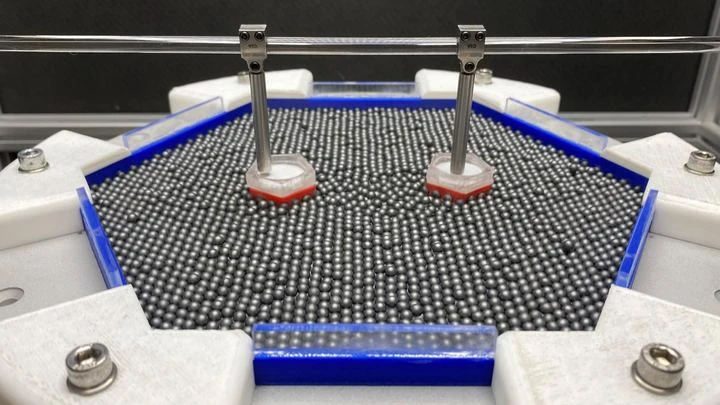
Shake a jar of sand and marbles, and you'll see large objects float or sink depending on their size. But if you shake it cleverly, you can make the marbles gather into pairs and chains, as if glued together. It's this kind of 'invisible glue' that physicists from India and Germany have now caught and measured for the first time.
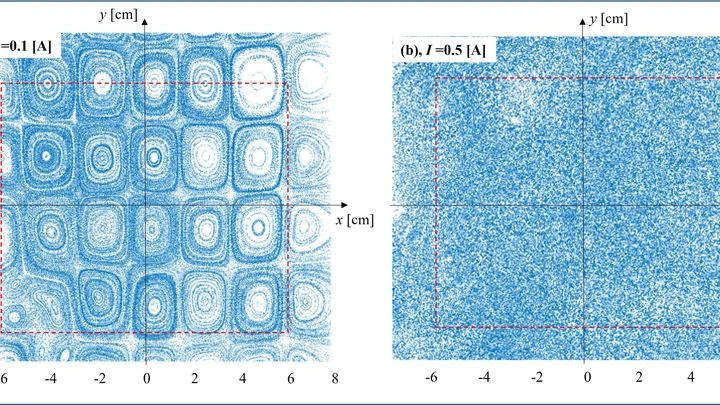
Water in a puddle after rain swirls differently than in a deep lake. A thin layer of fluid feels the bottom, and that changes the nature of its vortices. Scientists created such a layer in the lab: they poured in an electrolyte, ran a current and a magnetic field, and the fluid began to move.
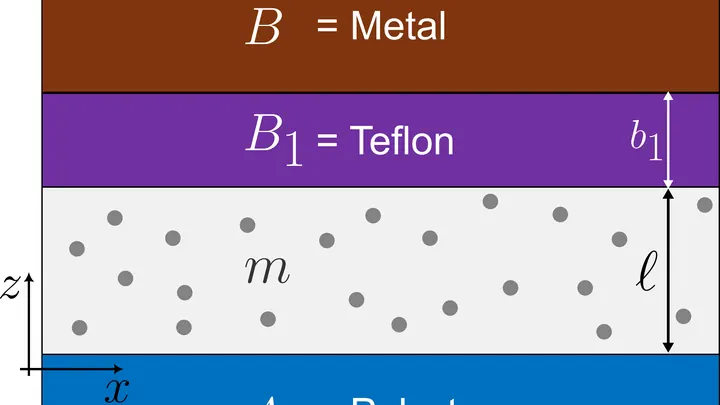
The space between two closely spaced surfaces is far from empty: it's a seething "quantum glue." Within it, quantum fluctuations continuously pop in and out of existence: microscopic bursts of energy in electromagnetic fields that, according to quantum theory, give the vacuum a dynamic structure.