object

reissner nordstrom black hole

A charged, non-rotating black hole solution to the Einstein-Maxwell equations.
48 related articles

Description

The Reissner–Nordström black hole is a solution to Einstein's equations that describes a non-rotating, electrically charged black hole. Unlike the simpler Schwarzschild black hole, which is characterized only by mass, this solution includes an electric charge, making it a more complete theoretical object. It is a static, spherically symmetric solution to the Einstein–Maxwell equations, meaning it accounts for both gravity and electromagnetism.

History

The solution was independently discovered by Hans Reissner (1916) and Gunnar Nordström (1918), shortly after Schwarzschild's solution. It was one of the first exact solutions to Einstein's field equations beyond the vacuum case.

How it works

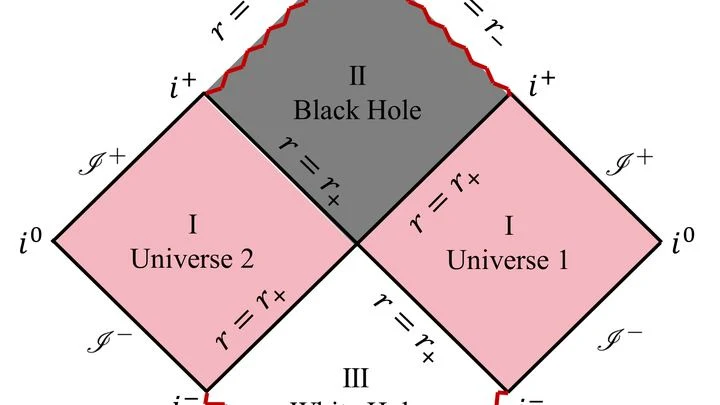
The solution arises from combining general relativity with Maxwell's equations of electromagnetism. The charge creates an electric field that contributes to the stress-energy tensor, which in turn curves spacetime. This results in a geometry with two horizons (inner and outer) for a charge less than the mass, unlike the single horizon of a Schwarzschild black hole. The outer horizon is the event horizon, while the inner horizon is a Cauchy horizon, where causality may break down.

In practice

While real astrophysical black holes are expected to be nearly neutral, the Reissner–Nordström solution is used as a theoretical laboratory for studying quantum gravity, black hole thermodynamics, and the information paradox.

Fun fact

For a charge greater than the mass (in geometric units), the Reissner–Nordström solution has no event horizon, leaving a naked singularity — a possibility that the cosmic censorship conjecture forbids.

Concept graph →

Related articles · 48

HEP Theory2026-08-062 minarXiv:2608.06016express
Hairy Black Holes and Strings
A black hole is not just a dark sphere. In string theory, it can grow 'hair'—extra scalar fields such as the axion and the dilaton. These fields gently alter the geometry of space around the hole.
Black Holes Sound Different in a Curved World
A black hole rings like a bell after being struck. This ring is the gravitational waves that detectors pick up. But what changes if the space around the hole is curved not only by its mass but also by an additional quantum correction?
General Relativity2026-08-051 minarXiv:2608.04470express
How Dark Matter Reshapes Black Holes
An invisible scaffold holds galaxies together, keeping them from flying apart. This is dark matter — matter that doesn't shine and barely interacts with ordinary stuff. Astrophysicists have long debated what it's made of.
HEP Theory2026-08-052 minarXiv:2608.04745express
A Cold Black Hole and Quantum Chaos
In the far reaches of space, there exists a hypothetical object: an ultracold black hole. It is charged and resides in an expanding universe (de Sitter space). Its temperature hovers just above absolute zero — about one trillionth of a degree above it.
General Relativity2026-08-052 minarXiv:2608.05061express
Black Holes Don't Like Being Squeezed
Drop a stone into a calm lake, and ripples spread in even circles. Spacetime around a massive body behaves similarly: if the body is perfectly round, the disturbances it causes are symmetric. A black hole in general relativity resembles a perfectly smooth mirror of water.
General Relativity2026-08-042 minarXiv:2608.03320express
A Magnetic Leash for Particles Near a Black Hole
A black hole is not a vacuum cleaner. By itself, it doesn't pull everything in more strongly than an ordinary star of the same mass. But if there's a magnetic field nearby and charged particles flying around, an interesting game begins.
HEP Theory2026-08-042 minarXiv:2608.04107express
Machine Learning Peers into the Heart of a Black Hole
A black hole is like a perfect safe: everything that falls in disappears without a trace. But quantum mechanics whispers that on the microscopic level, information is not lost but recorded on an invisible "surface." Understanding this record means unraveling the fabric of gravity.
General Relativity2026-08-031 minarXiv:2608.02259express
The Black Hole and Its Secret Twin
A rotating black hole is no calm whirlpool. Space around it shudders and rings at the slightest disturbance, like a guitar string after a pluck. These oscillations are described by the Teukolsky equation — a complex mathematical construct that physicists have studied for half a century. Recently, a strange symmetry was noticed in this equation.
General Relativity2026-08-022 minarXiv:2608.01200express
A Black Hole in a Dark Fur Coat
A black hole is not silent. When perturbed, it rings like a bell, and that ring is its quasinormal modes — damped oscillations. Physicists delved into the world of charged black holes in anti-de Sitter space (a universe with negative curvature, like a saddle).
General Relativity2026-07-241 minarXiv:2607.22856express
The Star That Shines and Melts
Usually, a black hole is described as a frozen frame: there's mass, there's charge, and it's all static. But real objects live in time. They radiate, lose energy, and change.
General Relativity2026-07-241 minarXiv:2607.22876express
Wormholes Powered by Vacuum Energy
Two metal plates in a vacuum attract each other without any magnets or charges. This is the Casimir effect: the void is not empty; particles constantly pop in and out of existence, and there are fewer of them between the plates than outside. The pressure difference pushes the plates together.
General Relativity2026-07-202 minarXiv:2607.17887express
How Black Holes Lose Their Spin in an Extended Theory of Gravity
A pair of black holes circles in a dance, gradually drawing closer. They lose energy and spin — a process known as angular momentum radiation. In standard Einstein theory, only gravitational waves carry away angular momentum.
General Relativity2026-07-192 minarXiv:2607.17223express
Why a Rotating Black Hole Can't Stand Still
A rotating black hole is like a whirlpool in a river — spacetime swirls around it, dragging along everything nearby. In some gravity theories, this whirlpool also includes an extra field — a vector field. At each point, it has a direction and a length, like a compass needle.
General Relativity2026-07-182 minarXiv:2607.16581express
Gravitational Waves Without the Mathematical Jungle
A taut trampoline sheet dips under a heavy ball. If the ball spins quickly, the sheet begins to twist around it. Spacetime near a rotating black hole behaves similarly: it is not just curved, but also dragged along by the rotation, like water swirling around a whirlpool.
General Relativity2026-07-121 minarXiv:2607.10603express
Naked Singularity Turns into a Wormhole
A black hole usually hides its singularity behind an event horizon — an invisible boundary from which not even light can escape. But sometimes this 'cloak' is absent, and the singularity, a point where familiar physics breaks down, is exposed to an outside observer.
General Relativity2026-07-112 minarXiv:2607.10199express
A Black Hole Without a Breaking Point
A stone drops into a pond — ripples spread and fade. Strike a bell, and it hums at its own pitch. A black hole, after being perturbed, also 'rings,' emitting gravitational waves of a decaying tone.
General Relativity2026-07-082 minarXiv:2607.07583express
Vacuum Around a Thin Shell
Quantum vacuum is not absolute emptiness. It is more like a taut membrane that constantly ripples from invisible particles popping in and out of existence. Even in total darkness, this membrane trembles. Physicists decided to see how it behaves around a thin spherical shell, inside which is ordinary flat space, like in our room.
HEP Theory2026-07-082 minarXiv:2607.07872express
How the Universe Loses Energy at Its Very Edge
Every river has an estuary — the place where its waters meet the sea. Spacetime, too, has its own 'shore': it is called future infinity, and it lies where all signals, light, and gravitational waves ultimately go.
General Relativity2026-07-052 minarXiv:2607.04386express
A Quantum Twist at the Heart of a Black Hole
A black hole is where the usual rules break down. At its center, according to classical physics, lurks a singularity: a point of infinite density where everything that falls in gets crushed. Quantum theory was supposed to soften this picture.
HEP Theory2026-06-291 minarXiv:2606.30794express
A Black Hole in a Fluffy Fur Coat
An ordinary black hole is surrounded by a thin photon sphere — a place where light can loop around before falling in or escaping. In the new work, this region has puffed up into a whole layer packed with massless particles that zip around at nearly the speed of light and don't press against the walls.
General Relativity2026-06-262 minarXiv:2606.28253express
Kerr Black Holes: Their Eternal Stability Proven
At the centers of many galaxies lurk giant rotating black holes. Astrophysicists have long suspected that these objects are remarkably resilient: after swallowing a star or merging with another hole, they quickly settle down and forget the catastrophe.
General Relativity2026-06-202 minarXiv:2606.22060express
How Gravity Leaves Its Mark on the Fabric of Space
When massive bodies accelerate (say, two stars orbiting each other) the space around them doesn't stay calm. It trembles like the surface of a pond after a stone is thrown. These tremors are called gravitational waves. They carry energy away, and the source gradually loses mass.
General Relativity2026-06-192 minarXiv:2606.21549express
Charge Turns Bald Black Holes Hairy
Two magnets collide in a dark room, stick together into a clump, and a dull thud echoes. Black holes behave much the same way, except instead of magnets they carry electric charge, and instead of a thud, there's a burst of gravitational waves. But there's a third player in this story — an invisible field that physicists call scalar.
General Relativity2026-06-182 minarXiv:2606.20975express
Quantum Computer Solves Einstein's Equations for the First Time
Strike a tuning fork with a mallet — it vibrates, and the sound gradually fades. A black hole behaves much the same way when disturbed: it emits gravitational waves — ripples in spacetime itself — and then settles down.
HEP Theory2026-06-171 minarXiv:2606.19281express
How a Black Hole Responds to a Nudge
A black hole is not a deaf wall. Give it a gentle tap, and it will respond. Physicists call this 'tidal deformability'—an object's ability to change shape under an external force. For a static black hole, this ability is zero: a static field doesn't bend it.
General Relativity2026-06-171 minarXiv:2606.19433express
Exact Solution to the Wave Equation Found Inside a Star
Deep inside a star compressed to its limit, particles behave like the strings of an unusual musical instrument. Their oscillations obey a complex equation that for nearly a century no one could solve exactly.
General Relativity2026-06-101 minarXiv:2606.12630express
How Gravity Rewires Electricity
A flashlight beam travels straight into the dark: that's how we usually think of light. But near a massive body, like a star or a black hole, space is curved, and the beam bends smoothly, as if guided by an invisible hand. The authors of a new study have worked out exactly how gravity alters the familiar laws of electricity and magnetism.
General Relativity2026-06-081 minarXiv:2606.09786express
Spin Inside a Neutron Star: How a Vortex of Matter Rewrites the Rules
A neutron star is the leftover core of an exploded giant, compressed to the size of a city. A teaspoon of its matter weighs a billion tons. Inside such a star, particles are packed so tightly that quantum effects start to show. One of them is the intrinsic rotation of particles, or spin.
Galaxies2026-05-271 minarXiv:2605.29069express
Dark Matter: Quantum Vortices Around Black Holes
In the quantum world, dark matter particles can merge into a single superfluid droplet — a state where matter flows without friction, like an ideal fluid. When near a black hole, this droplet doesn’t just disappear into it but twists into stable vortices, like water swirling around a rock in a stream.
General Relativity2026-05-252 minarXiv:2605.26369express
How a Black Hole Gives Away Its 'Wrongness'
A massive top spins so fast that space itself twists into a spiral around it. This is a black hole — only instead of wood and metal, it's made of pure gravity. Add an unusual electromagnetic field that slightly changes the rules of the game, and you get a 'deformed' black hole: its shape and behavior differ a bit from the familiar ones described half a century ago.
HEP Theory2026-05-191 minarXiv:2605.20349express
How a Charged Black Hole Loses Weight and Charge
Drop an ice cube into boiling water, and it will melt away until nothing is left. A black hole in space behaves much the same way — except the 'boiling water' is space itself, which continuously siphons energy out of the hole.
General Relativity2026-05-192 minarXiv:2605.20493express
Electricity and Magnetism Swap Roles — Black Holes Don't Notice the Switch
Two electrically charged spheres attract each other with a certain force. If you replace their charges with magnetic poles, a spring scale shows exactly the same force. Black holes, it turns out, behave the same way — except instead of springs, the fabric of spacetime itself does the work.
General Relativity2026-05-141 minarXiv:2605.14729express
Inflation and Dark Energy: One Cosmic Spring?
Right after the Big Bang, space swelled at an unimaginable speed — that's inflation. Now expansion has slowed, but galaxies are moving apart faster and faster. The culprit behind the acceleration has been named dark energy.
General Relativity2026-05-131 minarXiv:2605.13508express
Astrons: Electric Leviathans That Defy Cosmology
In the searing plasma of the newborn Universe, when space itself still rang with the echo of the Big Bang, objects may have emerged that challenge gravity itself. Not ordinary black holes — but electrically charged giants, astrons.
General Relativity2026-05-102 minarXiv:2605.09786express
How Gravity Loops the Invisible
Hold a magnet near a pile of iron filings, and they line up along invisible lines — the field wraps around the magnet from pole to pole. In a similar way, you can visualize gravity around massive bodies: instead of filings, it's space itself; instead of a magnet, a star or a black hole. The authors propose decomposing gravity into two fields.
HEP Theory2026-05-052 minarXiv:2605.03277express
Black Holes Hum Continuously, Not Just Ring Like Bells
A stone falls into a pond, and ripples spread across the water. If the pond is choppy, with waves coming from all directions, the pattern gets more complicated. That's roughly how spacetime behaves around a black hole when something perturbs it: it vibrates, emitting gravitational waves.
General Relativity2026-05-041 minarXiv:2605.02429express
Black Holes: Light's Hidden States
Black holes aren't faceless devourers. Sometimes they behave like water: they can 'freeze' or 'boil', changing their internal state. Scientists described this by modeling light near a black hole as a gas.
General Relativity2026-05-032 minarXiv:2605.01934express
A Black Hole with Magnetic Charge
A magnetic field can hold a star against complete collapse: that's the idea behind a new kind of black hole. Instead of the usual point of infinite density, inside there is a field that prevents space from crunching down to zero. It's like a spring: the harder you squeeze, the more it pushes back.
General Relativity2026-05-021 minarXiv:2605.01602express
Five-Dimensional Wormholes
You can poke a pencil through a folded sheet of paper, and the path between two points becomes shorter. That's roughly how the idea of a wormhole works: a tunnel in space connecting distant regions.