Classical physics is the framework that describes the world at everyday scales, where quantum effects are negligible. It encompasses Newtonian mechanics, electromagnetism, and thermodynamics, and it explains phenomena from the motion of planets to the flow of fluids. In the context of the provided titles, classical physics serves as the baseline against which quantum phenomena are contrasted, such as in the study of pilot-wave systems or the emergence of quantum entanglement from classical oscillators.
History
The foundations were laid by Isaac Newton in the 17th century with his laws of motion and universalgravitation, later extended by James Clerk Maxwell's electromagnetism in the 19th century. These were formalized into a coherent framework by the early 20th century, before quantum mechanics emerged.
How it works
Classical physics operates on deterministic laws, where the state of a system is fully specified by properties like position and momentum. It relies on continuous variables and local interactions, without the probabilistic outcomes or non-locality of quantum mechanics. This framework is effective when action scales are large compared to Planck's constant, making quantum effects imperceptible.
In practice
Classical physics underpins most engineering, from bridge construction to satellite navigation, and remains essential in fields like fluid dynamics and acoustics.
Fun fact
The boundary between classical and quantum is not sharp; macroscopic objects can exhibit quantum effects under extreme isolation, as explored in the 'dancing dust grain' experiments.
A sculptor looks at a block of marble and sees the figure within, waiting to be freed from excess material. Instead of adding clay, he removes everything that is not part of the form. The authors of a new study on magnetic resonance took a similar approach: rather than complicating the tissue model by adding ever more details, they stripped away the superfluous to reveal the essence.
In the first instants after the Big Bang, the universe expanded faster than light could cross it. Like an inflating balloon, but instead of rubber, it was space itself. On this balloon, ripples inevitably formed — tiny compressions and rarefactions from which all galaxies and stars later grew.
Newton gave us a world where bodies move in a void and clocks tick the same for everyone. For three centuries, this picture worked flawlessly. But it relies on many invisible props: absolute position, the 'up-down' direction, and a single rhythm of time for the entire universe. We have never measured these directly — only through the relations between objects.
Two massive bodies frozen in a quantum superposition resemble a pair of dancers trying to keep a single rhythm while an orchestra blares around them. Each gravitational wave is a musician throwing them off beat.
A courtroom interpreter is distracted by every rustle: the creak of a chair, a cough in the back row, the rustle of papers. By the end of the day, they are translating not what the witness said, but what they heard through the noise. Rare translation errors are not the result of a single loud shout, but of the accumulation of many small disturbances.
The early universe resembled an overheated cauldron, seething with quantum fluctuations (random bursts of energy). In this chaos, like steam over boiling water, a special field, the scalar field, condensed. It became the 'engine' that made space expand at an incredible rate. This process is called inflation.
The universe right after the Big Bang was like a boiling cauldron: bubbles of a new state of matter were bursting and growing everywhere. These were first-order phase transitions — exactly like water boiling, only at temperatures reaching trillions of degrees.
Photographing hummingbird wings with an ordinary camera gives a blurry smudge. For a sharp picture, you take many rapid shots from different angles and piece them together: that's how a quantum 'snapshot' is made. In the lab, scientists 'feel' the vibrations of a tiny mirror with a laser beam.
Two synchronized swimmers dive into the sea. One hits calm water, the other a whirlpool. Their movements, perfectly coordinated at the start, diverge. Something similar happens to two quantum particles when one moves in flat space and the other in curved space.
The Mpemba effect is a mystery where hot вода sometimes freezes faster than warm water. Usually this is attributed to how вода loses heat and энтропию (a measure of disorder). But in a glass of water, chaos prevents a precise model.
Physicists built a quantum model: a particle in a well with two depressions separated by a barrier.
Building a house on sand is a bad idea. In physics, it was long believed that a quantum theory of gravity could not be built on a fixed "sand"—a pre-existing spacetime.
A regular object moves along a predictable path, like a ball. In the quantum world, a particle is smeared into a probability cloud. To find order in this fog, scientists have recast Schrödinger's equation in the language of flowing water.
When a grain of sand falls on a table, its impact is predictable. But if you squeezed it down to the size of an atomic nucleus, the familiar laws of gravity would break down — the force of gravity would grow without bound.
An empty glass on the table seems reliable. But if there's a microcrack in the bottom, one day it will break — not with a crash, but quietly, spreading in a web of lines. So too with the vacuum: it may not be the true vacuum but a false one — temporarily stable, yet ready to transition to a deeper, real state.
Gravity seems simple: it keeps us on the ground and makes planets orbit. But if it were classical (described by Einstein's equations as the curvature of spacetime, while all matter follows the quantum laws of the Standard Model) then an ordinary quantum bit (qubit) falling freely…
In the scorching heart of a dying star, an invisible stream is born — a neutrino gas. The particles race through matter almost without stopping, but when their density is enormous, they start to feel each other. Old calculations described this as a jostle in a crowd: each shove changes direction, but no connection arises between passersby.
A flashlight beam travels straight into the dark: that's how we usually think of light. But near a massive body, like a star or a black hole, space is curved, and the beam bends smoothly, as if guided by an invisible hand. The authors of a new study have worked out exactly how gravity alters the familiar laws of electricity and magnetism.
The familiar metronomes placed on a movable platform eventually start to swing in sync. In the quantum world, this trick long eluded scientists. But now physicists have synchronized even the most exotic state — a Fock state, where the number of light particles is precisely defined, like in a counter.
An old mechanical alarm clock ticks on the shelf. You hear the steady sound, see the hands moving, and you're certain time is passing. But if you take the clock apart, you won't find a single part labeled "time." Only springs and gears.
The end of the Universe is not just the fading of light. If dark energy, the mysterious substance accelerating cosmic expansion, tears it apart in a Big Rip scenario, or if expansion reverses into a contraction that pulls everything back to a point like a big bang in reverse, a…
Gravity is a cosmic net: massive bodies stretch it, and lighter objects roll along its curves. But in the world of atoms, this net begins to tremble chaotically, producing infinite values in the equations. Spacetime curvature ceases to be smooth.
Usually, quantum corrections to gravity explode into infinities.
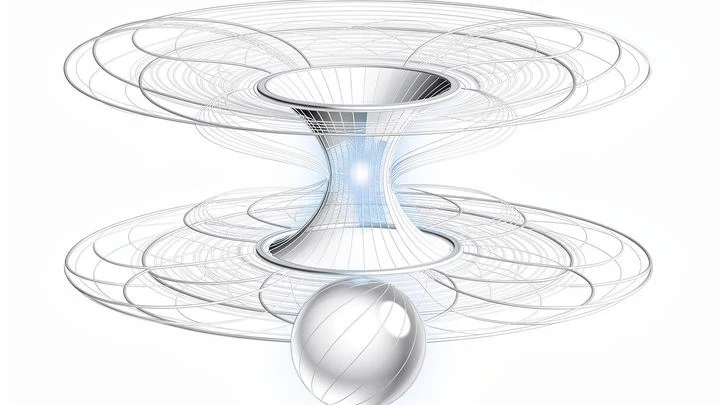
First thing that comes to mind when thinking about the birth of the Universe is an explosion. But modern cosmology paints a more refined picture: birth through the neck of a wine glass. This geometry is not a sommelier's fantasy, but a rigorous form of Euclidean wormhole that connects two anti-de Sitter worlds.
A lightning strike splits the sky in a fraction of a second, leaving a branched trail. At the same moment, in a tiny superconducting crystal cooled to near absolute zero, an avalanche of magnetic field rushes through — thin fingers of magnetization piercing the material.
A magnetic field in plasma resembles a stretched soap film: pressure from inside pushes it out, while surface tension pulls it in, giving it shape. Here too, magnetic pressure and tension forces balance each other.
In one model, spacetime is a smooth lake, and quantum particles are fish swimming in it. Their motion inevitably creates ripples. The math insists that the water trembles — otherwise the theory collapses. This trembling is strictly ordered and comes in two types.
A rubber band stretched in different directions behaves differently from a whole sheet of paper. If you pull on an edge, the deformation does not spread evenly but seems to linger in certain spots.
Three craftsmen work in the same workshop. The first tries to figure out whether tiny hourglasses are built into nature's own machinery. The second attaches a laser pointer to a microscope to see details invisible to the naked eye. The third, conversely, takes living threads and carefully weaves them into fragile quantum circuits.
According to Einstein, spacetime is a flexible fabric, curved by matter. But in the quantum world, everything is different: particles are smeared over a probability cloud, governed by a rigid rule discovered by Max Born.
Gravity is like a stretched trampoline: massive bodies press into it, making other bodies roll toward them. This shared curvature of space, gravity, affects everyone, but it doesn't convey secret messages.
A thrown stone arcs along a clean trajectory, but an electron's position in an atom is smeared out like fog. The transition from one to the other is a puzzle. New work shows that the fuzziness disappears not because of an observer, but because of the particle's own gravity.
The void can produce particles if a strong enough field is applied. Physicists call this the Dirac–Klein paradox. Previously, explaining it required the most complex calculations of quantum field theory. But we can make do with a visual image: a tightly stretched rubber band with a knot. The knot is a particle.
It all started with tiny quantum flickers on the primal canvas. Inflation — an avalanche-like expansion proposed by Alan Guth — stretched those brushstrokes to the scale of galaxies.
A Network That Decides When to Stop
A crowd grows: each new person joins the group with a probability that depends on how large the group already is. If the group is small, joining is easy; if it is huge, people start to hesitate, and growth slows down. This mechanism, called feedback, changes the entire behavior of the network.
According to ordinary mechanics, an electron in an atom should spiral into the nucleus and crash into it, like a surfer losing speed and falling off the board. But atoms live for billions of years. Because space isn’t empty. Even in absolute vacuum, an invisible electromagnetic sea ripples — the zero-point field. Its waves continuously nudge the electron.
A snowdrift grows by strict rules: falling snowflakes form bumps, those attract more snow, and the bumps amplify. The same mathematics describes city growth, patterns on bark, ripples on water, and clusters of cosmic dust. Physicists call this uniformity universality.
The assembly of a virus shell is like fastening a button: protein blocks must interlock in the correct order, and thermal fluctuations act like trembling fingers. With weak binding, the trembling helps find the right position — the shell closes faster.
An ion channel in a cell membrane is a gate just a few atoms wide. Every second, millions of charged particles, sodium and potassium ions, pass through it. Classical physics said that to get through, an ion must jump over an energy barrier, like a traveler crossing a high mountain pass.
An attempt to suppress room background noise by adding anti-sound turns into speaker howl if the circuit has an error. A similar glitch occurred with a theory that set out to remove the main cosmic hum — the inexplicably weak dark energy.
A pot on a stove receives heat, but not work: the gas under the lid just heats up. But what if the stove is not ordinary, but quantum? Then heat and work can arrive simultaneously, like from an engine that also heats.
In a new study, exactly this case is described: a classical system (say, a pendulum or a small mirror) bathes in a quantum environment.