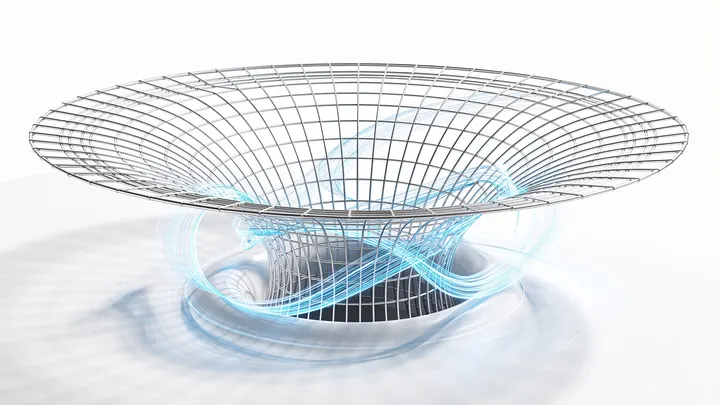
Backreaction is the influence of quantum fields on the very spacetime that hosts them. In classical general relativity, matter and energy curve spacetime, and that curvature dictates how matter moves. But when quantum fields are present, they fluctuate and carry energy, and these fluctuations can alter the geometry in ways the classical solution never predicted. The concept is central to understanding how black holes evaporate, how the universe behaves at the smallest scales, and why the vacuum is not truly empty.
History
The term gained prominence in the 1970s with Stephen Hawking's work on black hole radiation, where he showed that quantum effects near the horizon lead to particle emission and a gradual loss of mass, a direct consequence of backreaction.
How it works
In semiclassical gravity, the expectation value of the quantum stress-energy tensor acts as a source in Einstein's equations, modifying the metric. This feedback loop means the quantum field both feels the curvature and contributes to it. In practice, the backreaction is often tiny, but near black hole horizons or during the early universe, it can become significant, leading to effects like horizon shifts or the slow mass loss of black holes.
In practice
Backreaction is essential in models of black hole evaporation and in cosmological calculations of vacuum energy, helping refine predictions for the early universe's expansion.
Fun fact
Backreaction can cause a black hole's horizon to shrink, but the emitted radiation carries information, leading to the famous black hole information paradox.
A stone drops into a pond, and ripples spread across the water. In the same way, massive bodies generate gravitational waves, except it's space itself that ripples. So far, these waves have been caught by giant detectors that barely flinch as a wave passes through. But what happens on the microscopic scale, inside a tiny piece of matter?
When you blow up a balloon too quickly, its surface starts to quiver. Something similar happened to space in the first moments after the Big Bang: the universe expanded rapidly, and the very fabric of space began to ripple.
A black hole that swallows matter might not just evaporate over billions of years: it could pop like a soap bubble and turn into its opposite: a white hole. This scenario emerged from numerical experiments in semiclassical gravity.
At the center of nearly every galaxy lurks a supermassive black hole. Its gravity is so strong that it warps space itself. But few stop to wonder: what does it do to the very fabric of reality — the fields that permeate the cosmos?
One such field is the Higgs field.
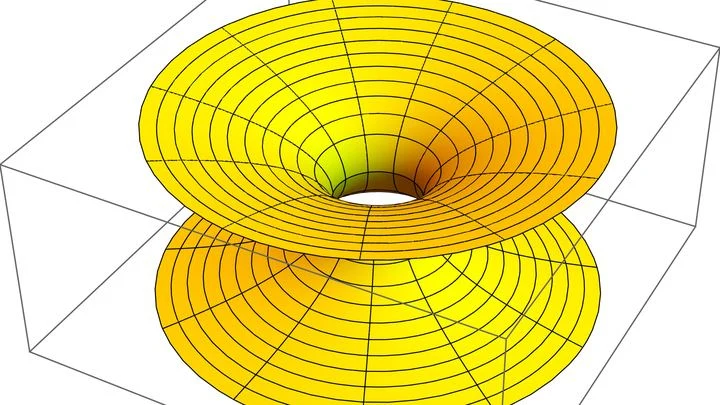
In a two-dimensional universe, a black hole looks like a funnel in spacetime. But the authors of the new work went further: they proposed that the space where particle momenta 'live' is also curved, like a saddle.
Cosmic ripples begin with tiny clumps. 380,000 years after the Big Bang, the universe was nearly homogeneous — density fluctuations were only one part in 100,000. But gravity turned these weak ripples into galaxies, clusters, and giant voids.
A black hole is not eternal. Even in a perfect vacuum, it slowly loses energy — a process known as Hawking radiation. Quantum effects near the event horizon create pairs of particles, one of which escapes, carrying away some of the black hole's mass.
Crystals fascinate us with their perfect spatial order: atoms frozen at lattice points, like beads on an invisible string. But what if the same symmetry unfolds in time? Time crystals are systems that, without any external cue, start repeating their states cyclically — clocks wound by nature itself. Inside this tireless rhythm, disorder seems to have no place.
In the first moments of the universe's life, there was not even a hint of dark energy — the very force that today pushes galaxies apart ever faster. But if you look deeper, down to the Planck scale (billions upon billions of times smaller than an atomic nucleus), spacetime ceases to be smooth.
A black hole is not just a vacuum cleaner. It glows faintly, emitting particles — this idea was proposed by Jacob Bekenstein, who connected the hole's temperature to its degree of disorder. Detecting such radiation in space is incredibly difficult.
Quantum tunneling — the ability of particles to pass through barriers forbidden by classical physics — powers stars with thermonuclear fusion, ignites primordial nucleosynthesis, and gives us flash memory.
A textbook black hole resembles a perfectly smooth sphere: everything outside it calmly flies off to infinity. However, quantum gravity paints a different picture. Recently, within loop quantum gravity, a solution was found — a 'Kruskal' black hole where spacetime beyond the horizon behaves differently.
The space we live in appears three-dimensional. But when physicists try to reconcile gravity with quantum mechanics, familiar dimensions start behaving strangely. In a new study, scientists showed that to describe a massive particle while accounting for quantum gravitational effects, it is natural to add two more dimensions.
A classical black hole has a temperature and other thermodynamic properties. When physicists began accounting for changes in the cosmological constant, the energy of empty space, a strange coupling emerged in the equations.
A builder checks the strength of an arch not by running through all possible shapes in their head, but by mentally nudging it and seeing how much force is expended. That's essentially how the principle of virtual work works in mechanics. The authors of a new study have applied this approach to the very geometry of spacetime.
They constructed a covariant framework of virtual work for the metric.
The black hole paradox has haunted physicists for decades. If a hole evaporates, where does its contents go? Discoveries by Stephen Hawking and Jacob Bekenstein showed that saving the laws of nature requires an unconventional move.
Imagine the universe as a woven blanket of invisible threads.
Ripples on a pond spread in circles from a thrown stone. Now imagine the pond itself begins to tremble — the water oscillates not only from the stone but also on its own. That's roughly how gravitational waves behave in space where a special scalar field pulsates.
An ordinary donut surface, but not smooth — instead, pierced by invisible layers, like puff pastry where each layer is slightly rotated relative to its neighbor. That's how a contact structure on a three-dimensional manifold works: at each point, a plane is defined, and these planes twist smoothly, touching each other according to a special law.
A star contracts under its own gravity, and at some point its fate hangs on a razor-thin balance. Classical physics paints a grim picture: if the mass and the force of compression are tuned with terrifying precision, what emerges is not a black hole but a 'naked' singularity.
An empty glass on the table seems reliable. But if there's a microcrack in the bottom, one day it will break — not with a crash, but quietly, spreading in a web of lines. So too with the vacuum: it may not be the true vacuum but a false one — temporarily stable, yet ready to transition to a deeper, real state.
A bonfire doesn't burn out all at once. If you glance at the flames at a random moment, all you see is a jumble of fire tongues, and you can never tell what exactly burned: a wet branch, an old magazine, or an armful of dry grass. But if you watch the fire hour after hour, rhythms emerge in its dance: a burst of heat, a lull, a change in color. These rhythms tell the story of what was thrown into the flames.
A black hole is not an eternal vacuum cleaner. Left alone in the void, it slowly disappears, radiating energy like a puddle drying on asphalt. This process, predicted by Stephen Hawking, is called evaporation.
Light cones are not about light; they are boundaries in spacetime that separate causes from effects. These cones are not rigid: a massive object curves them, like a heavy ball pressing into a stretched sheet.
Our universe isn't just expanding: it's doing so faster and faster. It's like raisin bread dough in the oven: the raisins move apart, and the farther they've already separated, the faster they continue to recede. The strange force pushing the cosmos apart is called dark energy. Most scientists think it's constant, like a permanent spring built into the very fabric of space.
A blacksmith forges a sword. With each hammer blow, the red-hot metal flattens, but the hammer, the anvil, and the surrounding air all warm up slightly. Part of the impact energy is irreversibly lost as heat — a trade-off familiar to anyone who has ever driven a nail, and it turns out to be the key to the biggest mysteries of the cosmos.
Light falling into a black hole carries information — for instance, the path a photon took. The horizon (the surface from which nothing returns) responds by changing its entropy — a measure of disorder, akin to the number of shuffled pages in a book.
For nearly a century, astronomers have watched galaxies spin as if held together by invisible mass. Fritz Zwicky first noticed it, and Vera Rubin precisely measured the speeds of stars at the edges.
A wormhole is a tunnel through the fabric of spacetime, an idea expanded by John Wheeler and Kip Thorne. Just as a mountain passage tends to cave in, the throat of a wormhole wants to snap shut.
The universe is not a solid monolith, but a canvas of countless quantum threads. Spacetime doesn't flow like water, but vibrates like a tapestry in the wind. For a long time, physicists only saw the overall pattern, neglecting the tremor of individual threads.
A tiny black hole the size of an atomic nucleus but with the mass of a mountain emerged in the first moments after the Big Bang, when random clumps of energy collapsed into such objects.
In an orchestra, one musician plays so quietly that their sound is almost inaudible in the overall chorus. In the quantum world, such 'quiet' states are called dark: their energy barely escapes, like light in a darkened room. But if there are many musicians, their mutual influence can unexpectedly awaken even the most silent one.
A pot of soup forgotten on the stove cools to room temperature. It seems everything has come to rest. But if you look inside with a quantum magnifying glass, you'll find that water molecules haven't frozen: they continue their dance. It's just that now the dance is steady, not turbulent like when boiling.
Back in the 1930s, Fritz Zwicky noticed that the speeds of galaxies in clusters were too high for the visible mass. Later, Vera Rubin confirmed this for individual galaxies.
When a balloon with a painted pattern deflates, the pattern ripples and distorts. Something similar happens to a black hole that slowly evaporates, losing energy through the radiation discovered by Stephen Hawking.
In the seething cauldron of the early universe, the vacuum, like a supercooled liquid, could boil with bubbles of a new phase. For a long time, physicists pinned their hopes on these bubbles as a source of primordial black holes (PBHs)—ideal candidates for dark matter.
Sunlight hits a silicon wafer, and a current flows in the circuit. That's the familiar work of a solar cell: light knocks out electrons, and a p–n junction (the boundary between two layers with different conductivities) forces them to move in one direction. But in some crystals, current arises differently — without any junctions, purely from the material's internal structure.
In physics, there's an old ache. General relativity paints the beginning of the universe as a point — a singularity where equations break down and volume shrinks to zero. Quantum mechanics hints that at the most critical moment, something goes differently than classical physics predicts.
The universe abhors monotony. A century ago, Edwin Hubble and Georges Lemaître gave us an elegant picture: an expanding cosmos, smooth as the surface of an inflated balloon.