Energy conditions are a set of inequalities in general relativity that constrain the energy-momentum tensor, which describes the distribution of matter and energy in spacetime. They are used to rule out exotic solutions that would allow for phenomena like wormholes, time travel, or warp drives, which typically require negative energydensities. The most common are the weak, strong, null, and dominant energy conditions, each imposing different limits on how energy can flow.
History
The energy conditions were formalized in the 1960s and 1970s by physicists like Raychaudhuri, Hawking, and Penrose, as part of the singularity theorems and the study of black hole thermodynamics.
How it works
These conditions are mathematical statements about the energy density and pressure as measured by any observer. For example, the weak energy condition requires that the energy density as seen by any timelike observer is non-negative. The null energy condition, which is weaker, only requires this for lightlike observers. If a solution violates these conditions, it implies the presence of 'exotic matter' with negative energy, which is not known to exist in bulk form.
In practice
They are used in cosmology to constrain dark energy models and in theoretical studies of warp drives and wormholes, helping to determine which are physically plausible.
Fun fact
Quantum field theory is known to violate the weak energy condition locally, but the averaged versions may still hold, which is a topic of active research.
In nature's workshop, there is a strange lathe: it cuts threads on screws but forbids left-handed ones. You can tighten a screw as much as you like, in any clockwise direction, but counterclockwise is not allowed. This lathe is not a fantasy but an exact quantum rule that physicists have just built for magnetic materials.
In the big world, there's a simple rule: energy density can't be negative, and its flow can't outrun light. In a café, that would look like this: a waiter can't deliver orders faster than he can run. Physicists call this restriction the energy dominance condition.
But in the microworld, where quanta rule and spacetime can bend, energy starts acting up.
The universe right after the Big Bang was like a boiling cauldron: bubbles of a new state of matter were bursting and growing everywhere. These were first-order phase transitions — exactly like water boiling, only at temperatures reaching trillions of degrees.
Two metal plates in a vacuum attract each other without any magnets or charges. This is the Casimir effect: the void is not empty; particles constantly pop in and out of existence, and there are fewer of them between the plates than outside. The pressure difference pushes the plates together.
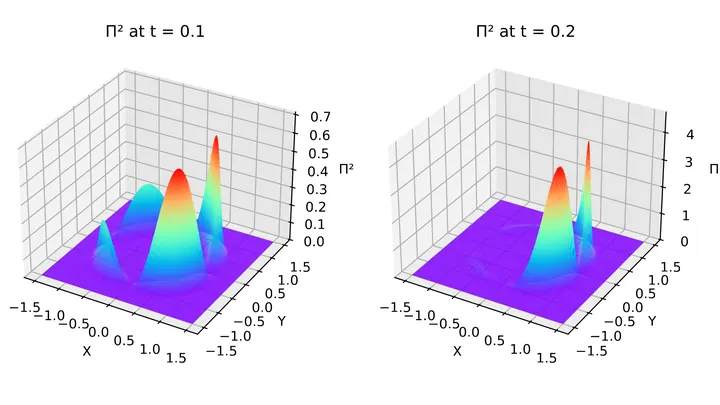
Boson stars are gravitational atoms. Only instead of electric charge, gravity itself serves as the nucleus, holding a cloud of scalar field in quantized clumps.
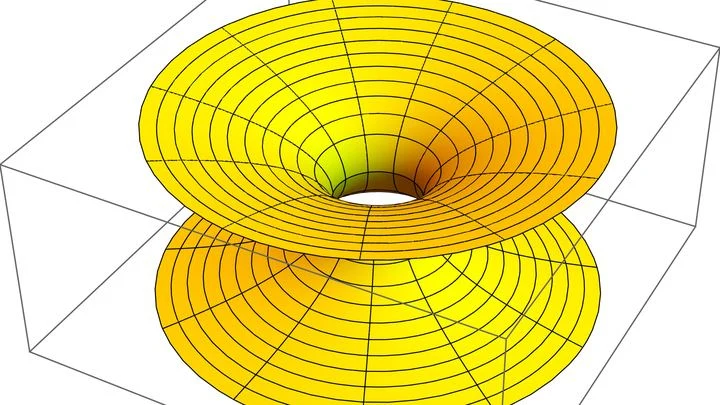
A wormhole is a hypothetical tunnel in curved spacetime connecting two distant regions of the universe and potentially shortening the journey between them.
The universe is expanding, and its history features two puzzling episodes that don't fit into a simple picture. The first is a brief period in its youth when everything flew apart faster than expected, as if someone had floored the gas pedal. The second is today's acceleration, as if the same pedal were pressed again, but more gently.
A wormhole is a tunnel through the fabric of spacetime, an idea expanded by John Wheeler and Kip Thorne. Just as a mountain passage tends to cave in, the throat of a wormhole wants to snap shut.
A warp drive creates a bubble around the ship, compressing space in front and stretching it behind. This is a clever way to bypass the speed-of-light limit without violating Einstein's theory.
When a star burns out and collapses under its own weight, the space around it crumples into a black hole. At the center, according to textbooks, lurks a singularity — a point where density becomes infinite and the laws of physics break down.
The void is not as empty as it seems. In the quantum world, even in a perfect vacuum, pairs of particles constantly pop in and out of existence, like ripples on a pond's surface, invisible to the eye but measurable. If you place a thin partition in this ripple, it alters the wave pattern.
Think of spacetime as a vast pond. A warp drive is a boat crossing it. Some boats, like the famous Alcubierre drive, churn the water into chaotic whirlpools. Others, like the Rodal design, glide smoothly, barely leaving a ripple.
A black hole isn't completely black. From its horizon, a faint thermal glow constantly seeps out, like steam rising from a cooling cup of tea. The temperature of this glow depends on the strength of gravity at the surface.
Light from distant galaxies, passing through clusters of matter, gets distorted — much like the bottom of a pool breaks up into ripples of water. Astronomers measure these barely perceptible bends in shape and create a map of gravitational ‘ripples.’ This is weak lensing — a natural detector of invisible matter.
Time is a one-way road: events race forward with no U-turn allowed. The arrow of direction is governed by entropy — a measure of disorder, which only grows in the Universe, like a traffic jam at rush hour. You can clear one intersection, but the overall congestion only gets worse.