A Schwarzschild black hole is the simplest type of black hole, characterized by having mass but no electric charge and no angular momentum (rotation). It is described by a solution to Einstein's field equations of general relativity, derived by Karl Schwarzschild in 1916. This solution describes a spherically symmetric, non-rotating black hole with a single event horizon.
History
Karl Schwarzschild derived this solution in 1916, just months after Einstein published general relativity, while serving on the German front in World War I. It was the first exact solution to Einstein's field equations.
How it works
The Schwarzschild solution predicts that if a mass is compressed within a critical radius (the Schwarzschild radius), it forms a black hole. The event horizon is the boundary beyond which nothing, not even light, can escape. The geometry of spacetime around a Schwarzschild black hole is static and spherically symmetric, with a singularity at the center where curvature becomes infinite.
In practice
Schwarzschild black holes are used as theoretical models to study gravitational lensing, accretion disk physics, and the behavior of matter under extreme gravity. They also serve as a baseline for testing more complex black hole solutions.
Fun fact
The Schwarzschild radius of the Sun is about 3 kilometers, meaning if the Sun were compressed to that size, it would become a black hole.
A black hole pulls in anything that gets too close. But if you toss in not one object but a pair, one of them can fly back out, carrying off some of the hole's rotational energy. This trick, devised by Roger Penrose in 1969, works only because a black hole has a horizon — a boundary beyond which nothing returns. Now it turns out the horizon isn't necessary.
A black hole rings like a bell after being struck. This ring is the gravitational waves that detectors pick up. But what changes if the space around the hole is curved not only by its mass but also by an additional quantum correction?
The idea was elegant: take a BTZ black hole (the three-dimensional analog of a regular black hole) and smooth its horizon with a special function. The hope was that inside, the spacetime signature might change — time becoming space, and space becoming time. But the calculations showed otherwise.
Drop a stone into a calm lake, and ripples spread in even circles. Spacetime around a massive body behaves similarly: if the body is perfectly round, the disturbances it causes are symmetric. A black hole in general relativity resembles a perfectly smooth mirror of water.
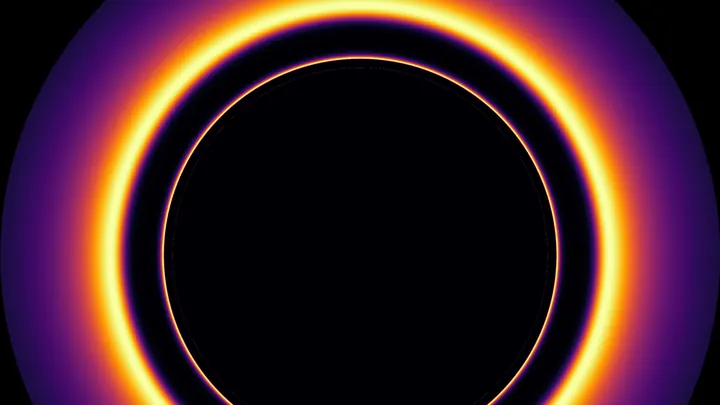
A black hole's shadow isn't just a black circle. Usually, we see a dark void surrounded by a glowing ring of hot gas. But if a black hole wasn't born from a dying star but has existed forever, its shadow might hide a surprise.
An eternal black hole is a solution to Einstein's equations with no past and no collapse.
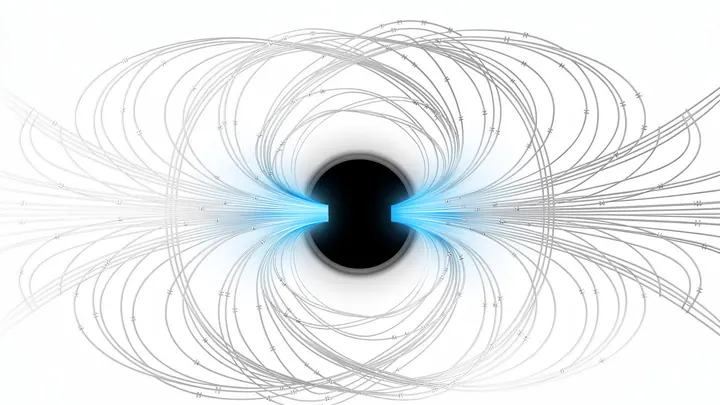
A black hole is not a vacuum cleaner. By itself, it doesn't pull everything in more strongly than an ordinary star of the same mass. But if there's a magnetic field nearby and charged particles flying around, an interesting game begins.
Two houses with identical facades. Windows, doors, wall color — everything matches. But inside, one is empty, while the other buzzes with life. How can you tell without stepping inside? In space, there's a similar puzzle: a black hole and a gravastar look the same from the outside, but they are built differently.
A black hole devours everything, even light. Yet it obeys the laws of physics: it possesses entropy — a measure of the hidden information an object 'remembers.' In the 1970s, Jacob Bekenstein and Stephen Hawking discovered a strange pattern: a black hole's entropy grows not with its volume, but…
At the center of a galaxy sits a supermassive black hole, surrounded by a vast, tenuous cloud of dark matter. It doesn't shine or heat, but its gravity warps space and changes the rules of the game for everything orbiting nearby.
At the center of nearly every galaxy lurks a supermassive black hole. Its gravity is so strong that it warps space itself. But few stop to wonder: what does it do to the very fabric of reality — the fields that permeate the cosmos?
One such field is the Higgs field.
An eardrum at the very edge of a waterfall. Sound behaves strangely here: echoes don't multiply: they fade. That's exactly what gravitational waves look like at the horizon of a black hole — the boundary beyond which even light disappears.
A black hole's horizon is not a wall but rather a one-way membrane. Anything that crosses it disappears forever. Stephen Hawking showed that this boundary should glow faintly, emitting particles. But catching such radiation from a real black hole is impossible: it's too far and too dim.
Physicists have found a workaround: build a "toy" black hole out of magnetic atoms.
A swarm of tiny invisible particles, like a cloud of pollen, drifts through space. A black hole sits in its path. Some particles fall in and vanish forever; others swing around the trap and fly away. The physicists built a map showing exactly how much matter gets swallowed and how much survives.
A pair of black holes circles in a dance, gradually drawing closer. They lose energy and spin — a process known as angular momentum radiation. In standard Einstein theory, only gravitational waves carry away angular momentum.
Gravity is the invisible glue that holds stars and planets together. But what if this glue has a tiny mass? In massive gravity, the carrier particles (called gravitons) weigh a minuscule but nonzero amount. This changes the rules near black holes.
The authors of the new study built on a mathematical tool — eigenvalue decomposition.
A taut trampoline sheet dips under a heavy ball. If the ball spins quickly, the sheet begins to twist around it. Spacetime near a rotating black hole behaves similarly: it is not just curved, but also dragged along by the rotation, like water swirling around a whirlpool.
A black hole usually hides its singularity behind an event horizon — an invisible boundary from which not even light can escape. But sometimes this 'cloak' is absent, and the singularity, a point where familiar physics breaks down, is exposed to an outside observer.
An ordinary black hole hides a singularity at its center — a point where density and curvature become infinite and the laws of physics break down. The authors of the new work built a model of a rotating black hole that, instead of a singularity, contains a calm "core" resembling ordinary flat space.
A stone drops into a pond — ripples spread and fade. Strike a bell, and it hums at its own pitch. A black hole, after being perturbed, also 'rings,' emitting gravitational waves of a decaying tone.
Quantum vacuum is not absolute emptiness. It is more like a taut membrane that constantly ripples from invisible particles popping in and out of existence. Even in total darkness, this membrane trembles. Physicists decided to see how it behaves around a thin spherical shell, inside which is ordinary flat space, like in our room.
In classical theory, a black hole is where matter collapses to a point of infinite density. Such a 'singularity' looks like an error in the equations: nature hardly tolerates infinities. Many physicists seek ways to 'smooth out' this flaw, and one idea is to modify the theory of gravity itself at small distances.
In cricket, there's a special delivery — the googly. The ball spins in a way that deceives the batsman. Physics had its own googly: for nearly half a century, mathematicians couldn't make twistor theory work with real gravity. It described 'nice' fields perfectly, where everything twists in one direction. But as soon as an 'awkward' component appeared, the machinery broke down.
The merger of two black holes is not just a silent dance, but a grand act after which spacetime itself vibrates for a long time. These damped oscillations — quasi-normal modes — are like the ringing of a gigantic bell. But there is another echo: barely perceptible, almost ghostly.
A black hole is where the usual rules break down. At its center, according to classical physics, lurks a singularity: a point of infinite density where everything that falls in gets crushed. Quantum theory was supposed to soften this picture.
Imagine a steam engine where instead of a steel piston there is an event horizon, and the cylinder is curved space itself. This metaphor has gained mathematical flesh: physicists have for the first time constructed a complete set of reversible heat cycles with a Schwarzschild black hole confined in a spherical cavity.
A black hole's interior is layered like an onion. In the new model, instead of an infinite point at the center, there are three regions: a dense core, a transition layer, and a crust just below the horizon. All arise from a single field that interacts with itself.
At the center of a black hole, classical theory paints a point where density and spacetime curvature shoot to infinity — like an infinitely sharp needle. But quantum corrections, tracing back to the work of Karl Schwarzschild, add a tiny “pillow”: space cannot collapse to zero.
An ordinary black hole is surrounded by a thin photon sphere — a place where light can loop around before falling in or escaping. In the new work, this region has puffed up into a whole layer packed with massless particles that zip around at nearly the speed of light and don't press against the walls.
A textbook black hole resembles a perfectly smooth sphere: everything outside it calmly flies off to infinity. However, quantum gravity paints a different picture. Recently, within loop quantum gravity, a solution was found — a 'Kruskal' black hole where spacetime beyond the horizon behaves differently.
Observations by James Webb showed: already 500 million years after the Big Bang (at redshifts z~10), the Universe was aglow with black holes with masses of billions of solar masses. This baffles theories of gradual growth: matter would not have time to 'feed' the seeds at the required rate.
The light of a distant star briefly brightens when a massive invisible object passes between it and a telescope. This phenomenon, gravitational microlensing, acts as a natural telescope. Usually, the lens is a black hole, warping the spacetime around it.
The Schwarzschild black hole is the simplest model in general relativity. But when you switch to teleparallel gravity (TEGR), where torsion replaces curvature, the horizon develops a problem. Some quantities built from torsion tend to infinity.
Strike a tuning fork with a mallet — it vibrates, and the sound gradually fades. A black hole behaves much the same way when disturbed: it emits gravitational waves — ripples in spacetime itself — and then settles down.
A black hole is not a deaf wall. Give it a gentle tap, and it will respond. Physicists call this 'tidal deformability'—an object's ability to change shape under an external force. For a static black hole, this ability is zero: a static field doesn't bend it.
Deep inside a star compressed to its limit, particles behave like the strings of an unusual musical instrument. Their oscillations obey a complex equation that for nearly a century no one could solve exactly.
The ocean bulges a full meter under the Moon: that's a tide. If a massive body sits near a black hole, the hole feels a tidal pull too. In ordinary Einsteinian gravity, it doesn't respond to such a static tide: its "tidal numbers" (measures of deformability) are zero.
A flashlight beam travels straight into the dark: that's how we usually think of light. But near a massive body, like a star or a black hole, space is curved, and the beam bends smoothly, as if guided by an invisible hand. The authors of a new study have worked out exactly how gravity alters the familiar laws of electricity and magnetism.
Usually, a wormhole is imagined as a tunnel in space, whose walls are held open by something unusual — matter with negative energy. Like the supports in a mine that keep the ceiling from collapsing. But in this work, the physicists did without supports.
In 2019, the image of the M87* shadow was a sensation: for the first time, humanity saw the outlines of a black hole, predicted by Schwarzschild and shrouded in myth. But what if that glowing crescent isn't a portrait of an absolute abyss, but of a cosmic portal?
Every quantum system (whether an atom, a crystal, or the entire Universe) has its own set of allowed energies, like the steps of a ladder. The hotter the system, the more readily particles climb to higher rungs.