The Unmixed Cocktail: Why Double Diffusion Is Powerless in the Interiors of Giant Planets
Original: "Self-Consistent Evolution Models Show Weak Double-Diffusive Mixing in Jupiter and Saturn"
A simulation spanning 4.56 billion years shows that double-diffusive convection transports only fractions of an Earth mass—and cannot erode the cores of Jupiter and Saturn.
Links in the knowledge graph 1
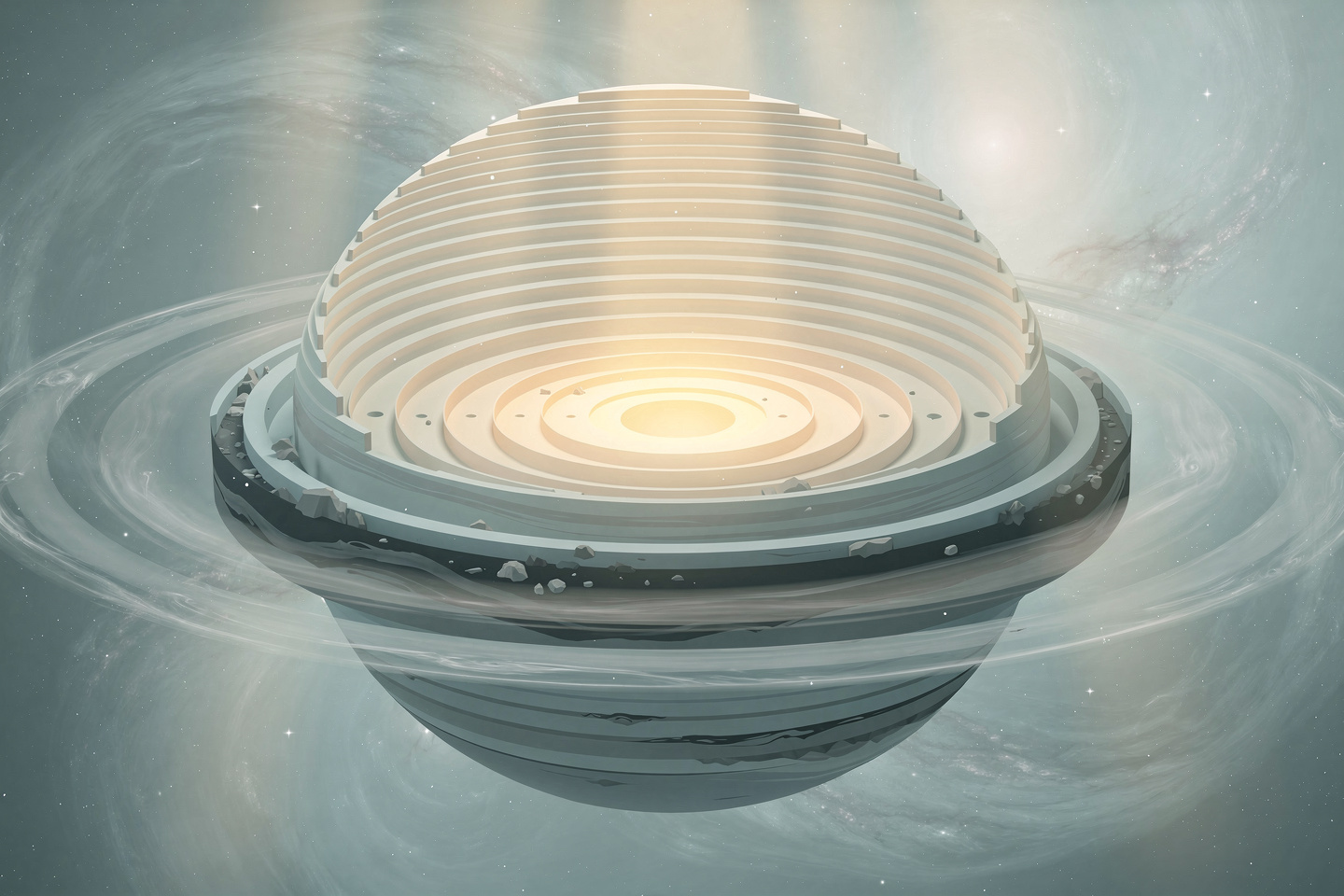
Oceanographers have long known: warm and salty water layers form steps without mixing. Inside Jupiter, the same laws could have diluted the core—but couldn’t. Double diffusion, the lazy bartender of planetary interiors, would spend almost all the planet’s energy to lift just a couple of Earth masses. So mixing is fixed at birth, and future observations of exoplanets will see ancient layers.
🎯 The idea of the double-diffusive “staircase” came from oceanography: there, stepped profiles of temperature and salinity are observed in seas and oceans. In Jupiter’s interior, such layers, if they existed, could extend for hundreds of kilometers. However, the energy to sustain them would be monstrously large—and that is precisely what kills them.
R_{\rho} = \frac{\alpha_\mu}{\alpha_T} \frac{\nabla_\mu}{\nabla - \nabla_{\rm ad}}
When 1 < Rρ < ~10, convective layers can form; the higher Rρ, the stronger the compositional stabilization.
\frac{E_{\rm mix}}{\rho_0 c_P \Delta T H} \sim \frac{H}{H_T}
In a compressible medium, the layer thickness H is comparable to the thermal scale H_T, and almost all available thermal energy is spent on mixing.