Why Double Diffusion Doesn’t Mix the Cores of Jupiter and Saturn ✛
Context
Understanding the interior structure of gas giants, from our own Jupiter to distant exoplanets, is key to unraveling their formation and evolution. Data from the Juno and Cassini missions point to fuzzy cores, where heavy elements (water, carbon) are spread across an extended region rather than confined to a sharp boundary. Double diffusive convection—a process that arises when a destabilizing temperature gradient coexists with a stabilizing composition gradient—has long been considered a likely mixing mechanism. Yet its real efficiency under planetary interior conditions, where heat transport dominates over substance diffusion, has remained unknown.
Methods
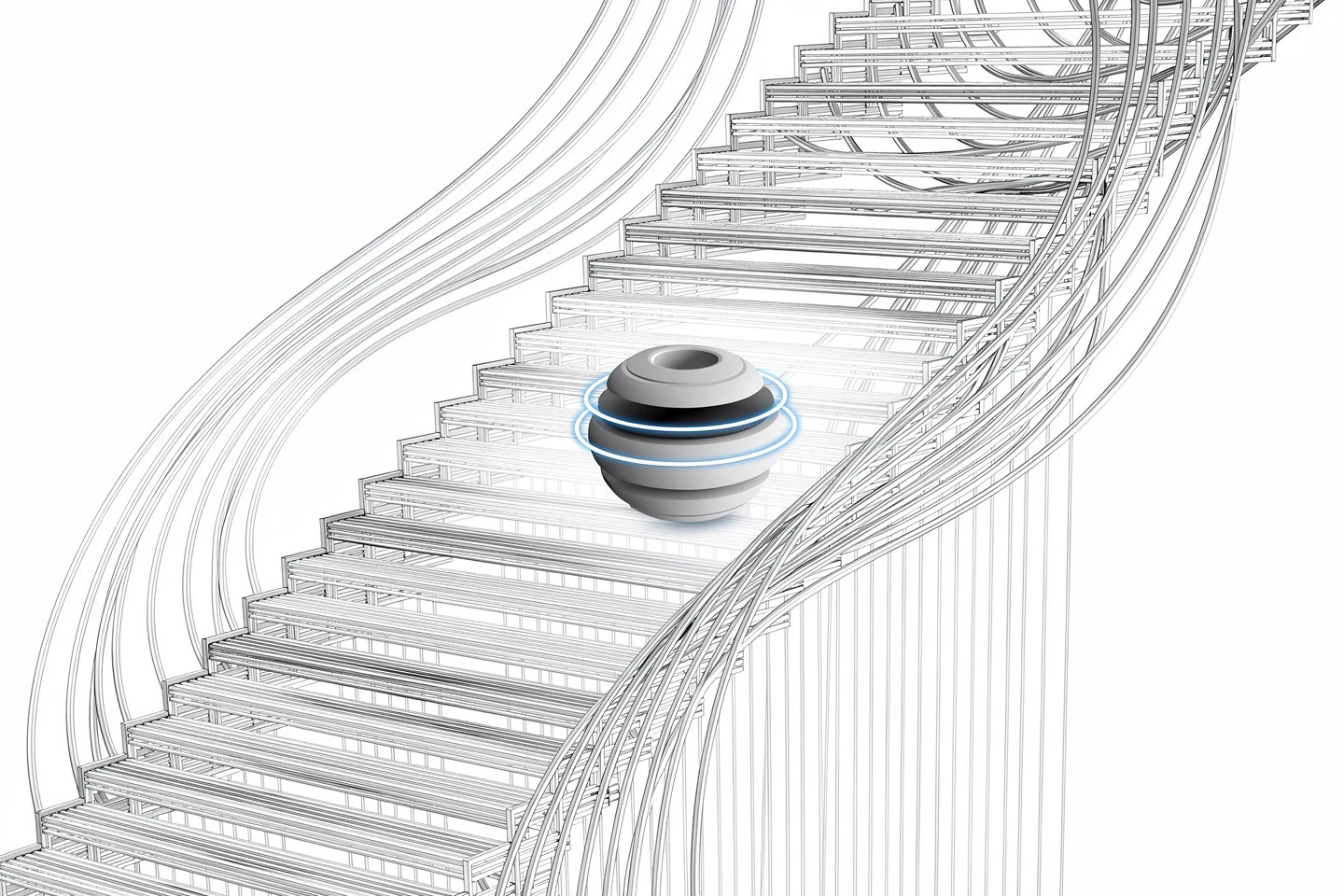
To assess the role of double diffusion, the authors have, for the first time, self-consistently implemented Spruit's (2013) recipe for convective 'staircases' into the APPLE planetary evolution code. Initial conditions were taken from formation models of Jupiter and Saturn, which already featured fuzzy cores due to partial vaporization of accreting planetesimals—essentially comets. The code accounted for ordinary convection (according to the Schwarzschild criterion), molecular diffusion, and double diffusive transport. The key parameter is the stability ratio 𝑅𝜌, which depends on the superadiabatic gradient and composition gradient. Effective transport coefficients for composition and heat were set as functions of 𝑅𝜌 and the microscopic properties of hydrogen and helium. The evolution was tracked on a Lagrangian mesh over 4.56 billion years, solving the structure and transport equations jointly using the Henyey method.
Results
The main result: double diffusive convection is catastrophically inefficient. In the baseline simulation, Jupiter redistributed only ≈0.11 Earth masses of heavy elements from the core to the envelope, and Saturn ≈0.07 M⊕. Artificially boosting the coefficients by a factor of 100 only raised these values to ≈0.55 and 0.61 M⊕, respectively, while a thousandfold boost yielded ≈2 and 1.3 M⊕. Strikingly, even this extreme exaggeration of transport does not lead to significant smearing of the profiles. The reason is self-regulation: enhanced heat transport lowers the superadiabatic gradient, reducing 𝑅𝜌, on which the effective coefficients depend nonlinearly. A negative feedback loop emerges, preventing runaway mixing. Thus, the primordial composition gradients imprinted during formation survive for billions of years.
Implications
The results imply that double diffusion cannot be the main architect of fuzzy cores. The observed distributions of heavy elements must be explained either by the accretion process itself (which may produce more extended gradients than previously thought) or by rare events—for instance, head-on collisions with bodies of ~10 M⊕. This calls into question numerous evolutionary models that relied on efficient post-formation mixing, and opens the door to revising transport mechanisms in planetary interiors. As Chandrasekhar already emphasized in the context of stars, mixing in compressible environments is energetically expensive, and planetary conditions only amplify this effect.
Future development
The immediate next step is to carry out hydrodynamic simulations in a fully compressible setting, without the Boussinesq approximation that artificially eases mixing. Calculations with a larger number of scale heights are already being developed, which will allow quantitative linking of the energy budget and transport efficiency. Moreover, detailed formation models (accounting for, say, migration of bodies and gases) must be coupled with long-term evolution to trace the fate of heavy elements from planetesimals to the structures measured by Juno and Cassini.
Impact
The work directly impacts the physics of gas giants and exoplanets, astrophysical fluid dynamics, and the interpretation of observational data, including future spectroscopy of distant world atmospheres. New insights into the energetics of convective mixing could reshape approaches to modeling brown dwarfs and even massive exoplanets, where similar processes may influence observed heat flows and chemical composition.
Next steps
Incorporating realistic impact physics into evolutionary codes and performing joint “formation + evolution” simulations capable of reproducing both gravitational moments and elemental abundances. Also needed are laboratory experiments on multilayered convection under planetary-like conditions, and further development of theoretical models of turbulent transport in stably stratified environments.
Key open problems
The study exposes a fundamental problem: the applicability of mixing theories developed for laboratory scales to planetary interiors, where compressibility alters the energy balance. This is part of a broader question of how thermal evolution distributes elements—directly relevant to the puzzle of fuzzy cores and the production of entropy in planetary interiors. The results also point to limitations of standard accretion models: perhaps early mixing of material was far more vigorous than commonly assumed.
The knowledge machine's view
This section is addressed to the author of the paper and their colleagues. Neighbouring works were found by meaning-based search across our archive, not by word overlap. We do not review: we show the field around the work.
What the work does
The authors implemented Sprout's double-diffusive convection recipe into the planetary evolution code APPLE for the first time and tracked the evolution of Jupiter and Saturn over 4.56 billion years. They showed that double diffusion transports less than 0.1 Earth masses of heavy elements, even when the coefficients are artificially enhanced. The reason is a negative feedback: enhanced transport reduces the superadiabatic gradient and weakens the mixing efficiency.
Where its strength is
This work provides a self-consistent estimate of the role of double diffusion in planetary interiors, revealing a self-regulating mechanism that limits mixing. This allows ruling out double diffusion as a primary mechanism for core erosion and redirecting the search for explanations to other processes.
Where it could go next
- It might be interesting to compare these findings with work on protoplanetary disk formation: if accretion itself creates fuzzy cores, then post-formation mixing may play a secondary role.based on: How Dust Disks Dance Around Newborn Stars arXiv:2608.02204v1
- Nearby is an analysis of how giant planets hide hydrogen inside themselves: perhaps one should consider how primordial composition gradients affect the distribution of hydrogen and helium in the envelope.based on: How Giant Planets Hide Hydrogen Inside arXiv:2606.30644
- The archive contains a study on the thermal memory of a planet around a dead star: one could test whether composition gradients survive in white dwarfs formed from such planets, providing an observational test.based on: The Heat Memory of a Planet Orbiting a Dead Star arXiv:2607.01316
Worth trying
- Use formation models with more realistic accretion to test whether they can directly create extended gradients without additional mixing.
- Consider the influence of giant impacts on core–envelope mixing as an alternative to double diffusion.
- Test how the conclusion about the inefficiency of double diffusion changes for exoplanets with different masses and heat fluxes.
Why this may matter
If double diffusion indeed plays no role, the observed fuzzy cores require a revision of formation and evolution models of gas giants, which is important for interpreting data from Juno, Cassini, and future missions to ice giants.
Nearby works in our archive
- How Dust Disks Dance Around Newborn Starssimilarity 0.64
- Why Do Hot Jupiters Swell?similarity 0.62
- How Giant Planets Hide Hydrogen Insidesimilarity 0.62
- How Tidal Waves Sort Planetssimilarity 0.61
- Mars's dense layer reveals the fate of rocky planetssimilarity 0.61
- A Waterfall of Planets: The Mystery of the Vanishing Water Worldssimilarity 0.60
- The Heat Memory of a Planet Orbiting a Dead Starsimilarity 0.60
The closest work in the archive sits at 0.64 by meaning — the usual level for our corpus.
Original abstract
as written by the authors arXiv:2607.04629v1
Double-diffusive convection in the ``fuzzy'' cores of giant planets has been widely discussed as a mechanism for redistributing heavy elements, but its efficiency in evolutionary models remains uncertain. Previous estimates rely on idealized compositional structures and have not treated double-diffusive transport self-consistently in planetary evolution calculations. Here we implement a prescription for transport across convective staircases in the planetary evolution code \texttt{APPLE} and apply it to post-formation interior models of Jupiter and Saturn containing compositional gradients produced during formation. These models are evolved for 4.56 Gyr including convection, diffusion, and double-diffusive transport. We find that double-diffusive convection produces limited mixing between the deep interior and the envelope. In both Jupiter and Saturn, less than $$\sim 1\,M_\oplus$$ of heavy material is redistributed over the full cooling history, leaving the primordial compositional gradients largely intact. This inefficiency arises because the buoyancy work available to drive compositional transport is constrained by the thermal energy budget of the deep interior, in contrast to idealized Boussinesq simulations that operate in regimes more favorable to layer merging and efficient mixing. As a result, double-diffusive convection alone cannot significantly erode the compositional gradients generated during formation. The observed heavy-element distributions in Jupiter and Saturn therefore likely require additional transport mechanisms or formation pathways, including large collisional events, that produce broader initial mixing than standard accretion models predict.
The idea of double diffusive 'staircases' originated in oceanography: there, water layers with different temperatures and salinities form stepped profiles. In Jupiter's interior, such layers could stretch for hundreds of kilometers, if they existed. And the concept of a fuzzy core became popular after the Juno probe revealed that Jupiter's gravitational field is incompatible with a sharp boundary.
Key numbers
- Transported mass (Jupiter, baseline): 0.11 M⊕
- Transported mass (Saturn, baseline): 0.07 M⊕
- Boost ×1000 (Jupiter): ~2 M⊕
- Boost ×1000 (Saturn): ~1.3 M⊕
- Simulation age: 4.56 Gyr