The Unmixed Cocktail: Why Double Diffusion Is Powerless in the Interiors of Giant Planets ✛
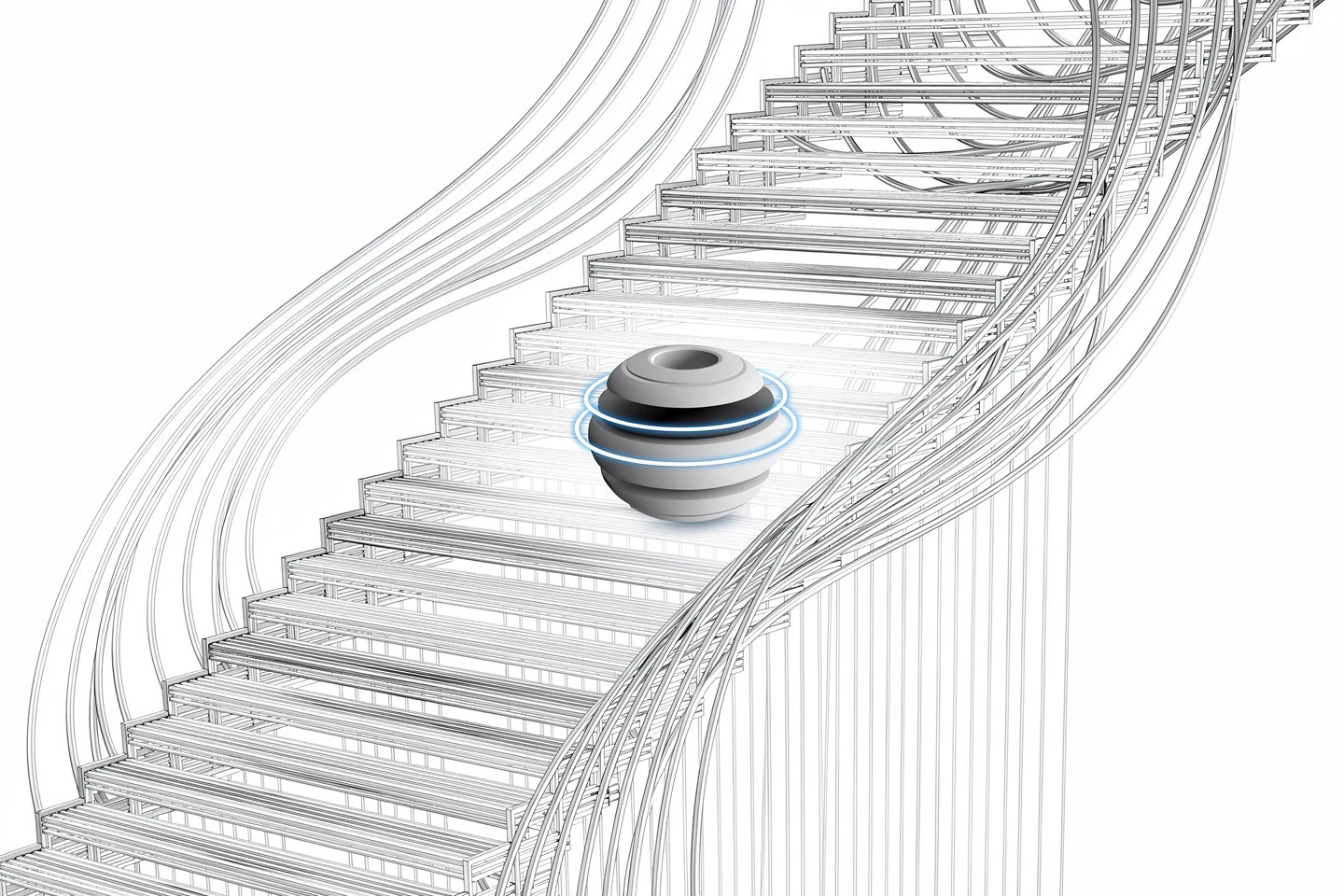
Forget the familiar images of planetary cores — a sharp boundary between rock and gas is a thing of the past. The Juno probe, diving into Jupiter’s gravitational field, and Cassini, into the embrace of Saturn, discovered that heavy elements are not gathered at the center but smeared over a vast region, as if someone carelessly shook a cocktail. For a long time, this smearing was thought to be the work of double-diffusive convection. This process, glimpsed in the ocean where layers of water with different salinities and temperatures form a stair-step structure, seems ideally suited for mixing planetary interiors. But calculations say otherwise.
The authors armed themselves with the recipe for convective staircases from Spruit (2013) and implanted it into the evolutionary code APPLE, which models the entire life of a planet — from molten infancy to the present 4.56 billion years. The initial conditions already incorporated diluted cores: planetesimals, bombarding the protoplanet, partially evaporated, leaving behind extended plumes of water and carbon, kind of ghosts of falling comets. Then the code calculated how these layers evolve under the influence of ordinary convection, that which obeys the Schwarzschild criterion, molecular diffusion, and, of course, double diffusion. The result? Jupiter shuffled only 0.11 Earth masses, Saturn even less. Even if a lab experimenter mentally boosts the transport coefficients a thousandfold, the numbers barely creep up to two masses, and that’s over the entire history of the Solar System.
This inefficiency has a rigorous physical justification. The stability parameter Rρ = (αμ/αT) (∇μ/(∇ – ∇ad)) determines whether layers arise at all. When Rρ is just above unity, layering turns on, but as soon as double diffusion attempts to enhance heat transport, the superadiabatic gradient drops and Rρ decreases — the system damps the mechanism itself, much like poking a cooling fire with a poker quenches the heat. The second equation, $E_{mix}$/(ρ₀ $c_P$ ΔT H) ~ H/$H_T$, puts an end to ambitions: it shows that in compressible interiors, the convective layer thickness H is comparable to the thermal scale height $H_T$, meaning the cost of mixing nudges right up to the total heat budget. Giant planets, composed mostly of hydrogen and helium, take this principle to the extreme, and the production of entropy from mixing turns out to be negligible. Chandrasekhar, in his work on stars, warned that in a compressible fluid, even small composition inhomogeneities cling tenaciously.
What does this mean for our understanding of planets? Diluted cores are not the product of slow burning, but either a congenital feature imprinted during the accretion era, or a scar from a colossal impact — say, a head-on collision with a body of ten Earth masses. Models that relied on efficient post-formation mixing are headed for the scrap heap. Our views on distant exoplanets also need revision: if layers are so stable, then spectroscopy of their atmospheres will read not modern chemical reactions, but the ancient recipe preserved from the moment of birth. In the interiors of planets, as in archaeological digs, each layer is a page of the chronicle.
Ahead lie hydrodynamic simulations without the compromises of the Boussinesq approximation, capable of capturing the full harshness of compressible convection. Laboratory experiments with multilayer stratification are step by step reproducing conditions where every centimeter of height devours joules. The next generation of theoretical turbulent transport models may learn to predict how thermal evolution distributes elements not only in Jupiter and Saturn, but also in brown dwarfs and in bloated worlds around alien stars. One thing is certain: the cosmic mixer has turned out to be hopelessly weak, and every celestial body keeps its history in intact layered packaging.
The idea of the double-diffusive “staircase” came from oceanography: there, stepped profiles of temperature and salinity are observed in seas and oceans. In Jupiter’s interior, such layers, if they existed, could extend for hundreds of kilometers. However, the energy to sustain them would be monstrously large, and that is precisely what kills them.