The Cores of Jupiter and Saturn: Why Heavy Elements Stay Put ✛
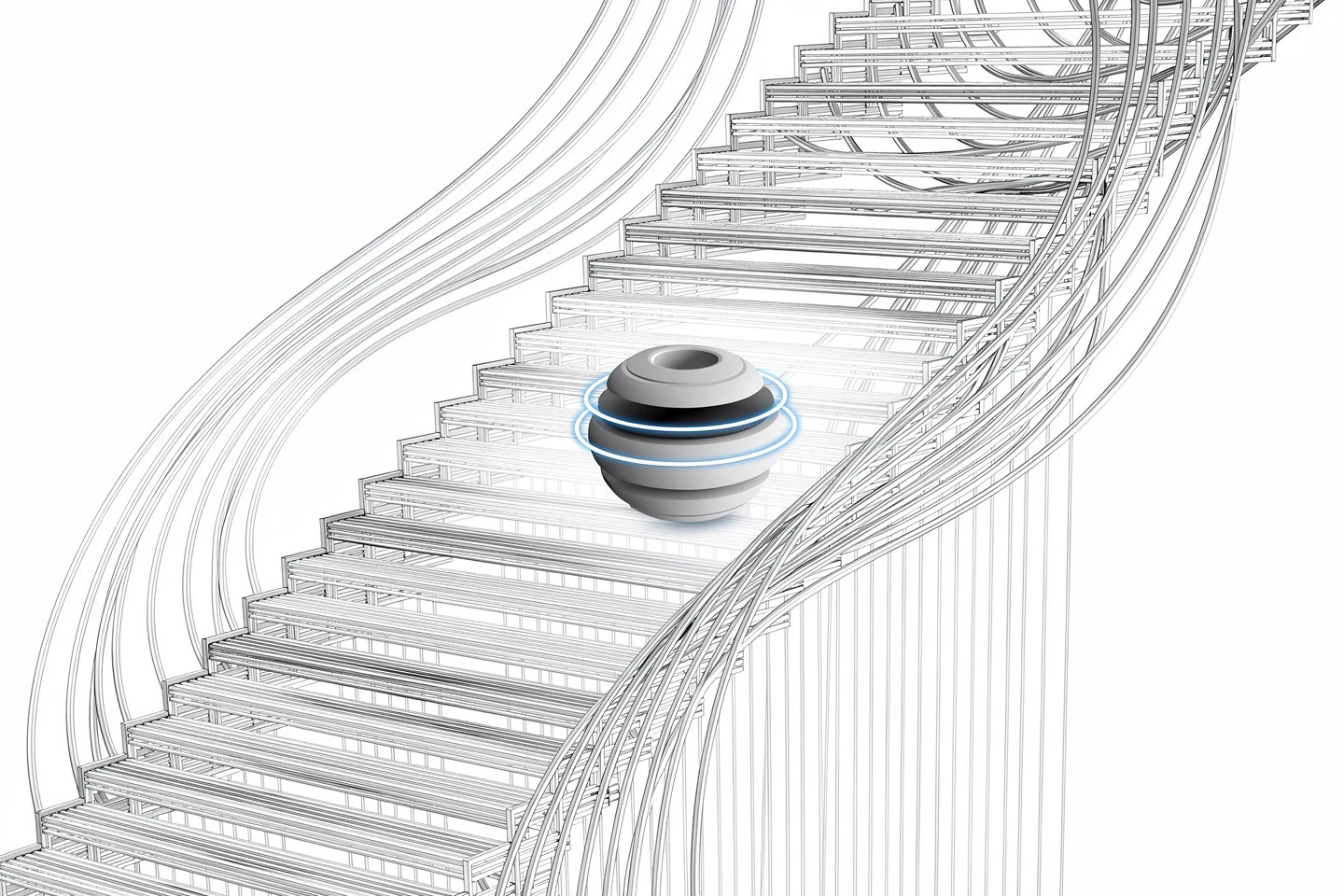
Imagine a layered cocktail: thick syrup at the bottom of the glass, light juice on top. If you gently warm the glass, the syrup stays put — the heat nudges the liquid to mix, but the syrup's high density prevents it from rising. Something similar, but on a colossal scale, happens deep inside giant planets. Jupiter and Saturn consist mostly of light gases, hydrogen and helium, but their centers harbor heavier elements like water and carbon, possibly delivered by comets and asteroids early on. Probe data show that the cores of these planets lack a sharp boundary; instead, they are smeared over thousands of kilometers. Scientists long thought that a peculiar type of convection, double diffusion, might gradually disperse heavy material from the core into the envelope, like a slow current.
New simulations traced the evolution of Jupiter and Saturn over 4.5 billion years. The computer code included the double-diffusion mechanism alongside ordinary convection, using a criterion formulated by Karl Schwarzschild. The result was modest: over the entire lifetime of the Solar System, Jupiter shed only about 0.1 Earth masses of heavy stuff, and Saturn even less. Even when the mixing was artificially boosted a thousandfold, the cores barely slimmed down — by just one or two Earth masses at most. The reason is that the interiors of gas giants are heavily compressed, and any motion of particles against gravity drains almost all of the planet’s thermal energy. As astrophysicist Subrahmanyan Chandrasekhar once pointed out, under such conditions mixing simply shuts off, and entropy (disorder) hardly increases.
So the blurring of heavy elements we see today is not the result of slow, gradual mixing but a legacy of a violent youth. Either early accretion (the clumping of material during planet formation) itself created extended gradients, or rare cataclysms, such as head-on collisions with bodies ten Earth masses in size, mixed everything all at once. This discovery matters beyond our home: billions of exoplanets in the Galaxy might also have such “unfinished” cores. In the future, with the help of atmospheric spectroscopy of distant worlds, we may check how often traces of unmixed interiors appear. For now, the puzzle of layered planets gets a little clearer.
The idea of the double-diffusive “staircase” came from oceanography: there, layers of water with different temperature and salinity form step-like profiles that can be observed in the ocean depths.