Baryon acoustic oscillations are periodic density perturbations of baryonic matter in the early Universe, generated by acoustic waves in the photon-baryon plasma before recombination. The waves had a certain maximum length — the acoustic horizon (about 150 Mpc in current units), which after recombination became a standard ruler. In galaxy distribution, this manifests as a slight increase in the probability of finding two galaxies at a separation of ~150 Mpc. By measuring this scale at different epochs, cosmologists refine the parameters of the Universe's expansion and dark energy.
History
The concept of sound waves in prestellar matter dates back to work by Evgeny Lifshitz (1946) on gravitational instability. In the 1970s, Jim Peebles and Yuri Zeldovich predicted that these waves would leave an observable trace. The first convincing detection of the BAO peak was made in 2005 by the SDSS collaboration using a sample of red galaxies. Research on nucleosynthesis by George Gamow and Ralph Alpher played a key role in determining the composition of the primordial plasma, which allowed calculation of oscillation parameters.
How it works
Before recombination, baryons and photons are tightly coupled by scattering. Gravitational potentials of dark matter attract the baryon-photon fluid; compression increases photon pressure, causing a rebound — this is an acoustic wave. Its speed is determined by the density ratio of baryons to photons: c_s = c / sqrt(3(1+R)), where R = 3ρ_b/4ρ_γ ≈ 0.6 at recombination. By the time of deionization, different oscillation modes freeze in various phases, creating a series of peaks in the power spectrum. The dominant peak corresponds to the wave that traveled a distance r_s ≈ ∫ c_s dt / a(t) from the Big Bang to recombination. Today this scale is seen as a preferred distance between galaxies. Measuring the BAO peak in radial and transverse directions yields the Hubble parameter H(z) and angular diameter distance D_A(z), which is critically important for testing dark energy models.
In practice
Serve as a standard ruler for measuring cosmic distances and the expansion rate of the Universe, helping to uncover the nature of dark energy.
Fun fact
The speed of sound in the primordial plasma reached 57% of the speed of light — faster than any modern sound in matter.
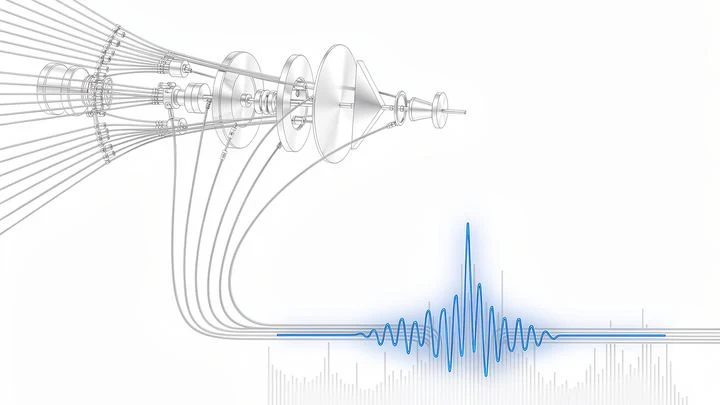
Picture a radio receiver with a single tuning knob that moves all of its internal coils at once, like one living organism. That is exactly how a new instrument for the search for the axion works, a particle that may fill galaxies with invisible mass. Inside a copper cylinder the height of a coffee can sit rods of aluminum oxide.
Galaxy Mrk 590 behaves like a radio receiver that sometimes picks up a signal and sometimes fades into static. Its supermassive black hole has been brightening and dimming for decades, and astronomers caught every such 'switch-on.' In 2017, the receiver came alive again, but the VLA radio telescope heard not the signal they expected.
On Mars, as on Earth, the air breathes: pressure rises and falls in rhythm with the daily tide — a wave heated by the Sun. But hidden in the InSight recordings was another, weaker wave. It's like an echo that gets lost in the loud sound of the main tone.
This weak wave is called a Kelvin wave. It circles the planet like ripples on water from a thrown stone.
An archaeologist carefully brushes away layer after layer, and each new stratum at the charmonium dig is a rare decay captured by the detector. Charmonium — a bound state of a charm quark and its antiquark — lives for mere fractions of a second, yet it manages to tell us about the forces that hold quarks together.
The Sun has quiet regions where the magnetic field is barely visible. But even there, sound waves find loopholes to rise higher. These loopholes are magnetic tubes that expand upward like funnels. Inside them, sound travels more freely.
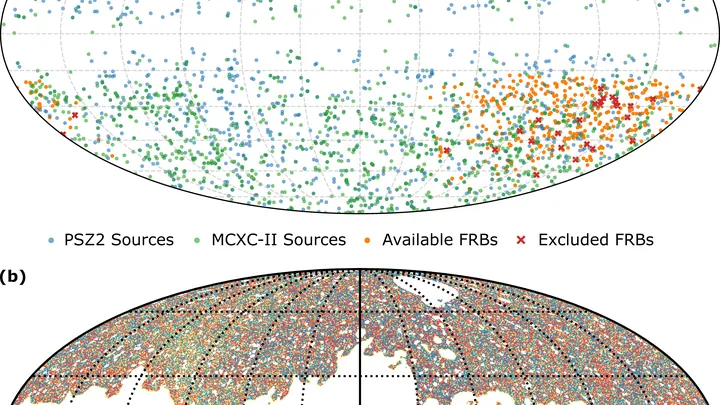
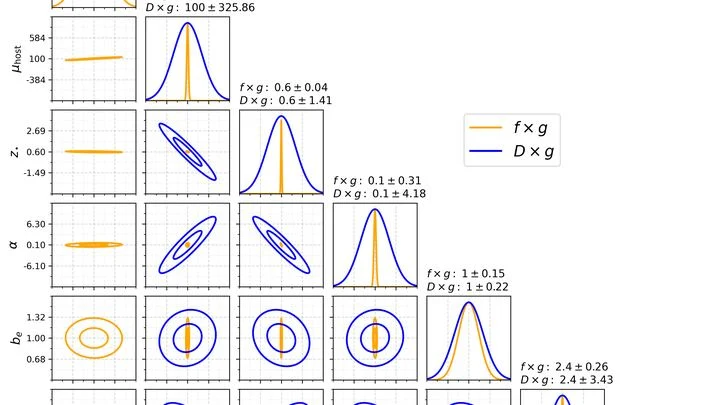
The night sky looks smooth, but it's actually clumpy — vast communities of galaxies that bend light from distant objects like lenses. When a short, powerful radio burst goes off somewhere in the universe, its path to an Earth telescope can pass near such a clump.
An accountant tallies up all the factories, warehouses, and shops, but the balance doesn't add up — half the inventory seems to have evaporated. That's roughly how astronomers have spent decades searching for ordinary matter in the present-day Universe.
In the first instants after the Big Bang, the universe expanded faster than light could cross it. Like an inflating balloon, but instead of rubber, it was space itself. On this balloon, ripples inevitably formed — tiny compressions and rarefactions from which all galaxies and stars later grew.
When you blow up a balloon too quickly, its surface starts to quiver. Something similar happened to space in the first moments after the Big Bang: the universe expanded rapidly, and the very fabric of space began to ripple.
The calm surface of a lake suddenly ripples — somewhere in the depths, an underwater cliff has collapsed. The water trembles almost imperceptibly, and the circles spread wider and wider until they reach a bobber near the shore.
In the first moments after the Big Bang, the universe resembled a boiling cauldron. According to one hypothesis, dark matter, the invisible substance that holds galaxies together, could have been born there.
The hot broth of the early universe seethed with particles and antiparticles. They were born and died in pairs, and by all laws of symmetry should have annihilated each other completely. But something went wrong, and a tiny excess of matter survived. From it, stars, planets, and we ourselves later assembled.
Physicists call this imbalance baryon asymmetry.
A gravitational wave from a black hole merger is like a bell tolling in the night. The loudness tells you how far away the source is. But to learn how fast the night itself, the cosmos, is expanding, you usually need a second signal: a flash of light or a catalog of galaxies. Both are rare to catch.
Betelgeuse, the red supergiant familiar from Orion's shoulder, keeps surprising us. After the mysterious Great Dimming of 2019–2020, when the star suddenly dimmed, it didn't just recover; it changed its ways.
The very first moment of the universe's existence is like a taut string suddenly struck. It vibrated, and those oscillations froze into galaxies and voids. But physicists suspect there were other vibrations — fast, local, almost like a drumroll against a slow melody.
A noisy café. You're trying to make out two quiet conversations: one from the table by the window (black hole mergers), the other a barely audible whisper from the far corner (echoes of the universe's birth). But the hiss of the espresso machine and street noise (detector jitter) drown everything out. New work teaches a computer to separate these sounds.
A bright lantern in thick fog seems dim, while a weak flame in clear air can be seen a kilometer away. A similar oddity baffled astrophysicists almost half a century ago.
The universe right after the Big Bang was like a boiling cauldron: bubbles of a new state of matter were bursting and growing everywhere. These were first-order phase transitions — exactly like water boiling, only at temperatures reaching trillions of degrees.
A fast radio burst is a short but powerful flash of radio waves from deep space. As it travels to us, the signal passes through clouds of tenuous gas, and the more gas it encounters, the more the signal is smeared across frequencies. Astronomers call this delay the dispersion measure — essentially, it's a "weighing" of all the matter along the line of sight.
In the first fractions of a second after the Big Bang, the universe was a stage of rapid change. A stretched rubber sheet that cools quickly becomes covered with microscopic cracks. A similar process on a cosmic scale could have given rise to cosmic strings — ultra-thin but super-dense threads of energy stretching across the entire universe.
These strings are not just defects in space.
The first moments after the big bang: space expands rapidly — physicists call this period inflation. Inside this swelling fabric, like soap bubbles in a stream of air, regions of new vacuum begin to form — a first-order phase transition. Most bubbles pop or merge as soon as they appear.
A thrown stone sends ripples across water. A gravitational wave is the same kind of ripple, but in spacetime. It is produced, for example, by the merger of two black holes. In classical physics, this ripple is eternal: once created, it travels through the Universe without fading.
The universe rang piercingly in its first moments. During the inflation epoch, when space expanded faster than light, energies were monstrous — trillions of times higher than in the Large Hadron Collider.
In the first moments of its life, the universe resembled a boiling cauldron. Matter wasn't spread evenly — clumps and voids were brewing within it, and their violent motion gave rise to a trembling of space itself: gravitational waves.
Light from quasar J0744+2052 traveled to us for almost 12 billion years. Along the way, it bumped into hydrogen clouds that snatched individual lines from the spectrum — like a comb sifting through delicate frequencies. Astronomers call this pattern the Lyman-alpha forest in spectroscopy.
A massive aluminum cylinder weighing a ton hangs in a vacuum. A gravitational wave, a ripple in spacetime, passes through it, and the bar begins to tremble almost imperceptibly. That trembling can be heard as sound: gravitational waves turn into a phonon — a quantum of sound vibrations.
The early Universe was like a rapidly cooling ocean. At colossal temperatures, everything was one — quarks, electrons, forces all blended into a symmetric 'steam.' But as it expanded and cooled, this steam condensed, phase transitions cascading one after another like water turning to ice.
Eight bright spots on the radio sky. They are all the same quasar HS 0810+2554, whose light passed through a gravitational lens — a massive foreground galaxy.
In the first moments after the Big Bang, cosmic symmetry breaking divided the hot plasma into regions with different vacuums — the lowest energy states of a field.
2.1 × 10⁻⁹ — that's the temperature variation across the sky, about the same as measuring ripples a fraction of a millimeter high on the ocean surface. This microscopic non-uniformity is imprinted in the cosmic microwave background and tells the story of the very beginning of time.
A cold, black mirror — that's what the sea of dark energy, the invisible substance driving the expansion of the universe, looked like for billions of years. But the DESI spectrograph has caught a faint ripple.
Inside a supercomputer, fifteen stable wave clumps — solitons — collide to form a halo of dark matter. These waves obey an equation that Erwin Schrödinger derived for electrons at the beginning of the 20th century, but now they paint a portrait of a giant galactic cocoon.
13.8 billion years ago, the universe swirled in a waltz. The right turn was forbidden. Today, the echoes of that cosmic ball reach us as a barely perceptible ripple in spacetime — gravitational waves. Their existence was predicted by Albert Einstein.
A tiny satellite, like a swimmer, cuts through invisible layers of gas in the bloated envelope of a red giant. Each orbit excites an acoustic wake — compression waves traveling through plasma.
The Universe is a giant concert hall, where instead of walls and balconies, invisible clouds of dark matter float. This architectural ensemble is not static: it refracts and scatters the 'music' rushing through it — gravitational waves from merging black holes.
Picture the early Universe as an unimaginably large bell. Inflation — the era of rapid expansion, dreamed up by Alan Guth, strikes it, sending a wave rippling across the fabric of spacetime.
Gravitational waves from merging black holes sound like bass chords, pulsars tap out a rhythm, and the cosmic microwave background carries echoes of the Big Bang. But there is a silent player — dark matter, whose presence is betrayed only by gravitational effects.
A black hole merger is not a silent impact. The newborn hole quivers and decays, emitting gravitational waves — ripples in space itself. This signal is called the 'ringdown,' and it resembles the fading chime of a bell: it has a fundamental tone and several overtones.
The Universe has been singing its majestic symphony of expansion for almost 14 billion years. Astronomers, like orchestra tuners, catch its harmonics — the redshift of distant galaxies, following the discovery of Edwin Hubble and the theoretical insight of Georges…