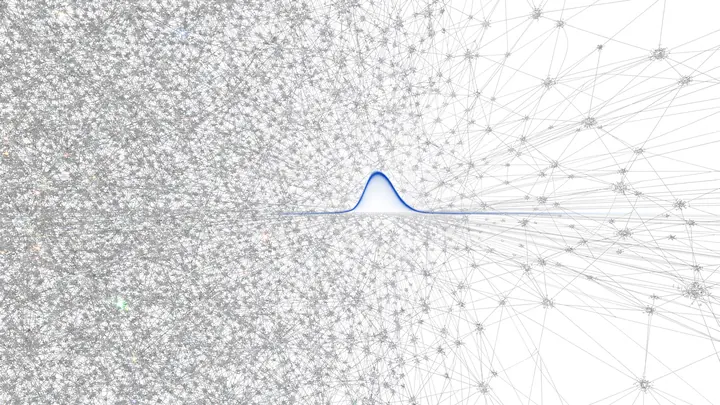
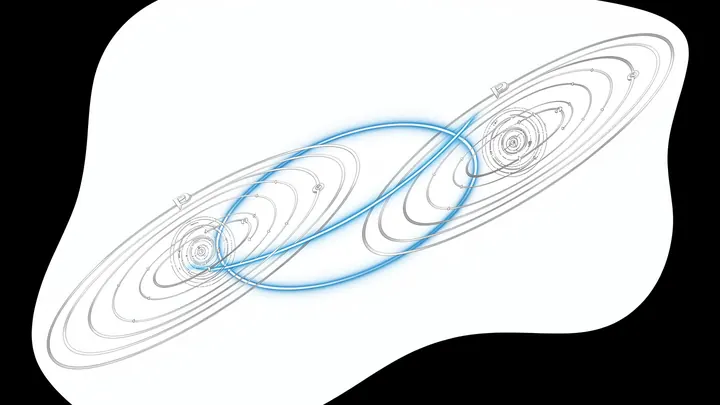
The Dark EnergySpectroscopic Instrument (DESI) is a powerful ground-based survey that measures the light from tens of millions of galaxies and quasars to create the largest three-dimensional map of the universe. Its primary goal is to understand dark energy, the mysterious force driving the accelerated expansion of the cosmos. By observing how galaxies cluster at different distances, DESI traces the growth of cosmic structure and the expansion history of the universe with unprecedented precision.
History
DESI is a successor to earlier surveys like SDSS and 2dF, which pioneered large-scale galaxy redshift mapping. It began its main survey in 2021 and has already produced major results, including hints that dark energy may not be constant.
How it works
DESI uses 5,000 robotic fibers to capture the spectra of galaxies simultaneously, measuring their redshifts. The redshift indicates how fast a galaxy is receding, which, combined with its distance, reveals the expansion rate of the universe at different epochs. By comparing these measurements to theoretical models, scientists can infer the properties of dark energy, such as whether its density is constant or changes over time.
In practice
DESI's data helps refine cosmological models, which are used to interpret other observations like the cosmic microwave background and supernovae, and to understand the ultimate fate of the universe.
Fun fact
DESI's robotic positioners can reposition all 5,000 fibers in under two minutes, allowing it to capture spectra of thousands of galaxies every hour.
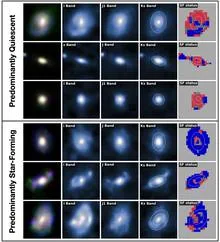
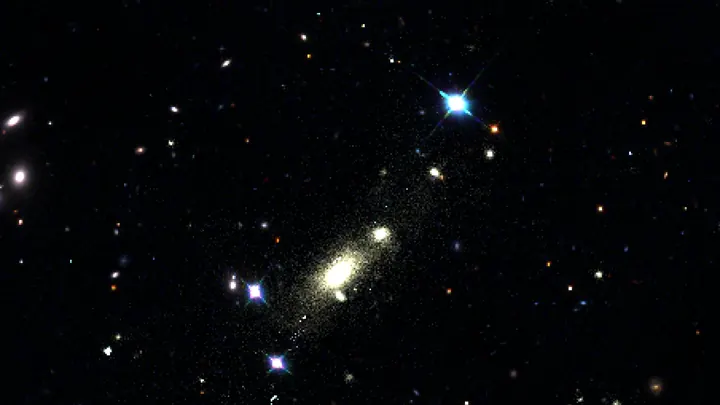
A ground-based image of a distant galaxy looks like a view through frosted glass: the atmosphere smears details, hiding the internal structure. Astronomers have long wanted to know where exactly star formation shuts off in galaxies, but ground-based telescopes could not resolve the subtle color gradients.
Imagine a huge stadium packed with people dressed in black. You're standing outside, trying to figure out what's happening inside, even though you can't see a single person. But if two people bump into each other and exchange bright T-shirts, you'd spot a flash of color.
A gravitational wave from a black hole merger is like a bell tolling in the night. The loudness tells you how far away the source is. But to learn how fast the night itself, the cosmos, is expanding, you usually need a second signal: a flash of light or a catalog of galaxies. Both are rare to catch.
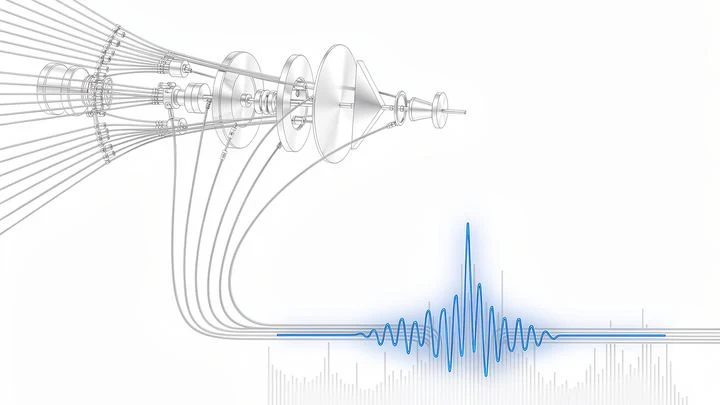
Five thousand robotic fingers of the DESI spectroscopy reach toward the telescope's focus. In a single night, they record one hundred thousand light signatures. Hidden among these records are binary star systems with white dwarfs — cataclysmic variables.
380 thousand years after the Big Bang, the universe cooled enough for light to decouple from plasma. That cosmic microwave background still pervades space, like the first chord of a symphony, the echo of a fiery beginning.
A cold, black mirror — that's what the sea of dark energy, the invisible substance driving the expansion of the universe, looked like for billions of years. But the DESI spectrograph has caught a faint ripple.
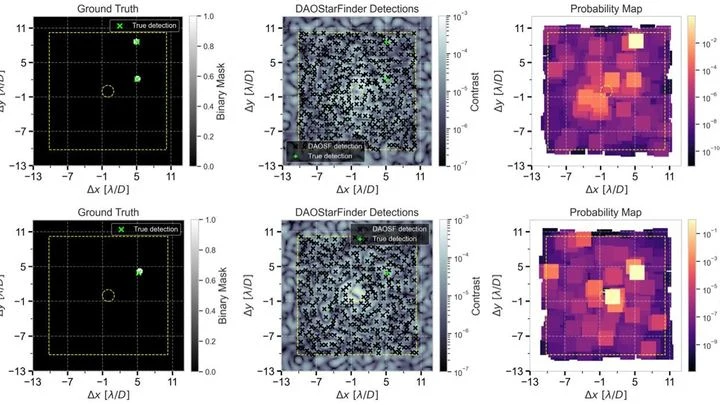
A pebble on a streambed lies still as sunlight sparkles dance on the water's surface. In astronomy, the contrast is similar: a real exoplanet is the stone, while myriad speckles (patches of scattered starlight) are the ripples trembling in instruments.
The Universe has been singing its majestic symphony of expansion for almost 14 billion years. Astronomers, like orchestra tuners, catch its harmonics — the redshift of distant galaxies, following the discovery of Edwin Hubble and the theoretical insight of Georges…
Decades of radio astronomy have listened to space, hoping to catch narrowband radio transmissions — the technogenic 'voice' of distant exoplanets. But our own technological evolution reveals a paradox: loud analog signals, like 1960s TV broadcasts, are just a brief squawk of a newborn civilization.
A drama is brewing in cosmology: two principal musical instruments, the orchestra of the early Universe and the chamber ensemble of the modern cosmos, play the same symphony of expansion at different tempos.
The Universe is a giant labyrinth of curved mirrors. The mass of galaxies and clusters distorts the light of distant quasars, as if toying with our perception of the cosmos. Hidden in this hall of mirrors is the key to the greatest mystery: dark energy, which is pushing space apart ever faster.
The Universe is an orchestra playing the symphony of the Big Bang. For a long time, the conductor was thought to be dark energy — an unwavering metronome setting the pace of expansion.
In the late 1990s, the night sky delivered a surprise: Saul Perlmutter and Adam Riess found that the expansion of the Universe is accelerating. Ever since, the greatest riddle has been dark energy — a substance making up nearly 70% of the cosmos, yet evading laboratory study.
Einstein’s cosmological constant — a blunder or a boomerang insight? The universe’s acceleration caught physicists off guard: ΛCDM works, but why is the vacuum energy so absurdly tiny? Imagine an ocean heaving with quantum fluctuations, yet on the surface only a microscopic ripple.
The universe is expanding at an accelerating rate, like dough that keeps rising faster even though the yeast ran out long ago. For twenty years, astronomers have been searching for the cause and call it dark energy. But what it is remains a mystery.
New work proposes an unexpected source: the vacuum inside the atomic nucleus.
For decades, two independent methods of measuring the rate at which galaxies are flying apart, the Hubble constant, have given conflicting numbers. The situation resembled a room with two thermometers showing different temperatures.
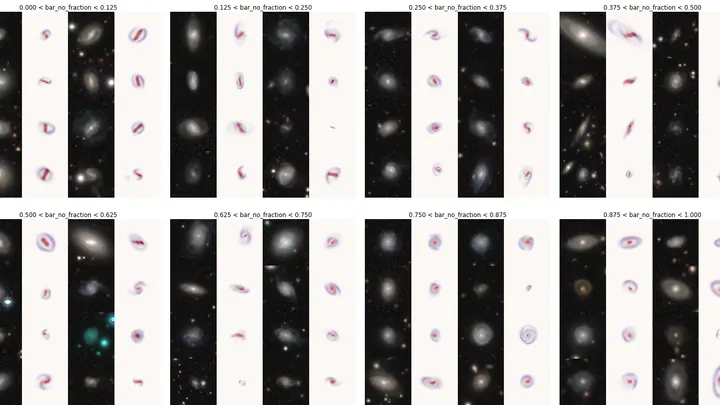
An ordinary photo editor highlights objects in an image. The ZooBot:3D neural network works with distant galaxies like a cartographer drawing a map of an unexplored land.
The Universe grows like a metropolis: galaxies skyscrapers are erected on an invisible scaffold of dark matter: its gravity pulling in construction material. Meanwhile, dark energy makes the city itself continuously expand.
The Universe resembles a dense forest: up close, individual galaxy-trees are visible, gathered into groves, but from a distance everything merges into a solid green canopy. The boundary beyond which the cosmos becomes homogeneous is called the angular scale of homogeneity: it's the size of a patch of sky from which galaxies are distributed evenly.
In the late 1990s, astronomers including Saul Perlmutter discovered that the universe is expanding at an accelerating rate. The cause was dubbed dark energy — an invisible force stretching the cosmos.
Astronomers build maps of galaxies and listen to the radio whisper of neutral hydrogen. The signal is so faint that even a working TV would drown it out, but sensitive antennas pick it up from the depths of the Universe.
Imagine a huge layered cake, where the layers of dough are space and the filling is a special region resembling an invisible wall. This wall is not made of bricks but of energy, and it could be as thick as the entire universe. If such a wall exists, it should stretch the dough layers differently: those lying along it spread apart faster, while those across it spread slower.
When a car on cruise control hits a bump, the speed jumps for a moment, but the engine runs smoothly. Something similar was recently noticed with dark energy — the force that makes the Universe expand faster and faster.
For a long time, dark energy, the mysterious force prodding the expansion of the Universe, was considered eternal and unchanging, like yeast that never loses its activity. But explaining such constancy through the laws of the microcosm proved impossible, and scientists began to suspect that the “leaven” might be going flat.
Imagine inflating a balloon. It expands quickly at first, then slows down, and then suddenly speeds up again, as if someone gave the pump another squeeze. That's what seems to be happening to our universe.
The Universe performs a symphony in two contrasting tempos. The first explosive accelerando (inflation, conceived by Alan Guth) sent spacetime soaring in the first trillionth of a second. The second acceleration, slow but relentless, began five billion years ago.
A quantum dot is a trap for electrons, just a few atoms in size, where a particle behaves like a ball in a tiny box. Place two such boxes side by side, and electrons can hop between them, making the system akin to a pair of communicating vessels.
The universe is expanding faster and faster, and scientists blame it on dark energy. Its origin is explained in a new way: dark energy isn't eternal, but appears only after dark matter clumps together into lumps — future galaxies.
The mechanism works like a pump that turns on when pressure drops.
Images of distant galaxies are riddled with curved arcs and smears — light warped on its way to us. This effect, predicted by Albert Einstein, acts like a giant funhouse mirror: a massive galaxy cluster distorts the images of background sources.
Dark energy is usually seen as an innate property of the cosmos, at work from the very first moments. But a new model suggests it behaved like water on the verge of boiling: long unnoticed, then suddenly kicking in at a critical moment. This scenario is called 'late activation': around 5–7 billion years ago, a shift occurred, and the universe’s expansion began to accelerate.
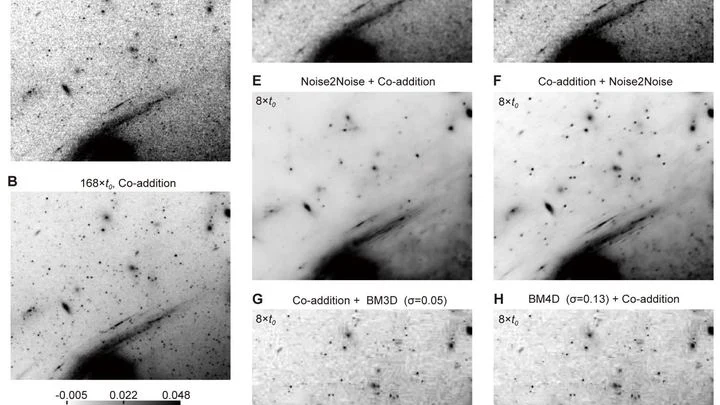
The night sky in a telescope image looks like a photo taken through a fogged-up window: bright stars are visible, but everything faint drowns in a murky haze. That haze is noise — random interference from electronics, heat, and the atmosphere itself.
Cosmic particles with energies millions of times greater than anything our accelerators can produce slam into the atmosphere and create a shower of secondary particles. This shower emits radio waves that antennas on the ground pick up. But the signal is weak: it's swamped by the radio noise of our galaxy and the receivers' own noise.
Galaxies are flying apart, but the expansion rate measured from the afterglow of the Big Bang and from supernova explosions doesn't match: this problem has been called the Hubble tension. It's like two dancers losing their rhythm because they can't feel each other.
A galaxy cluster's gravity warps spacetime, acting like a colossal lens: it focuses and amplifies light from distant objects, as predicted by Einstein. Such lenses are rare, but they let us glimpse what lurks at the edges of the cosmos.
When light from a distant galaxy travels toward us, dark matter along the way bends the rays slightly, like imperfect glass. Astronomers measure these distortions to understand where the invisible mass lurks. But galaxies also have their own, "intrinsic" distortions: they align not randomly but along the invisible threads of the cosmic web.