Why Even a Heavy Apparatus Trembles express
The quantum world loves balance. When a massive particle is forced to split, to go down two paths at once, something must give way in response. That "something" turns out to be the very apparatus that split the particle.
Imagine a heavy platform resting on soft springs. You give a sharp shove to a cart away from it in one direction — the platform recoils slightly in the other. It's the same here: the apparatus creating the superposition gets a microscopic recoil. Its center of mass shifts. If this shift is larger than the quantum uncertainty in the apparatus's position, the particle and apparatus become entangled. The particle's quantum coherence is lost — not due to noise or heat, but due to the very geometry of the experiment.
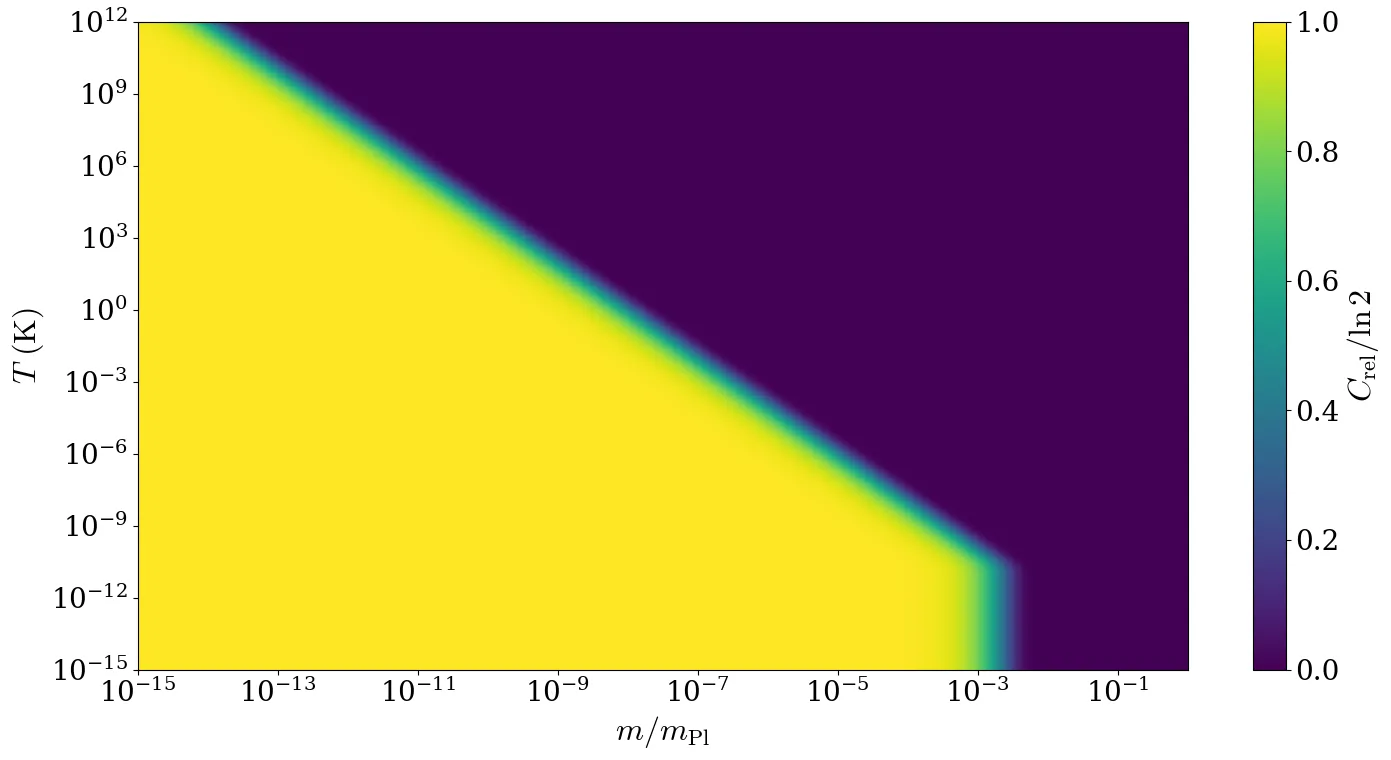
The authors derived a simple rule: to preserve a particle's superposition with spread $d$, an apparatus of mass $M$ must be either very cold or very rigidly bolted to the table. Otherwise, its trembling will smear the picture. Curiously, the constraint applies even for particles much lighter than the Planck mass and for quite massive apparatuses. For instance, in experiments on gravitational entanglement of two particles, the recoil of mirrors or traps could become a decisive hindrance.
This is not a death sentence but a guideline. Knowing the limit, you can calculate in advance what table, what cooling, and what rigidity are needed for the quantum dance to take place.
The Planck mass is about 22 micrograms — the mass of a grain of salt. All of "heavy" quantum mechanics so far works with masses billions of times smaller.