Molecularinterferometry is the experimental demonstration of quantum wave-like behavior in molecules, extending the classic double-slit experiment to objects composed of hundreds or even thousands of atoms. When a beam of molecules passes through a grating or an interferometer, the molecules interfere with themselves, producing a pattern that reveals their wave nature. This is a direct test of the quantum superposition principle at macroscopic scales, probing the boundary between the classical and quantum worlds. Such experiments also provide a sensitive probe of decoherence—the process by which interactions with the environment destroy quantum coherence—and can be used to measure molecular properties with extreme precision.
History
The first interference experiments with molecules were performed in the 1990s, with groups led by Anton Zeilinger and others demonstrating diffraction of fullerenes (C60) in 1999. Since then, the mass and complexity of interfering molecules have steadily increased, reaching molecules with over 10,000 atomic mass units by the 2020s.
How it works
In a typical setup, a beam of molecules is collimated and directed toward a diffraction grating—often a nanofabricated silicon nitride mask with periodic slits. The molecules are detected downstream, and their arrival positions are recorded. If the molecules behaved classically, they would form a simple shadow pattern, but quantum mechanics predicts an interference pattern of alternating bright and dark fringes. The fringe visibility depends on the molecule's de Broglie wavelength, which is inversely proportional to its momentum. To observe interference, the molecules must be cooled and their internal states controlled to minimize decoherence from thermal radiation or collisions. Advanced setups use Kapitza-Dirac scattering with laser light or Talbot-Lau interferometers with multiple gratings to enhance the effect.
In practice
Molecularinterferometry is used to measure molecular polarizabilities, magnetic moments, and internal energy levels with high precision, and it informs the design of matter-wave sensors for inertial navigation and gravitational field mapping.
Fun fact
In 2019, researchers interfered molecules made of over 2,000 atoms, each molecule containing more than 100 carbon atoms, and the interference pattern remained visible—demonstrating that quantum superposition survives in objects far larger than single particles.
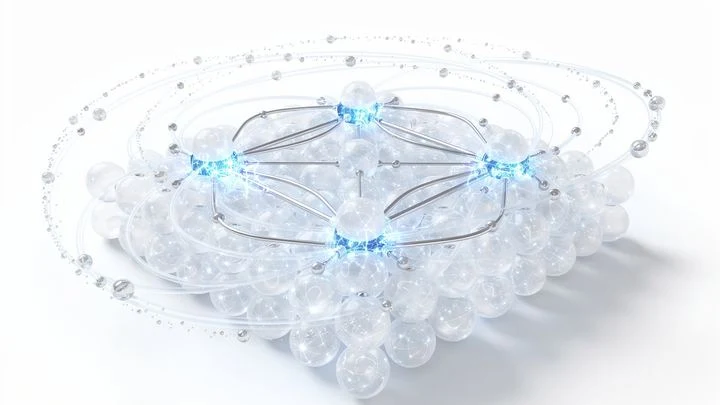
A layered cake of molybdenum disulfide MoS2 sits on the lab bench. It is prepared in the usual way: adhesive tape peels off the top layers to obtain a thin sample. But beneath the tape remains an invisible cavity where the atomic floors are no longer pressed together. It is there that electrons begin to behave differently than in the crystal bulk.
At night on a volcano summit, six telescopes stare at the same speck of light. Each catches its own copy of the wave, and if you combine their signals, you get an image that no single instrument could produce alone. But there's a catch: light captured by different stations cannot simply be added like photographs.
The two states of a strontium atom are like twins running down the same track, but one is slightly higher than the other. Usually, the light used to manipulate atoms pushes one twin harder and the other more weakly. Here, they chose a wavelength of 813 nanometers—'magic'—where both get the same kick.
In a hall with a thousand spectators, applause blends into a general noise, but if someone falls out of rhythm — a ripple runs through the crowd. The quantum world works similarly: atoms in a trap can behave as a single whole, or they can fall apart into independent individuals.
The quantum world loves balance. When a massive particle is forced to split, to go down two paths at once, something must give way in response. That "something" turns out to be the very apparatus that split the particle.
Drop two pebbles into a pond at the same time — the ripples will spread evenly and in sync. The same happens in a quantum interferometer: a particle is split into two waves that travel along different paths and then meet. Ideally, their crests align.
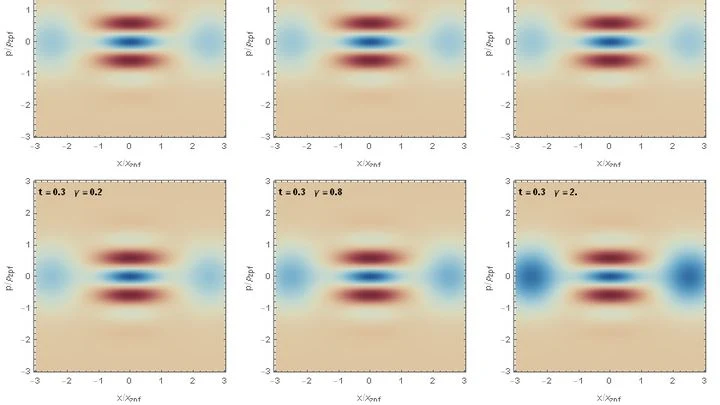
Even at absolute rest, atoms emit a faint noise — unavoidable quantum jitter. In the debates between Einstein and Bohr, this noise, like an unceasing whisper, blurs the interference fringes from an atomic slit. Overcoming this limit was considered impossible.
A coffee whirlpool can span two spots in a cup — a blur of swirling liquid. Quantum particles behave similarly: a spacetime whirlpool where they exist in two places at once. But gravity acts as the spoon that stirs the fabric of space and time.
Sunlight hits a silicon wafer, and a current flows in the circuit. That's the familiar work of a solar cell: light knocks out electrons, and a p–n junction (the boundary between two layers with different conductivities) forces them to move in one direction. But in some crystals, current arises differently — without any junctions, purely from the material's internal structure.
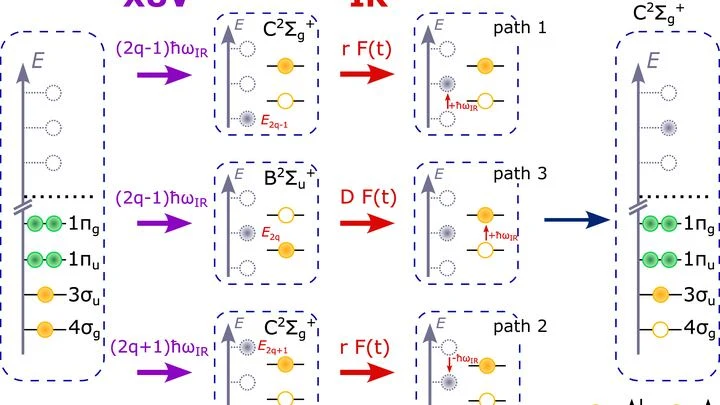
A high-speed camera capable of capturing the motion of electrons is an attosecond interferometer. It sends two laser pulses at a substance with a tiny delay. The first, ultraviolet, acts like a flash, knocking an electron out of the molecule. The second, infrared, like an invisible hand, gently nudges or slows this electron in flight.
A laser beam hits an atom, and an electron is knocked loose. It accelerates, returns, and, crashing into the atom, emits a flash of light — a harmonic. If there are two light beams and they are crossed like an intersection, the electron can choose different routes. In the new experiment, the two beams had comparable strength and were directed at right angles.
A security guard needs to check five rooms but can't go inside. He knocks on the door and listens: silence means someone is inside, while an echo means the room is empty.
Galileo, legend has it, dropped balls from the Tower of Pisa to prove that heavy and light objects fall equally. This law formed the foundation of Einstein's theory of gravity. Today, scientists have turned an entire space station into such a tower.
When an aircraft is on final approach or a submarine is navigating blind, the navigator needs an instrument that never loses track of motion. Conventional gyroscopes based on atomic waves are extremely precise, but they have a quirk: the signal repeats like a wallpaper pattern, and after half a step, the pattern starts to look the same. The instrument loses its sense of position.
Normally, electric current is the same in both directions, like water in a straight pipe. But at the boundary between a normal metal and a superconductor, this rule breaks down. Two waves on water, going around a wide obstacle from different sides, can arrive with different delays and meet ‘out of step’.
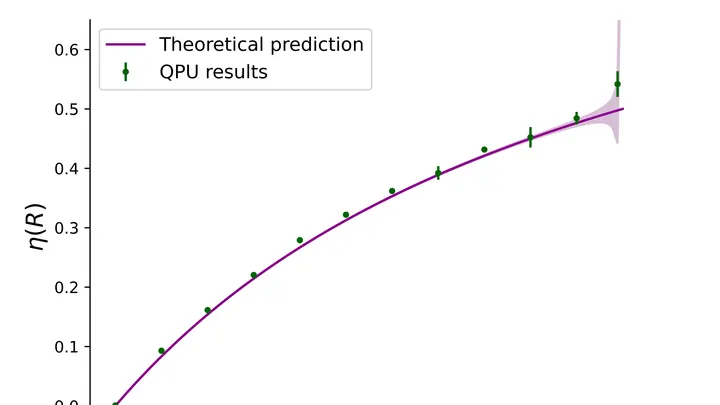
A tuning fork rings dully when it strikes a crack. That principle scales up in this experiment: physicists turned molecules into an ultrasensitive tuning fork to eavesdrop on the electron's asymmetry.
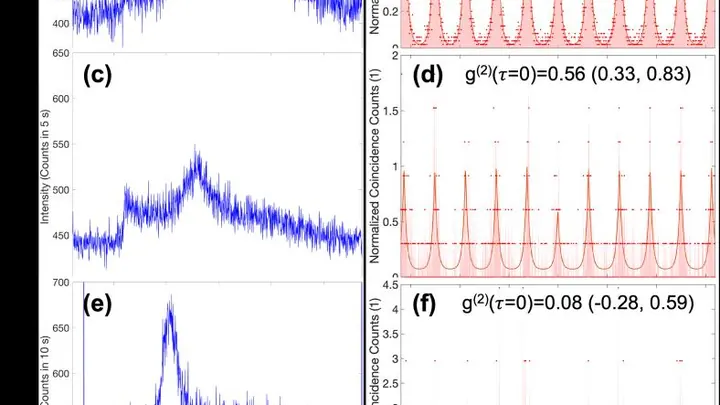
The light from a single molecule is like a lone voice in a vast choir. To hear it, you need not a microphone but a delicate instrument that catches each photon and notes its arrival time.
Drop two pebbles into a pond: each sends out ripples, and on the water you'll see crests where waves reinforce each other and troughs where they cancel. Protons behave much the same way: when there are two, they create a double ripple that adds up into a recognizable pattern.
Light from a single source can be made to 'meet' itself, and then fringes appear on the screen, like ripples from two pebbles dropped into water. Physicists have long known how to do this with two photons, but making four particles of light merge at once was tricky: single-photon sources lost too many particles along the way.
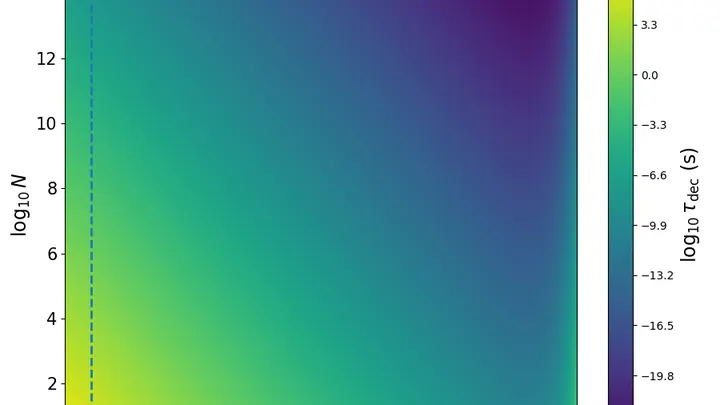
A quantum particle can be in two places at once, but large objects never are. Is it noise that creates chaos and increases entropy? Or does nature itself forbid quantum tricks in the macroworld?
One hypothesis suggests that quantum 'fuzziness' disappears on its own, and the heavier the object, the faster it goes.
On an ordinary optical table, amid lasers and mirrors, a cloud of a hundred strontium-87 atoms begins to live by the laws of curved spacetime. Half a second later, its quantum interference fades: gravitational time dilation destroys the superposition.
In 1963, a Tanzanian schoolboy named Erasto Mpemba noticed that hot ice cream freezes faster than cold. That paradox, named after him, long remained a subject of debate in classical thermodynamics. Now the quantum world offers its own version: a state with more strongly broken symmetry can recover it faster than a less broken one.
Six barium ions lined up in a flat hexagon inside a Paul trap, a device that holds charged particles with oscillating electric fields. But a slight change in the shape of the trapping potential made the crystal rearrange: one ion moved to the center, and the other five formed a ring around it.
Picking up an ultraweak microwave signal is like trying to hear a whisper in a storm. Rydberg atoms, inflated to the size of bacteria, promise to become perfect antennas. But there's a fatal catch: during optical readout, up to 98% of messenger photons vanish without a trace in the detector.
Niels Bohr insisted: you cannot simultaneously know which path a photon took and see interference. For a long time, this was considered a limitation of knowledge — we simply cannot obtain both types of information at once.