The measurement problem is a central puzzle in quantum mechanics: when a quantum system is measured, its wave function—a superposition of all possible states—apparently 'collapses' into a single definite outcome, but the theory does not specify how or why this happens. This issue challenges our understanding of reality, as it suggests that the act of observation plays a fundamental role in determining physical properties. It has profound implications for the interpretation of quantum mechanics, from the Copenhagen interpretation to many-worlds and objective collapse theories.
History
The problem was articulated in the 1920s and 1930s by the founders of quantum mechanics, including Niels Bohr and Werner Heisenberg, who proposed the Copenhagen interpretation. John von Neumann formalized the measurement process in 1932, and later, in 1957, Hugh Everett III proposed the many-worlds interpretation to avoid collapse altogether.
How it works
In standard quantum mechanics, a system evolves deterministically according to the Schrödinger equation, which predicts a superposition of states. However, upon measurement, the system appears to randomly 'choose' one outcome, with probabilities given by the Born rule. The problem is that the equation does not describe this transition; it is simply postulated. Proposed resolutions include decoherence (interaction with the environment suppresses interference, but does not fully solve the problem), or modifying the dynamics with spontaneous collapse mechanisms, as in the GRW theory.
In practice
Understanding the measurement problem is crucial for developing quantum technologies, such as quantum computing and quantum cryptography, where measurement errors and decoherence must be controlled. It also guides experimental tests of quantum foundations, like those probing the boundary between quantum and classical behavior.
Fun fact
Recent experiments with macroscopic objects, like tiny mirrors and superconducting circuits, are testing whether gravity might cause wave function collapse, which would resolve the measurement problem by making it a physical effect rather than a conceptual one.
Two dancers on the same stage mirror each other's moves even when a curtain separates them. In the quantum world, such pairs are called entangled, and physicists have spent half a century probing how far this connection reaches. Until now, all tests with massive particles concerned their internal properties, such as spin, but not their motion itself.
At night on a volcano summit, six telescopes stare at the same speck of light. Each catches its own copy of the wave, and if you combine their signals, you get an image that no single instrument could produce alone. But there's a catch: light captured by different stations cannot simply be added like photographs.
A handful of coins drops onto a table — heads and tails land wherever they please. The same goes for an instantaneous snapshot of a quantum chain: in some places a particle is present, in others it is not. But behind the disorder lurks a precise angle.
In this work, a chain of particles closed into a ring was considered. It was divided into four arcs: two were measured, two were left untouched.
In a hall with a thousand spectators, applause blends into a general noise, but if someone falls out of rhythm — a ripple runs through the crowd. The quantum world works similarly: atoms in a trap can behave as a single whole, or they can fall apart into independent individuals.
The quantum world loves balance. When a massive particle is forced to split, to go down two paths at once, something must give way in response. That "something" turns out to be the very apparatus that split the particle.
A compressed spring can sit for years without moving. It seems frozen forever, but inside the metal, atoms slowly rearrange, and one day the spring clicks, settling into a new, more relaxed position.
The quantum world is usually drawn with points, but real instruments only see blurry spots. Heisenberg and von Neumann long suspected: precision is unattainable.
In a football stadium, the crowd's emotions arise from the chatter of individual fans. If mood could be both joyful and sorrowful at once, you'd have a quantum superposition. But the murmur of thousands of voices instantly forces that blend into a single definite state.
If you carry a cup of coffee slowly and steadily around a room and then return to the same spot, nothing happens to the drink. But in the quantum world, things are different: a particle that makes such a loop comes back not quite the same. It picks up an elusive 'extra'—the geometric phase, which physicists call the Berry phase.
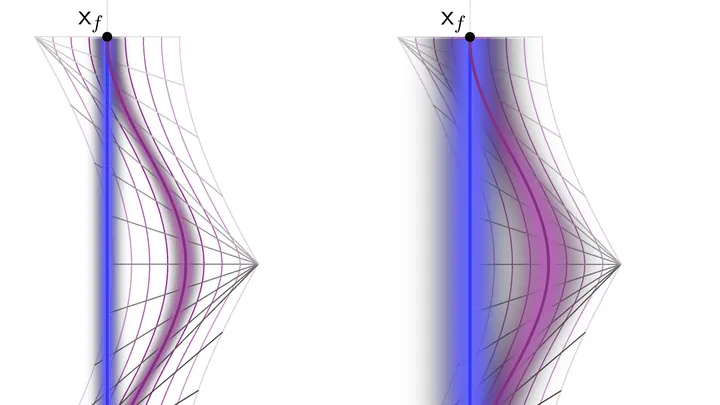
A coffee whirlpool can span two spots in a cup — a blur of swirling liquid. Quantum particles behave similarly: a spacetime whirlpool where they exist in two places at once. But gravity acts as the spoon that stirs the fabric of space and time.
A thrown stone arcs along a clean trajectory, but an electron's position in an atom is smeared out like fog. The transition from one to the other is a puzzle. New work shows that the fuzziness disappears not because of an observer, but because of the particle's own gravity.
The void can produce particles if a strong enough field is applied. Physicists call this the Dirac–Klein paradox. Previously, explaining it required the most complex calculations of quantum field theory. But we can make do with a visual image: a tightly stretched rubber band with a knot. The knot is a particle.
Two coins are flipped in different cities, but they always land the same way. Physicists call this entanglement: particles behave as if an invisible thread connects them. But what if the thread isn't instantaneous, just very fast — still not faster than light? Then some signal could slip between measurements, and the coincidences would be explained without any magic.
In quantum theory, a particle can run along two paths at once. When measured, we catch it on just one. According to Niels Bohr, all other possibilities vanish instantly — like a branch snapped off a trunk. Yet Hugh Everett insisted: the tree of reality grows all its branches at once, and we only see the one we’re on.
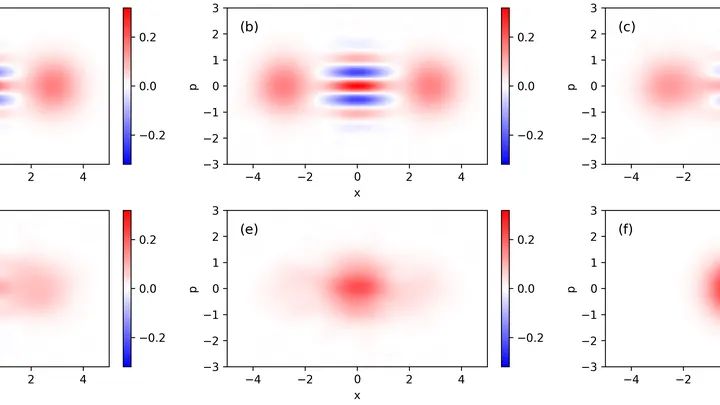
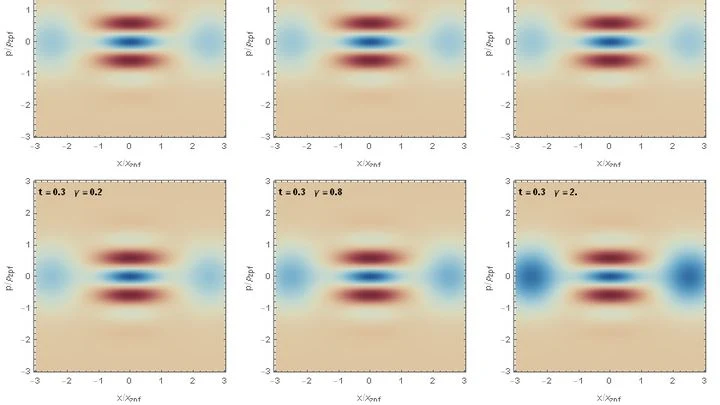
Light can be more than just a stream of particles; it can be a wave with a specific shape over time. Sometimes this shape changes so rapidly that capturing it is like photographing a bullet in flight. Scientists have devised a way to measure such fleeting quantum states of light.
For this, they use a device called a balanced homodyne detector.
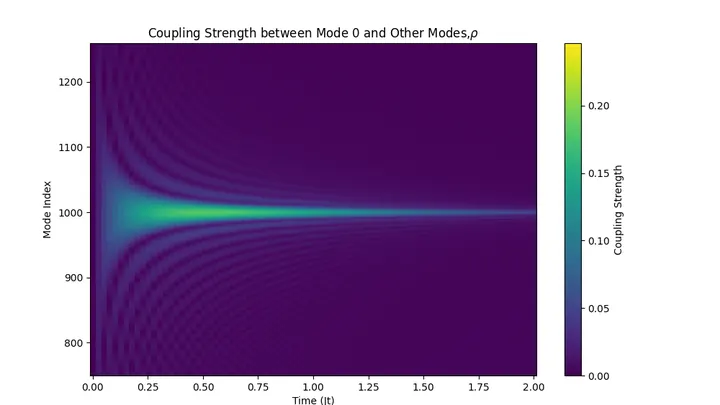
The quantum world is full of surprises: even simply observing a particle changes its behavior. In a new study, physicists showed that continuously measuring energy can make quantum chaos more pronounced. They used a quantity that indicates how long a quantum state remains similar to itself under repeated measurements.
Hot water sometimes freezes faster than cold — this is the Mpemba effect. In the quantum world, it’s even more astonishing: a system bubbling with disorder (with high entropy) can settle incredibly faster than one that is almost calm.
The solution lies in islands of silence within any system — regions untouched by the destructive noise of the environment.
Time is like a highway: from afar it looks flawlessly paved, but zoom in and every pothole appears. These bumps are the quantum fluctuations of the vacuum, making it impossible to measure the journey exactly. Physicists built a clock model whose operation relies on spontaneous particle creation from the void.
A quantum particle can be in two places at once, but large objects never are. Is it noise that creates chaos and increases entropy? Or does nature itself forbid quantum tricks in the macroworld?
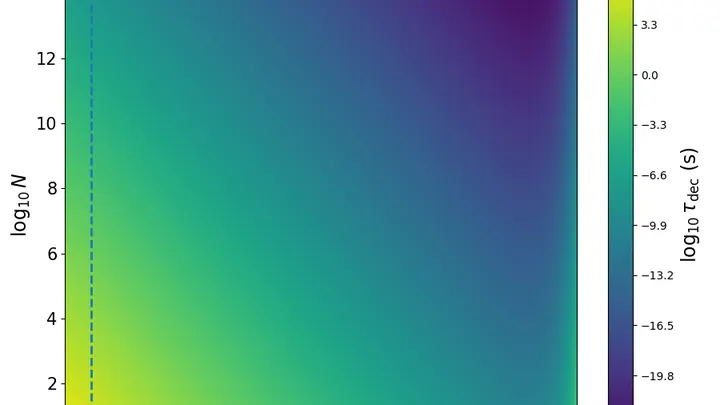
One hypothesis suggests that quantum 'fuzziness' disappears on its own, and the heavier the object, the faster it goes.
Two great theories describe reality: one — how massive bodies cause curvature of space, the other — the Standard Model — governs elementary particles. Reconciling them remains elusive, like trying to describe an ocean storm in the language of a diamond lattice.
A single photon passes through two slits and leaves an interference pattern on a screen. Quantum mechanics describes this process with a wave function, but what happens to the particle itself?
In September 2024, the concert hall in Linz had more than just an orchestra on stage. Next to the musicians, a setup was generating pairs of entangled photons: a laser with a wavelength of 405 nm passed through a nonlinear crystal and split into two photons at 810 nm, which flew off to two measurement stations, Alice and Bob.
Two muons are born in the decay of an eta meson and fly apart, linked by quantum entanglement. One experimenter, Alice, measures the spin of the negative muon, while another, Bob, records the direction of the positron from the decay of the positive muon. It would seem that the order of events should affect the correlations.
Quantum mechanics is a linear theory. This property is so fundamental that violating it would mean losing the superposition principle and, consequently, the possibility of superluminal information transfer. But physicists have long suspected that at a deep level, where gravity meets quanta, linearity might not survive.
A quantum state under continuous measurement is not a frozen picture but a random dance. Each measurement outcome nudges the state one way or another, and to predict the future you have to track the entire trajectory.