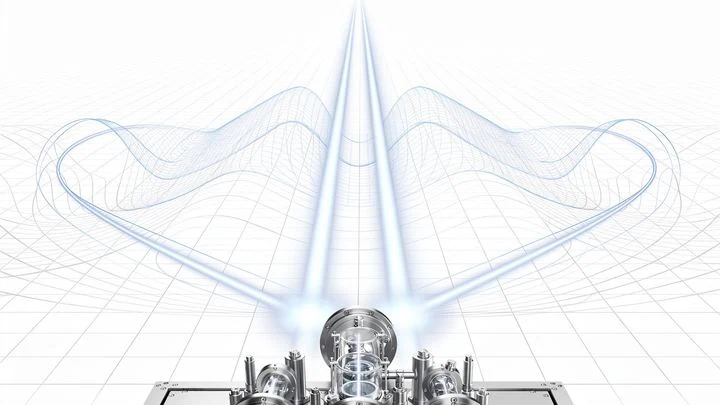
Gravitational entanglement is a hypothetical phenomenon where the gravitational field itself can create quantum entanglement between two or more particles, even if they never directly interact through any other force. In standard quantum mechanics, entanglement typically arises from direct interactions like photon exchange or contact forces. Gravity, however, is fundamentally different: it is a manifestation of spacetime curvature, and quantum gravity theories suggest that this curvature should have quantum properties. If gravity is indeed quantum, then two masses separated in space should become entangled purely through their gravitational influence, a signature that would prove gravity is not a classical field but a quantum one.
History
The concept was formalized in a 2017 proposal by Sougato Bose and, independently, by Chiara Marletto and Vlatko Vedral, who suggested tabletop experiments to test the quantum nature of gravity through entanglement generation.
How it works
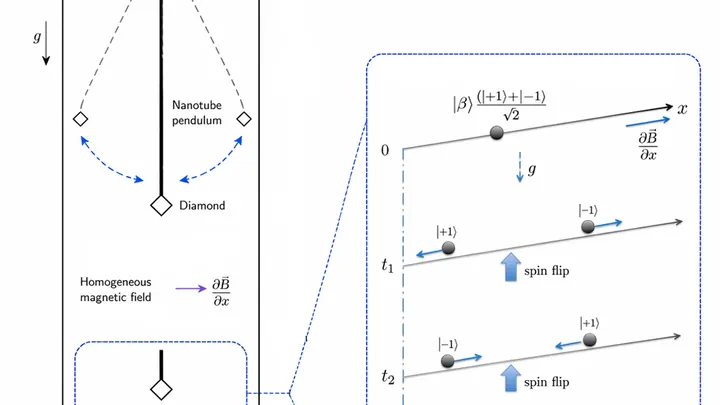
The idea relies on the principle that quantum information is conserved. If a massive object passes through a superposition of two locations, its gravitational field must also be in a superposition. When another particle interacts with this field, it becomes correlated with the object's position, creating entanglement. In a typical proposed experiment, two masses are each placed in a superposition of two positions. If gravity is quantum, the gravitational interaction between them causes their states to become entangled, measurable as correlations in their final positions. If gravity were classical, no such entanglement would arise, as classical fields cannot carry quantum information.
In practice
While no practical technology exists yet, the concept underpins proposed experiments to test quantum gravity in laboratory settings, potentially leading to new quantum sensing or computing architectures that exploit gravitational interactions.
Fun fact
The proposed experiments to detect gravitational entanglement are so sensitive that they require shielding from cosmic rays and seismic vibrations, as even the slightest disturbance would mimic or mask the effect.
Constant of universal gravitation, determining the strength of gravitational force between masses. — gravitational constant= 6.67430e-11cubic metre per kilogram per second squared
\hbar
constant
Reduced Planck constant, the quantum of angular momentum. — reduced planck constant= 1.054571817e-34joule second
c
constant
Speed of light in vacuum, the maximum speed at which information can travel. — speed of light= 299792458metre per second
Two tiny diamonds float in a vacuum, separated by a distance that light cannot cross during the experiment. Inside each, like a frozen spark, resides an entangled spin — a quantum state linking them into a single whole. Now the diamonds begin to move, but not just any motion: each one seems to split, existing in two places at once.
In the first instants after the Big Bang, the universe expanded faster than light could cross it. Like an inflating balloon, but instead of rubber, it was space itself. On this balloon, ripples inevitably formed — tiny compressions and rarefactions from which all galaxies and stars later grew.
A stone drops into a pond, and ripples spread across the water. In the same way, massive bodies generate gravitational waves, except it's space itself that ripples. So far, these waves have been caught by giant detectors that barely flinch as a wave passes through. But what happens on the microscopic scale, inside a tiny piece of matter?
Quantum field theory is the language physicists use to describe elementary particles and their interactions. The authors of the work decided to slightly "tweak" this language: they introduced deformations, that is, small changes to the rules of the game.
Light escaping a massive body loses steam. Its frequency dips slightly, and its color shifts toward red. Physicists call this gravitational redshift. In classical theory, it's all clear, but the moment you bring quanta into the picture, trouble starts.
Previously, this shift was modeled as a kind of mode mixer — a device that entangles different states of light.
In the quiet of the quantum world, there is no emptiness. Particles are intertwined by invisible threads — entanglement. The authors of the work proposed that the very fabric of spacetime is woven from these threads. This is not just a metaphor: they built a mathematical framework where the distance between points is determined by how much shared information they hold.
A massive aluminum cylinder weighing a ton hangs in a vacuum. A gravitational wave, a ripple in spacetime, passes through it, and the bar begins to tremble almost imperceptibly. That trembling can be heard as sound: gravitational waves turn into a phonon — a quantum of sound vibrations.
Gravity in our world is curved spacetime. That's how Einstein's general theory of relativity describes it. But what happens to gravity at the level of atoms and particles, where quantum mechanics rules? This question has remained unanswered for nearly a century.
Two tiny weights, each about the mass of a grain of sand, hang in the dark at a temperature colder than deep space. They don't touch, but an invisible thread connects them — gravity. The experiment physicists are now building aims to catch the moment when that thread tugs one weight due to the motion of the other.
A tiny magnetized sphere floats in a vacuum, held by invisible fields. It starts to spin around the axis of the magnetic field, just like a top that's been given a gentle nudge. That's precession. But when the sphere becomes really small, quantum laws come into play.
Two synchronized swimmers dive into the sea. One hits calm water, the other a whirlpool. Their movements, perfectly coordinated at the start, diverge. Something similar happens to two quantum particles when one moves in flat space and the other in curved space.
A quantum wave is like a long-exposure photograph: everything’s blurred, but the blur itself reveals motion. Usually these frozen waves are treated as convenient abstractions. Yet if at each point in the image you estimate, by brightness, the moment on the particle’s internal clock it landed there, flat space suddenly acquires curves.
In accelerators like the Large Hadron Collider, heavy nuclei collide at enormous speeds. For an instant, quark-gluon plasma (QGP) is born — a state of matter where quarks and gluons float freely, just like in the first microseconds after the birth of the universe.
This plasma is not just hot.
A magnetic field holds a tiny particle in mid-air, like an invisible dance partner. A special tuning of the field creates a trap with two "positions." In the ordinary world, a dancer occupies only one, but in the quantum world — both at once. Physicists have learned to achieve this for dust grains weighing trillionths of a gram.
A black hole is not just a vacuum cleaner. It glows faintly, emitting particles — this idea was proposed by Jacob Bekenstein, who connected the hole's temperature to its degree of disorder. Detecting such radiation in space is incredibly difficult.
According to Einstein's general theory of relativity Albert Einstein, a massive rotating body drags the fabric of spacetime along with it, much like a spoon twirled in a jar sets thick honey flowing.
Building a house on sand is a bad idea. In physics, it was long believed that a quantum theory of gravity could not be built on a fixed "sand"—a pre-existing spacetime.
When a grain of sand falls on a table, its impact is predictable. But if you squeezed it down to the size of an atomic nucleus, the familiar laws of gravity would break down — the force of gravity would grow without bound.
Two floats on the waves. Throw a stone into water, and the ripples will spread, rocking both floats one after another — not simultaneously. In the quantum world, such rocking is called entanglement: particles, like floats, begin moving in sync.
Gravity seems simple: it keeps us on the ground and makes planets orbit. But if it were classical (described by Einstein's equations as the curvature of spacetime, while all matter follows the quantum laws of the Standard Model) then an ordinary quantum bit (qubit) falling freely…
Spacetime can be imagined as a tightly stretched fabric. A massive body dents it, guiding light. Rotation twists the fabric into a spiral. Such a gravitational funnel can entangle a passing photon with the very source of rotation — say, a tiny mirror. Quantum entanglement springs up: an invisible thread binding their fates.
Two particles separated by kilometers change their states in concert, as if there were no distance between them. This is called quantum entanglement, and since its discovery it has baffled physicists: no known carrier can travel faster than light, yet correlations appear instantaneously.
Hot water sometimes freezes before cold: this is the Mpemba effect. In the quantum realm, a similar paradox appears: the more the equilibrium is disrupted, the faster it recovers. It's like fleeing from disorder (entropy) in reverse: the system rushes toward order, and a large initial imbalance only helps.
Light cones are not about light; they are boundaries in spacetime that separate causes from effects. These cones are not rigid: a massive object curves them, like a heavy ball pressing into a stretched sheet.
Two tiny mirrors in a vacuum are like figure skaters in a pairs routine. Their oscillations are synchronized by an invisible gravitational thread. When cooled to millionths of a degree above zero, this thread turns them into a single quantum link — the motion of one instantly echoes in the other.
The universe is not a solid monolith, but a canvas of countless quantum threads. Spacetime doesn't flow like water, but vibrates like a tapestry in the wind. For a long time, physicists only saw the overall pattern, neglecting the tremor of individual threads.
Two parallel streams of atoms, released from Bose condensates, begin their journey in free fall. In the classical picture, their separation remains unchanged — like two skiers gliding down a perfectly smooth slope. But if spacetime is not frozen snow, but a living, rippling membrane, then every tremble of it is transmitted to matter.
The riddle of quantum gravity has troubled minds for nearly a century. A classical field that curves spacetime refuses to fit into the probabilistic world of superpositions. Can gravitation, while remaining macroscopic, give rise to microscopic entanglement?
Holography is the idea that everything happening inside a volume can be encoded on its boundary, like an image on a hologram. In physics, this helps connect gravity to the quantum world. But sometimes, the holographic rules fail to assemble familiar spacetime, and scientists are looking for where exactly the mechanism breaks down.
A juggler tosses clubs while sitting on a spinning chair. If he starts spinning the clubs all in one direction, the chair will rotate the opposite way — otherwise, the conservation of angular momentum would be violated.
A stone falls to the ground along the most economical route — the one that expends the least time and energy. This principle of least action governs all of classical physics. But in the microworld, everything jitters: fields fluctuate, and you can't say precisely where anything is.
In particle physics, it has long been taken for granted that the forces of nature (electromagnetism, the weak and strong interactions) obey a strict symmetry called gauge symmetry. It's like a set of rules by which particles exchange force carriers. But where do the rules themselves come from?
Two balls suspended on threads swing side by side. Each moves on its own, but between them is an invisible thread — the attraction of masses. If gravity is quantum, it could bind them into a single whole: nudge one, and the other responds, even without contact.
Light bends around massive bodies: this has been known since Einstein's time. But what if gravity itself is not a smooth fabric of space but a stream of tiny carrier particles? Then a beam passing near a particle should not just bend but enter into a special quantum relationship with it.
This relationship is called entanglement.
Physicists are trying to hear a whisper in a noisy room. They build a soundproof booth, but even inside, their own breathing and heartbeat create interference. That's roughly how the search for quantum gravity goes: they want to see gravity bind two particles into a single whole — entangle them.
Picture two choirs in soundproof rooms on a wobbly stage. They sing, but can't hear each other — the air doesn't carry the tune. Yet if the stage trembles, its vibrations link their songs. That's the idea behind a new test for quantum gravity.
According to Einstein, spacetime is a flexible fabric, curved by matter. But in the quantum world, everything is different: particles are smeared over a probability cloud, governed by a rigid rule discovered by Max Born.
Gravity is like a stretched trampoline: massive bodies press into it, making other bodies roll toward them. This shared curvature of space, gravity, affects everyone, but it doesn't convey secret messages.