The String That Refuses to Go Quiet express
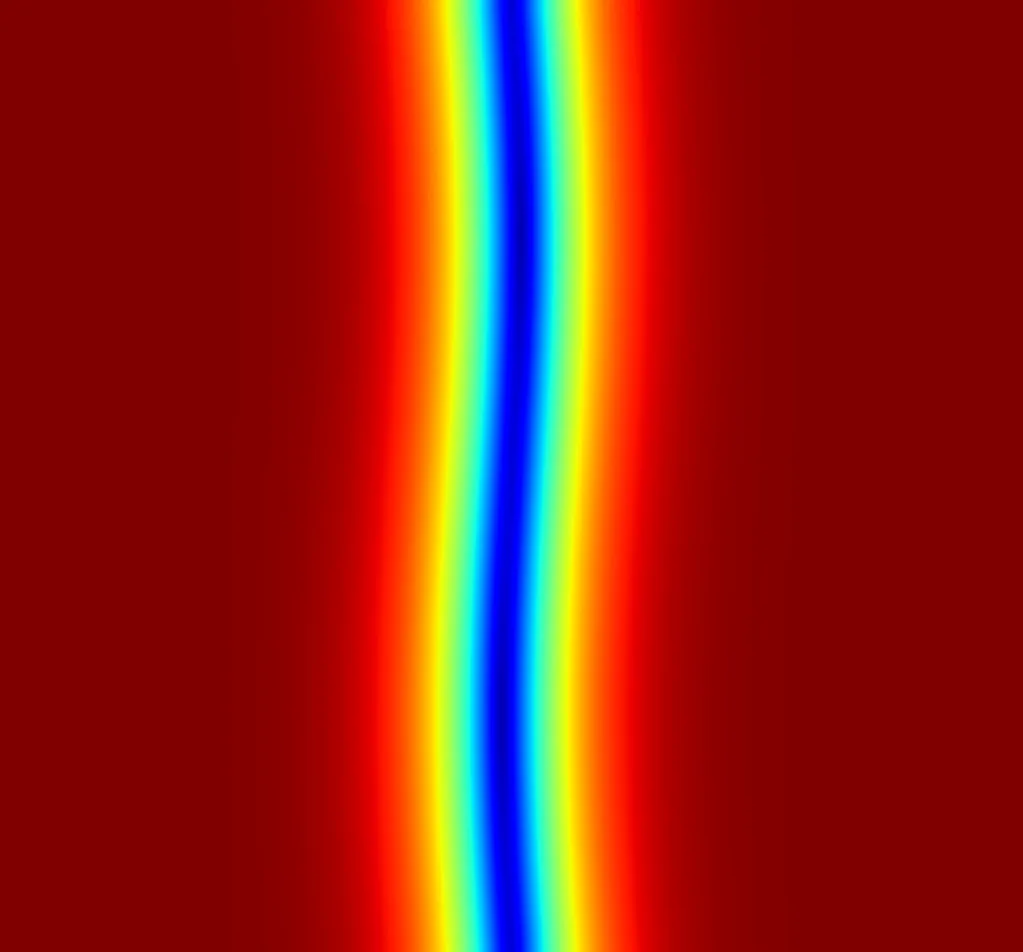
Pluck a guitar string, and it will vibrate and quickly fade. Now imagine a cosmic string: an ultra-thin filament of pure energy left over from the Big Bang, trillions of times thinner than an atom and denser than a neutron star. Strike it, and it might sing for billions of years.
In a new study, physicists examined a special type of oscillation — not transverse vibrations, but waves running along the string itself, like sound along a taut rope. These are vector excitations, which behave like massive particles trapped on a one-dimensional filament. The researchers calculated their spectrum and shape, then traced how they decay. The damping follows a power law — slow, like a cup of coffee cooling, not like a soap bubble popping.
But the most surprising result came from full 3+1-dimensional simulations. The vector mode entered resonance with the Goldstone sector — massless oscillations that are usually 'eaten' by the Higgs mechanism. This triggered a parametric instability: the string began to sway in two transverse directions at once, like a pendulum that suddenly swings not only back and forth but also side to side. The effect was unexpected: earlier studies suggested that ordinary shape modes excite only one direction.
Thus, the cosmic string transforms from an abstract guitar metaphor into a complex musical instrument capable of polyphony. And its 'songs'—gravitational waves and bursts of radiation — might one day tell us about the first moments of the universe.
Original abstract
as written by the authors arXiv:2607.16120
We investigate the dynamics of vector excitations localized on cosmic strings in the Abelian-Higgs model. These confined gauge field fluctuations behave as massive vector degrees of freedom propagating along the string. We show that they remain bounded for all values of the scalar self coupling $$\lambda$$, including parameter regimes in which the previously studied conventional shape mode is no longer present. After determining their spectra and spatial profiles, we analyze their decay through nonlinear coupling to bulk radiation. Their amplitudes exhibit the characteristic power law relaxation associated with non-linear radiation. For sufficiently large $$\lambda$$ the scalar radiation channel becomes kinematically inaccessible and the decay is instead mediated by quasinormal modes which can be interpreted as Feshbach resonances of the string. We then study the full $$3+1$$ dimensional dynamics of the vector-excited string. Field theory simulations reveal a parametric instability between the vector mode and the Goldstone sector. In contrast to the shape mode, the vector mode resonantly excites both transverse directions simultaneously. In addition, we build an effective model that captures the instability and identifies the nonlinear couplings responsible for it. Our results show that vector excitations constitute a long-lived massive degree of freedom with a non-trivial role in the dynamics of local strings.
A cosmic string as thick as a proton would weigh as much as a mountain, and a kilometer of such string would weigh about as much as Earth.