The Higgs mechanism is the process by which fundamental particles acquire mass through their interaction with the Higgs field, a scalar field that permeates all of space. Before electroweak symmetry breaking, the gauge bosons of the weak force and the fermions are massless. The Higgs field, with a non-zero vacuum expectation value, breaks this symmetry, giving mass to the W and Z bosons and to the fermions via Yukawa couplings. This mechanism is a cornerstone of the Standard Model of particle physics.
History
The mechanism was independently proposed in 1964 by Peter Higgs, and by François Englert and Robert Brout, and also by Gerald Guralnik, C. R. Hagen, and Tom Kibble. The Higgs boson was discovered at CERN's Large Hadron Collider in 2012, leading to the 2013 Nobel Prize in Physics for Higgs and Englert.
How it works
The Higgs field has a potentialenergy landscape shaped like a 'Mexican hat' — the minimum energy state is not at zero field value but at a non-zero value. The field settles into this minimum, breaking the electroweak symmetry. Particles moving through this field experience resistance, which manifests as mass. The Higgs boson, discovered in 2012, is the quantum excitation of this field, and its properties confirm the mechanism.
In practice
The Higgs mechanism is essential for understanding the masses of elementary particles and is a key component of the Standard Model. It guides searches for new physics beyond the Standard Model, such as supersymmetry and dark matter candidates.
Fun fact
Without the Higgs mechanism, all particles would be massless and travel at the speed of light, making the formation of atoms, stars, and life impossible.
A translator gets distracted by every rustle in the hall, and a one-hour meeting stretches into two. A single wrong intonation changes the meaning beyond recognition. That's roughly how a particle with spin 3/2—the gravitino — behaves. It cannot exist in isolation: its "speech" must be perfectly coordinated with its surroundings, or the whole structure falls apart.
At the center of nearly every galaxy lurks a supermassive black hole. Its gravity is so strong that it warps space itself. But few stop to wonder: what does it do to the very fabric of reality — the fields that permeate the cosmos?
One such field is the Higgs field.
The early Universe was like a rapidly cooling ocean. At colossal temperatures, everything was one — quarks, electrons, forces all blended into a symmetric 'steam.' But as it expanded and cooled, this steam condensed, phase transitions cascading one after another like water turning to ice.
Space is threaded with magnetic fields. They exist around galaxies, stars, and even in nearly empty voids — the vast empty spaces between galaxy clusters. It's usually thought that fields are amplified from weak 'seed' fields by turbulence, much like a dynamo. But the origin of the seed fields themselves has remained a puzzle.
A lump of dark matter drifts through the void — invisible, almost intangible. No one knows what it's made of, but a new study suggests viewing it as a drop of quantum liquid. Two kinds of fermion particles — call them "heavy" (ψ) and "light" (χ)—exchange signals via a third mediator particle (φ), like floats tied to a single line.
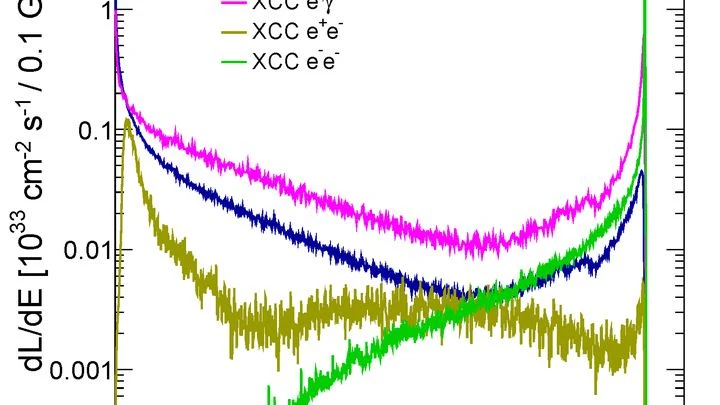
Two blindingly bright beams smash head-on. At the point of impact, a particle is born for an instant — the very one responsible for the mass of everything in the universe. That's the Higgs boson. Usually, it's produced by accelerating protons or electrons, but here the projectiles are particles of light themselves — photons.
In particle physics, it has long been taken for granted that the forces of nature (electromagnetism, the weak and strong interactions) obey a strict symmetry called gauge symmetry. It's like a set of rules by which particles exchange force carriers. But where do the rules themselves come from?
Throw a stone into a pond — ripples spread out, changing the scale of the wave. The new theory works much the same way: it gives each particle its own "scale ripple," and it's this curvature of an invisible space that turns out to be the source of mass.
The Higgs boson is like a conductor that gives mass to all other particles. Without it, electrons would be massless and atoms would fall apart. But how does the conductor interact with itself? That is the key question a future muon collider aims to answer.
A crowd of people moves freely across a square, but suddenly freezes in place without changing their positions. Everyone stays where they were, but motion stops. This is exactly what a symmetric mass generation transition looks like: the system gains rigidity, yet its symmetry remains untouched.
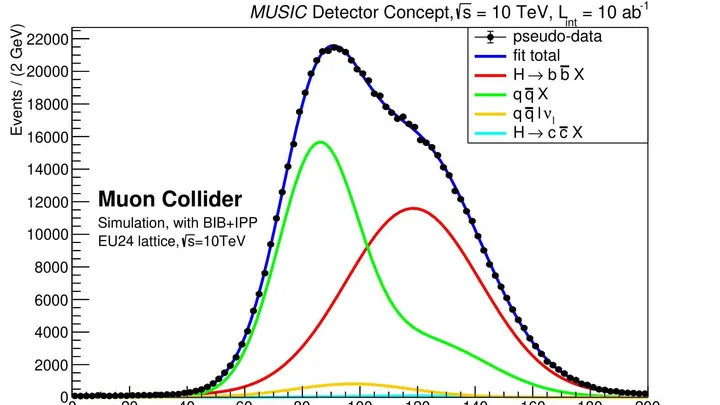
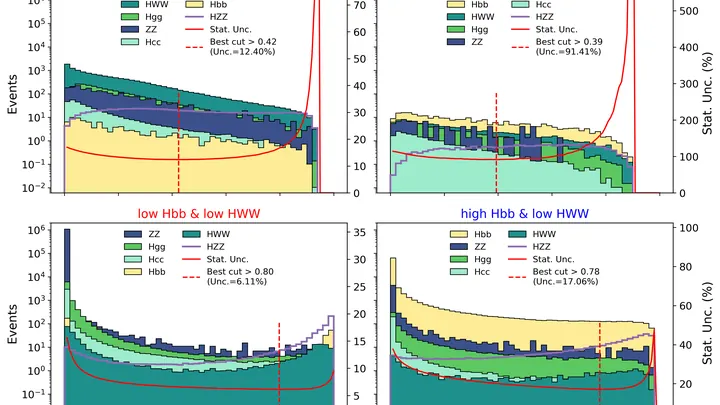
The Higgs boson lives an unimaginably short life — less than a billionth of a second. It cannot be caught directly, so physicists look at what remains after its decay: jets of particles, muons, neutrinos. But some information is lost if you consider only the explicit decay traces rather than the whole event.
A century ago, Einstein's equations predicted black holes, but inside them physics broke down: particle trajectories ended at the singularity, a point of infinite curvature. It was a dead end, the end of spacetime. Now physicist Itzhak Bars proposes a radical twist: the singularity is not a wall but a door.