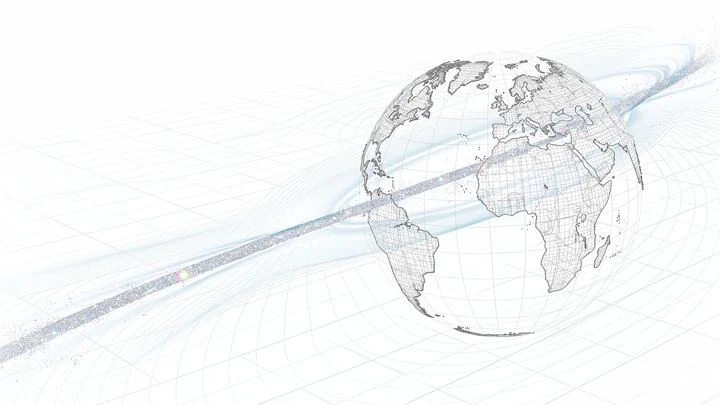
Cosmic strings are hypothetical one-dimensional defects in spacetime, predicted by many grand unified theories. They are extremely thin — thinner than a proton — but can stretch across the entire universe, carrying enormous energy densities. When two cosmic strings intersect or oscillate, they can produce cusps and kinks that emit intense bursts of gravitational waves. Unlike the gravitational waves from black hole mergers, which are short-lived chirps, cosmic string signals would be a stochastic background of bursts, potentially detectable by pulsar timing arrays or space-based interferometers. Some strings may also carry electric currents or magnetic monopoles, which would alter their dynamics and gravitational-wave emission.
History
Cosmic strings were first proposed by Tom Kibble in 1976 as a consequence of symmetry breaking in the early universe. Their gravitational-wave signatures were studied extensively in the 1980s and 1990s, and they remain a key target for gravitational-wave observatories.
How it works
A cosmic string is a concentration of energy that curves spacetime around it. When a string moves, it can emit gravitational radiation, especially at points where it moves at nearly the speed of light (cusps) or where it has sharp bends (kinks). If a string carries a current, it can also emit electromagnetic radiation, and if it has monopoles attached, these can slide along the string and collide, producing additional gravitational-wave bursts. The frequency and amplitude of these waves depend on the string tension and the presence of currents, making them a unique probe of high-energy physics.
In practice
Gravitational-wave detectors like LIGO, Virgo, and pulsar timing arrays search for cosmic string signals to test grand unified theories and probe physics at energy scales far beyond particle accelerators.
Fun fact
If cosmic strings exist, they could have seeded the formation of galaxies by creating density fluctuations in the early universe, acting as the 'seeds' around which matter clumped.
Cosmologists are like cartographers — only instead of mountains and rivers, they map invisible forces. Dark energy, which drives the accelerating expansion of the universe, remains a mystery. One idea is the 'kinetic gravity braiding' (KGB) model. In it, dark energy interlocks with gravity. The celestial map's paper becomes elastic. It alters the path of light rays.
Right after the Big Bang, space cooled unevenly. In some places, folds could have formed — threads of energy as thin as a hair but incredibly dense. Physicists call them cosmic strings. They oscillate, collide, and emit gravitational waves — ripples in the fabric of space itself.
In the first fractions of a second after the Big Bang, the universe was a stage of rapid change. A stretched rubber sheet that cools quickly becomes covered with microscopic cracks. A similar process on a cosmic scale could have given rise to cosmic strings — ultra-thin but super-dense threads of energy stretching across the entire universe.
These strings are not just defects in space.
The early Universe was like a rapidly cooling ocean. At colossal temperatures, everything was one — quarks, electrons, forces all blended into a symmetric 'steam.' But as it expanded and cooled, this steam condensed, phase transitions cascading one after another like water turning to ice.
Pluck a guitar string, and it will vibrate and quickly fade. Now imagine a cosmic string: an ultra-thin filament of pure energy left over from the Big Bang, trillions of times thinner than an atom and denser than a neutron star. Strike it, and it might sing for billions of years.
When a distant galaxy sends us light, it dims with distance, and from that dimming, we can tell how far away it is. Gravitational waves work in much the same way: the farther their source, the weaker the ripple in space that detectors on Earth pick up.
On May 14, 2019, LIGO detectors registered a gravitational burst that didn't fit the usual mold. Event GW190521 appeared as a collision of two black holes weighing 85 and 66 solar masses. The resulting hole of 142 solar masses landed right in the "forbidden" range — where stellar collapses leave almost no trace.
The Universe doesn't just expand — it resonates. After the Big Bang, stretched strings remained in its fabric — thin as a proton, yet heavy as a mountain range. Their oscillations give birth to gravitational waves, and in this radiation, like in a musical score, the history of fundamental symmetries is encoded.
Immediately after the Big Bang, in the seething cauldron of the cooling Universe, much like in unevenly hardening glass, stresses appeared — hairline cracks in reality, cosmic strings. Picture a tightrope walker balancing on an invisible cable stretched across the abyss of warped spacetime.
A fundamental string plucked at the moment of the Big Bang doesn't just hum a single note — waves run along it, and occasionally tiny loops peel off. These loops, like tuning forks, begin to ring at their own frequency, producing a very high-pitched sound.
Hold a magnet near a pile of iron filings, and they line up along invisible lines — the field wraps around the magnet from pole to pole. In a similar way, you can visualize gravity around massive bodies: instead of filings, it's space itself; instead of a magnet, a star or a black hole. The authors propose decomposing gravity into two fields.
The mystery of the missing antimatter has haunted physics since the mid-20th century. The Big Bang should have created equal amounts of matter and antimatter, yet today's world is almost entirely matter. The Standard Model is powerless to explain this baryon asymmetry — we need new particles and mechanisms beyond it.
When hot soup cools, clumps form on the surface — similarly, as the early universe cooled, it gave birth to threadlike clumps of energy: cosmic strings. Some of them are like a stretched rubber band: as long as it's intact, it's stable. But if you nick the band, it snaps.
A giant whirlpool spins at tremendous speed. If you toss a rope into it, securing one end at the rim and leaving the other outside, the whirlpool will wind the rope around itself, making it spin. That's roughly how a cosmic string behaves near a rotating black hole.
In the first moments after the Big Bang, the cosmos resembled a giant cooling pond. Just as water, when freezing, becomes covered with a network of cracks, so the cooling universe could have cracked — not into ice, but into the thinnest filaments of pure energy. These filaments are called cosmic strings.
Above the Sun's surface hang long ribbons of glowing gas — streamers. They look like giant harps stretched across the corona. When a wave runs along such a ribbon, it trembles and bends like a string after being plucked.
For a long time, it was thought that only a very fast ejection of material, one traveling at more than 500 kilometers per second, could launch such a wave.
According to theories beyond the Standard Model, our best description of elementary particles and their interactions, pairs of magnetic monopoles were born in the first instants after the Big Bang. These hypothetical particles carry only one magnetic pole—'north' or 'south'—unlike familiar magnets where poles are inseparable.
A rotating black hole is a cosmic whirlpool that sucks in everything around it. Some of these holes have invisible threads that stretch from the event horizon like spokes from a wheel. Scientists have long debated what these threads are and whether they can be observed.
In a new study, physicists have shown that these threads are not just a mathematical artifact.