Star Compass: A New Way to Measure a Black Hole ✛
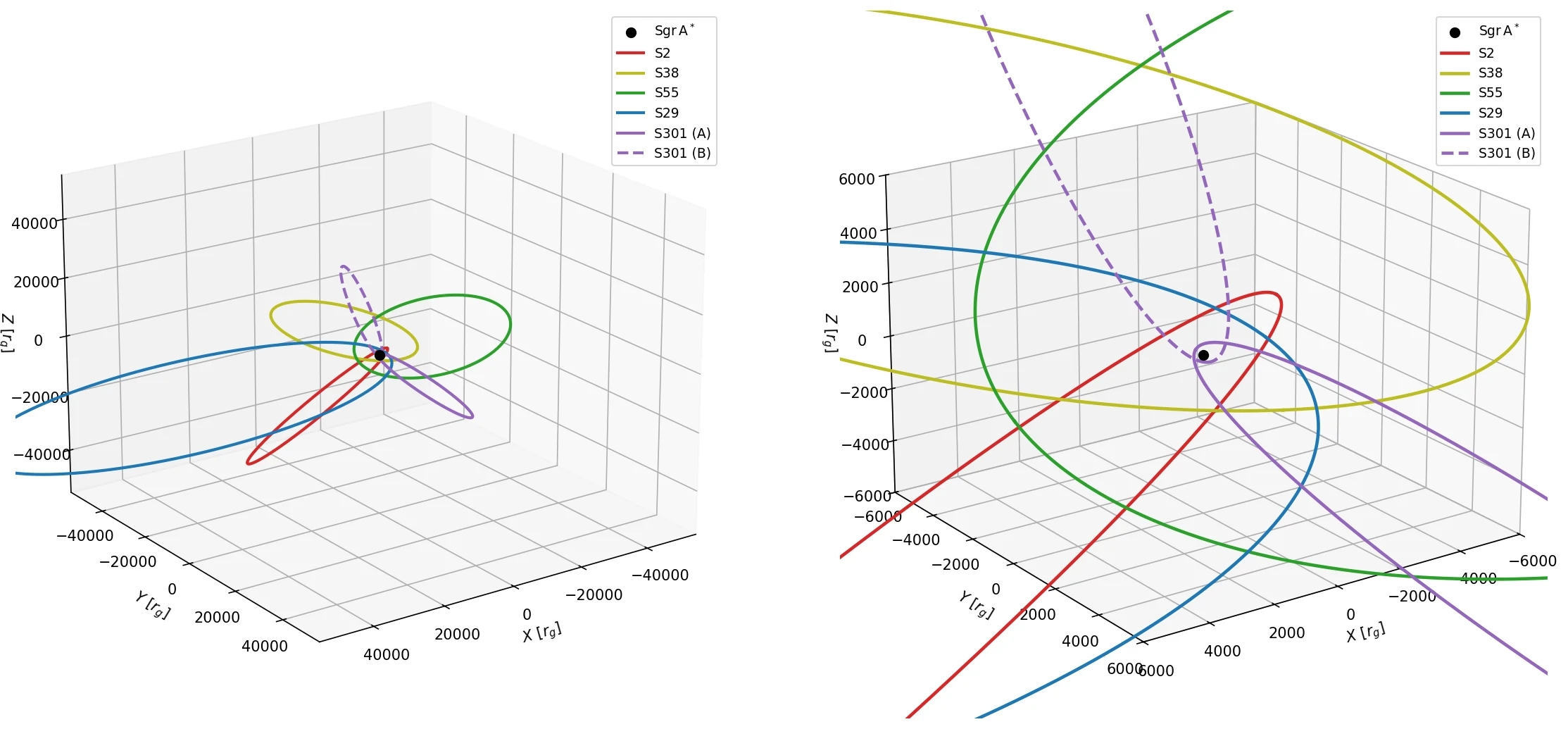
Star S301 orbits the supermassive black hole at the center of the Milky Way along an orbit whose closest point is comparable to the distance from the Sun to Uranus. This is the needle of a celestial compass. Its true north — the direction set by the hole's rotation, twisting spacetime (the Lense–Thirring effect). But other forces act on the needle too, like magnetic anomalies: clusters of invisible mass also turn the orbit.
Nearby are reference stars — S2, S38, S55. They fly far from the hole and barely feel the spacetime twist, but do feel the same anomalies. Comparing their orbits with S301's, astronomers can subtract the noise and extract the pure rotation signal. Thus the compass points true north.
Measurements will take years, but in a couple of decades we will for the first time see how spacetime rotates at the heart of the Milky Way. The compass needle S301 will point not just to anomalies, but to the very essence of the black hole.
S301’s pericenter is just 280 gravitational radii, roughly the distance from the Sun to Uranus. At that proximity to the black hole, the star whips up to 6% the speed of light — 18 thousand kilometers per second. If we built a starship traveling at that speed, it would reach Proxima Centauri in just 70 years.
The idea of measuring a black hole’s spin by tracking stars feels like a scene from Interstellar, where the crew explores the spinning black hole Gargantua. Reality is more modest: Sgr A* is millions of times more massive, but its spin may be moderate — yet measuring it would be a landmark achievement.