Precession is the slow, conical rotation of a spinning object's axis around another axis, caused by an external torque. In physics, it is most familiar from a spinning top, whose axis wobbles as gravity pulls on it. In the quantum world, precession appears in magnetic moments—the intrinsic spin of particles like electrons or nuclei—when they are placed in a magnetic field. This phenomenon is central to understanding how magnetic fields interact with matter, from the behavior of atomic spins in materials to the alignment of dark matter particles in the early universe.
History
The classical theory of precession was developed by Isaac Newton and later refined by Jean-Baptiste Biot and Félix Savart in the 19th century. The quantum mechanical treatment of spin precession was established by Wolfgang Pauli and others in the 1920s.
How it works
When a spinning object experiences a torque perpendicular to its angular momentum, the torque changes the direction of the angular momentum rather than its magnitude. This causes the axis to trace out a cone over time. For a magnetic moment in a magnetic field, the torque is proportional to the cross product of the magnetic moment and the field, leading to a precession at the Larmor frequency. The rate of precession depends on the strength of the field and the gyromagnetic ratio of the particle.
In practice
Precession is the basis for magnetic resonance imaging (MRI), where hydrogen nuclei in the body precess in a strong magnetic field, and for gyroscopes used in navigation systems.
Fun fact
The Earth's axis precesses over a 26,000-year cycle, causing the position of the North Star to shift over time.
A magnetic mirror is a tube open at both ends. The magnetic field inside is arranged so that hot plasma doesn't leak out: at the ends, the field lines bunch up like a cork in a bottle. Plasma particles flying toward the exit are repelled by these "corks" and bounce back. But some still escape: that's the classic "loss cone" argument.
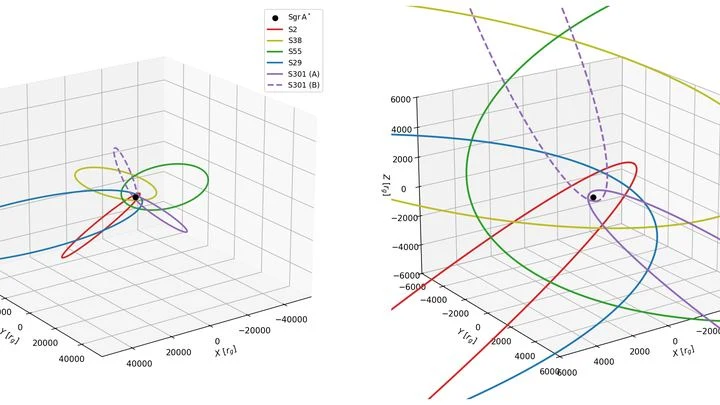
26,000 light-years from Earth, in the heart of the Milky Way, star S301 tears through space at 18,000 kilometers per second. It loops around the supermassive black hole Sgr A* on an elongated orbit. At its closest approach, just 280 gravitational radii separate the star from the black hole — roughly the distance from the Sun to Uranus.
A tiny magnetized sphere floats in a vacuum, held by invisible fields. It starts to spin around the axis of the magnetic field, just like a top that's been given a gentle nudge. That's precession. But when the sphere becomes really small, quantum laws come into play.
Dark matter remains one of the greatest mysteries of modern physics. Back when Vera Rubin observed galaxy rotation, she proved that visible matter is insufficient to keep stars from flying apart.
Cosmic rays do not travel in straight lines. Charged particles accelerated to enormous speeds loop through the Galaxy's magnetic field like dust motes in a gust of wind. It's usually assumed that they simply scatter along and across field lines.
A stone thrown into water leaves ripples. A satellite orbiting Earth also leaves a trace — not on water, but in the laws of physics. Its orbit is not a frozen line: it slowly rotates, like the hand of a giant clock.
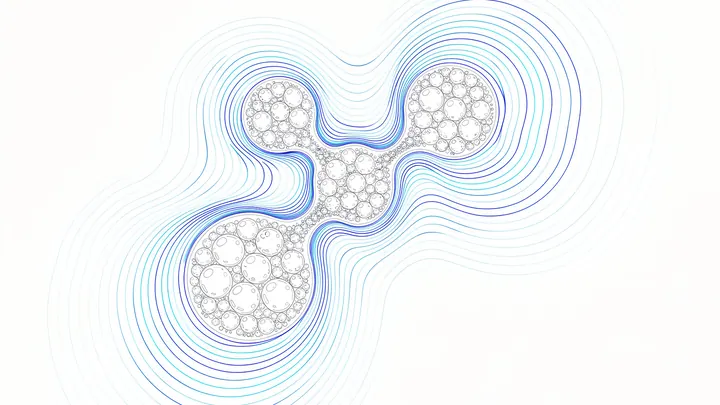
A handful of rice thrown into a glass of water scatters — the grains spread apart. Now imagine each grain propels itself forward with stubborn persistence and bounces off softly upon collision. Such particles are called active: they spend their own energy to move, like bacteria or microscopic robots.
In the first moments after the Big Bang, the universe was not empty and quiet but filled with hot plasma, particles, and magnetic fields. Among the particles, there may have been axions — light, nearly elusive dark matter candidates.
About 380,000 years after the Big Bang, the universe cooled enough for electrons and protons to finally combine into neutral hydrogen. Although this event is called recombination, it was actually their first meeting — the heat had kept them from sticking together until then.
A coin spinning on a table is a familiar sight. At first it rotates quickly, then it tilts, and its rattling becomes faster and faster. In the last seconds it seems to hover: the rotation slows, but the coin just won't finally lie flat. This final moment is a real puzzle for physicists.
Around young stars, flat clouds of gas and dust swirl: these are the birthplaces of planets. For matter in such a disk to clump together, it must be constantly stirred. But what makes the gas move chaotically when it would otherwise be calm? Part of the answer lies in the fact that the gas in the disk barely conducts electricity: it is weakly ionized.
A young star is like a layered spinning top: its outer layers rotate slower, its inner ones faster. The magnetic field here acts like sturdy threads binding these layers together. When the speeds differ, the threads begin to twist and stretch more and more.
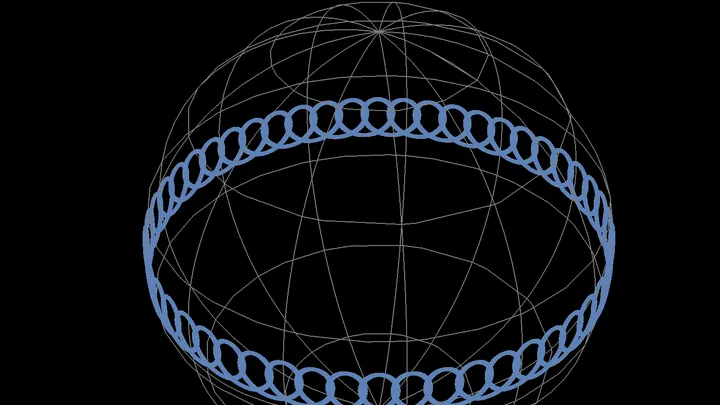
Vortons are invisible cosmic hoops, closed loops of curved spacetime. Thinner than an atom but heavier than stars, these Big Bang relics spin like giant carousels, churning everything around them. Einstein's equations describe how particles dance near such a hoop: paths twist into spirals or dart chaotically.