The Celestial Compass: S301 and Measuring a Black Hole's Spin ✛
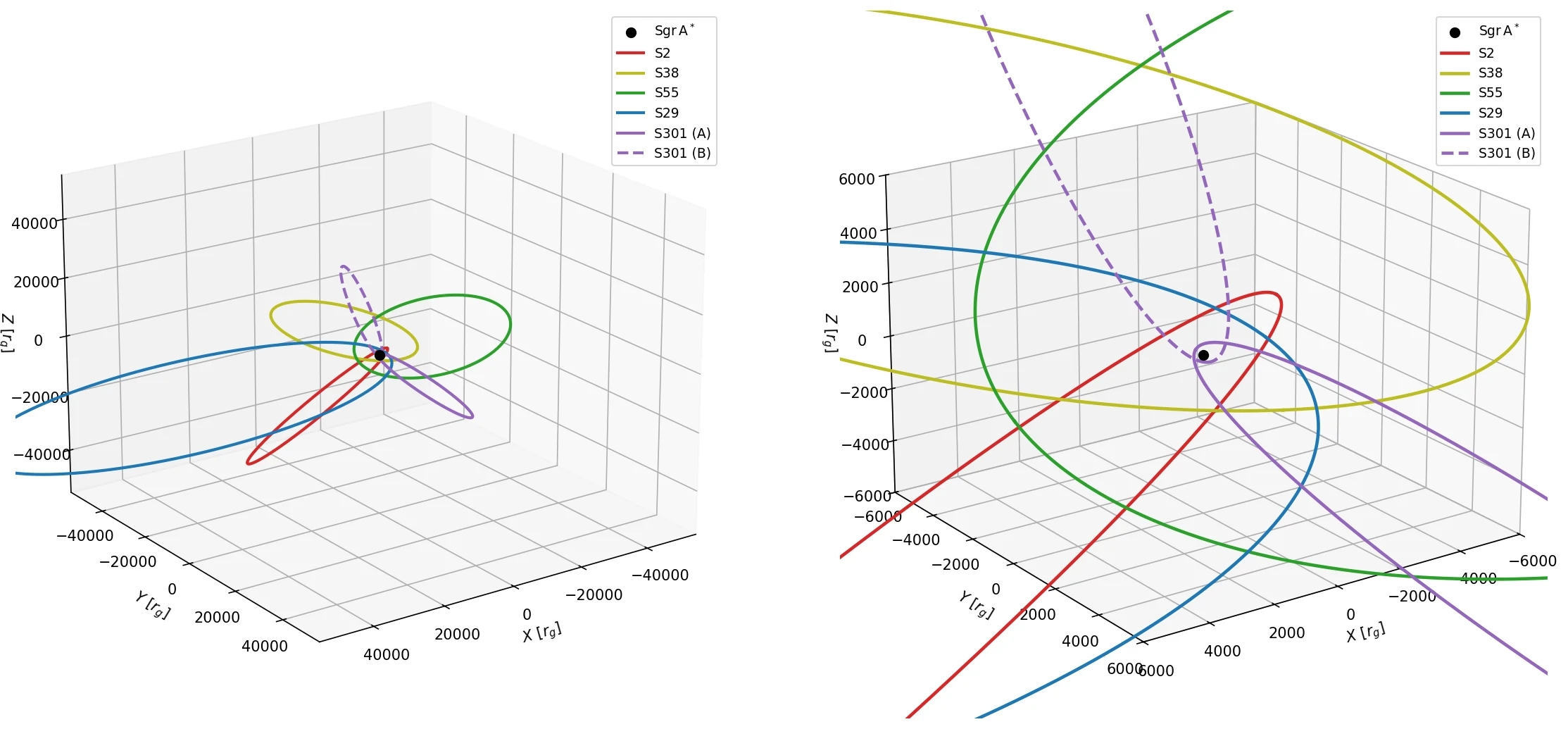
26,000 light-years from Earth, in the heart of the Milky Way, star S301 tears through space at 18,000 kilometers per second. It loops around the supermassive black hole Sgr A* on an elongated orbit. At its closest approach, just 280 gravitational radii separate the star from the black hole — roughly the distance from the Sun to Uranus. For comparison, the previous record holder S2 stayed ten times farther away.
S301's orbit is an extraordinarily sensitive celestial compass. Its needle points in the direction set by the spacetime dragging effect of the spinning black hole. But nearby lies a massive disk of gas and stellar debris. Its gravitational field slowly twists the orbit, like a magnetic anomaly throwing a compass off.
Astronomers have found a way to calibrate the compass. Stars S2, S38, and S55 have nearly the same apocenters as S301, but they pass much farther from the hole. Their precession is almost entirely due to the disk: they barely feel the spacetime twist. These reference stars act as calibration magnets: by measuring their motion, we reconstruct the map of gravitational anomalies and subtract it from S301's readings. The black hole's spin signal in S301 is 30 times stronger than in S2.
But that's not all. S301's orbit also experiences precession described by Schwarzschild — about 2° per orbit. Because of this, the disk's contribution varies from one period to the next, while the Lense–Thirring effect remains constant. This provides an additional temporal key to disentangle the signals.
S301's compass needle has already begun its slow turn. With new instruments, the ELT telescope and the upgraded GRAVITY+ interferometer, precision will improve by an order of magnitude. Within a couple of decades, astronomers will chart the gravitational map of the Galactic center with unprecedented detail, separate the vortex from the drift, and for the first time see the rotation of spacetime itself.
S301’s pericenter is just 280 gravitational radii, roughly the distance from the Sun to Uranus. At that proximity to the black hole, the star whips up to 6% the speed of light — 18 thousand kilometers per second. If we built a starship traveling at that speed, it would reach Proxima Centauri in just 70 years.
The idea of measuring a black hole’s spin by tracking stars feels like a scene from Interstellar, where the crew explores the spinning black hole Gargantua. Reality is more modest: Sgr A* is millions of times more massive, but its spin may be moderate — yet measuring it would be a landmark achievement.