Stellar Compass: S301 and Measuring a Black Hole’s Spin ✛
Context
Why it matters. The needle of the celestial compass—the star’s orbit—points not only toward the true north set by the whirl of twisted spacetime, but also toward the magnetic anomalies created by clumps of invisible mass. To measure the spin of the supermassive black hole at the center of our Galaxy — the source of gravity that bends the very flow of time — we must separate the frame-dragging effect, predicted by Einstein and calculated by Lense and Thirring over a century ago, from the mundane Newtonian influence of distributed mass. This is possible thanks to star S301, which brushes past the black hole at a distance of just 280 gravitational radii.
Methods
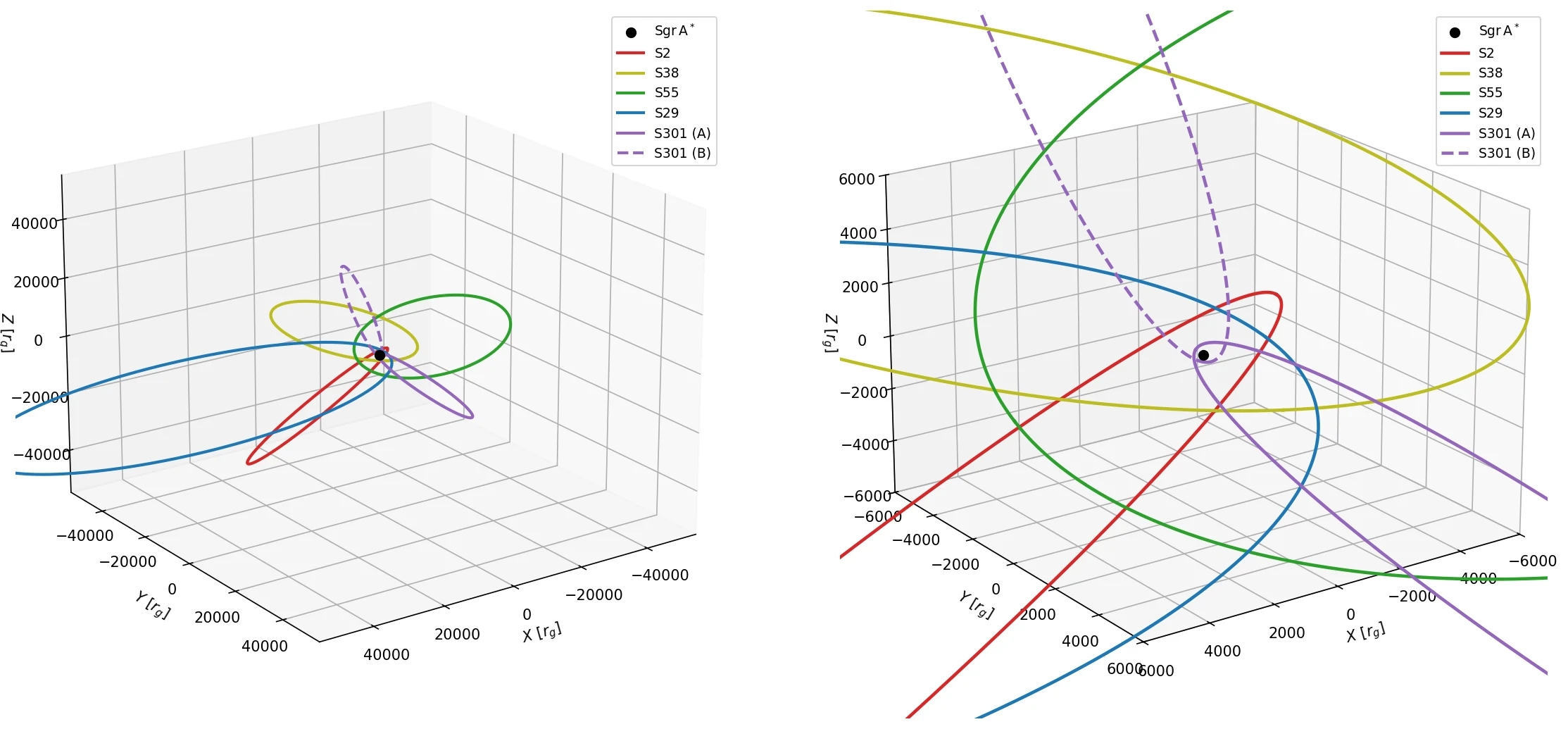
How they did it. Using the GRAVITY interferometer on the Very Large Telescope (VLT), astronomers tracked the positions of stars with astrometric precision down to tens of microarcseconds over many years. Spectra provided radial velocities. Orbits were constructed for S301 and three reference stars — S2, S55, S38 — all obeying Kepler's third law. The key trick: all these stars have similar apocenters (the farthest points from the black hole), so according to Law of Universal Gravitation, the torque from any hypothetical massive disk affects them almost identically. Meanwhile, the Lense–Thirring effect, which arises from spacetime curvature around a spinning black hole, depends sharply on pericenter distance: the signal for S301 is 30 times stronger than for S2. Numerical simulations confirm these estimates for various disk configurations.
Results
What they found. The numerical analysis showed: if there is a disk with 1000 solar masses around the black hole, the ratio of Newtonian to relativistic precession for S301 ranges from 0.4 to 2.5 depending on geometry, while for S2 it’s between 4 and 19. So the reference stars, whose precession is almost entirely Newtonian, act like calibration magnets: by tracking their motion, we map the gravitational ‘magnetic anomaly’ and subtract its contribution from the readings of the main compass — S301. Existing limits on S2’s precession already suggest the disk’s actual mass is likely several times smaller than the maximum, meaning the confusion is even weaker. Moreover, the swift Schwarzschild precession of S301’s orbit, described by Schwarzschild, at about 2° per period, causes the Newtonian contribution to vary from one orbit to the next, while the Lense–Thirring effect remains constant — adding a temporal fingerprint to separate the signals.
Implications
What this means for science. Directly measuring the spin of Sgr A* would be a triumph for experimental gravity. It would test the no-hair theorem, which says a black hole is fully described by just its mass, spin, and charge, and help reconstruct the growth history of our galactic nucleus — whether black holes merged or matter fell in smoothly. It will also shed light on why some black holes fire powerful jets while others, like ours, remain dormant.
Future development
Where this could go. With the Extremely Large Telescope (ELT) coming online and GRAVITY+ upgrades, precision will leap by an order of magnitude. Combining data from many stars, including yet undiscovered ones, and accounting for the granularity of the background—where mass is distributed not smoothly but as a swarm of compact objects—will allow us to extract the spin component with high confidence. Over decades, measuring the full spin vector, including the component along our line of sight, could become a reality through apocenter precession.
Impact
This breakthrough will impact black hole astrophysics, the cosmology of galaxy growth, and fundamental tests of general relativity.
Next steps
The immediate next steps are to resolve the orbital ambiguity of S301 (there are two degenerate solutions) and gather more data on the reference stars with GRAVITY+ and the ELT to refine the Newtonian background model.
Key open problems
This project directly tackles one of physics’ key unsolved problems: testing the no-hair theorem and mapping the spin distribution of supermassive black holes, shedding light on their evolution.
The knowledge machine's view
This section is addressed to the author of the paper and their colleagues. Neighbouring works were found by meaning-based search across our archive, not by word overlap. We do not review: we show the field around the work.
What the work does
Astronomers have tracked the star S301, which approaches the supermassive black hole Sgr A* to a distance of 280 gravitational radii, and proposed a method to separate the relativistic Lense-Thirring precession from the Newtonian influence of distributed mass using three reference stars (S2, S55, S38). Numerical simulations showed that for S301 the ratio of Newtonian precession to relativistic is 0.4–2.5, whereas for S2 it is 4–19, which allows the reference stars to be used for calibrating and subtracting the contribution of the massive disk.
Where its strength is
The clever use of stars with similar apocenters as 'calibration magnets' to subtract Newtonian noise turns S301 into a sensitive probe of the black hole's spin. The temporal key is especially strong: the fast Schwarzschild precession of S301 changes the Newtonian contribution, while the Lense-Thirring effect remains constant, providing an additional way to separate the signals.
Where it could go next
- The calibration method using reference stars can be extended to search for dark matter near the black hole: if invisible particles accumulate in a dense cloud, their gravitational influence would show up as orbital anomalies similar to the Newtonian contribution of the disk, but with a different spatial structure. In our archive, there is a nearby paper discussing how dark matter could ignite stars near supermassive black holes, and its approach to modeling the distribution of invisible mass could be adapted for analyzing orbital data.based on: The Invisible Ocean Ignites Dark Stars arXiv:2607.00840
- The idea of separating contributions by temporal dependence could be strengthened by incorporating accretion variability data: if the disk around Sgr A* is not static but subject to winds or flares, the Newtonian signal would be modulated, while the Lense-Thirring precession remains stable. A nearby paper shows how a black hole wind clears the Galactic center, and its model of a non-stationary environment could provide plausible scenarios for testing the method on realistic data.based on: Black Hole Wind Clears the Galactic Center arXiv:2509.10615
Worth trying
- Test whether data on the Schwarzschild precession of S2 can be used to independently constrain the disk mass, thereby reducing calibration uncertainty.
- Simulate how inhomogeneities in dark matter distribution, as predicted in work 2607.00840, would affect the orbit of S301 at current GRAVITY precision.
- Assess how variability of the accretion flow (according to scenarios from 2509.10615) could mimic or mask the Lense-Thirring signal on timescales comparable to the orbital period of S301.
Why this may matter
A direct measurement of Sgr A*'s spin would be key to understanding the growth history of our Galaxy and testing gravity in the strong-field regime, and the proposed calibration method paves the way for similar measurements of other supermassive black holes where the environment also introduces Newtonian noise.
Nearby works in our archive
- A Spinning Star Puts Gravity to the Testsimilarity 0.76
- How a Black Hole Warps Timesimilarity 0.68
- Black Hole Without Singularity: A New Geometry of Spacesimilarity 0.64
- Stellar Fossils: S301 — The Lost Twin?similarity 0.64
- Black Hole Wind Clears the Galactic Centersimilarity 0.63
- The Invisible Ocean Ignites Dark Starssimilarity 0.63
The archive is crowded around this work: 2 reviews nearby, closest at 0.76. This ground is well walked — and there is plenty to compare against.
Original abstract
as written by the authors arXiv:2607.24931v1
The discovery of S301 (GRAVITY Collaboration et al., 2026) with pericenter distance rp= 280rg and eccentricity e=0.9825, opens the prospect of measuring the spin parameter of Sgr A* through Lense--Thirring (LT) nodal precession. A major obstacle is Newtonian confusion: any non-spherical extended mass distribution can also induce nodal precession. We aim to separate the LT spin signal of S301 from the Newtonian nodal precession. We compare the secular Newtonian torque exerted by a disk or flattened mass distribution on the orbits of S301 and of the apocenter-matched reference stars S2, S55, and S38, using analytic estimates validated by numerical orbit-averaged torque calculations. For a disk or flattened distribution extending beyond the stellar pericenters, the secular Newtonian torque on a highly eccentric orbit is controlled mainly by the apocenter, whereas the LT signal is controlled mainly by the pericenter. Thus stars with apocenters comparable to S301's but much larger pericenters, in particular S2, but also S55, and S38, experience comparable Newtonian torques while having ~ 30 times smaller LT signals (for S2). Their measured precessions, or upper limits on them, can therefore calibrate the mass and orientation of the Newtonian background for subtraction from S301's precession. The Schwarzschild apsidal advance of S301 further rotates the orbit's pericenter relative to any disk, producing a systematic time dependence in the Newtonian contribution, while the LT signal remains fixed by the spin vector. Granularity of the perturber population sets a stochastic floor on this subtraction, which orbit- and star-averaging suppress. With continued GRAVITY+ astrometry and Extremely Large Telescope (ELT) spectroscopy, the in-plane spin projection may be within near-term reach; the full spin vector requires a much longer-term accumulation of the LT apsidal signal.
S301’s pericenter is just 280 gravitational radii, roughly the distance from the Sun to Uranus. At that proximity to the black hole, the star whips up to 6% the speed of light — 18 thousand kilometers per second. If we built a starship traveling at that speed, it would reach Proxima Centauri in just 70 years.
The idea of measuring a black hole’s spin by tracking stars feels like a scene from Interstellar, where the crew explores the spinning black hole Gargantua. Reality is more modest: Sgr A* is millions of times more massive, but its spin may be moderate — yet measuring it would be a landmark achievement.
Key numbers
- S301 pericenter: 280 r_g
- S2 pericenter: 2800 r_g
- precession ratio: ~30
- S301 period: 8.7 years
- Schwarzschild precession of S301 per orbit: 1.95°