Where a Black Hole's Ringing Begins express
When two black holes merge, the newborn object rings like a bell. This ring, gravitational waves of a special kind, astronomers call quasinormal modes (particular damped oscillations). They decay quickly but still reveal the black hole's mass and spin. The question is where in space this ringing begins.
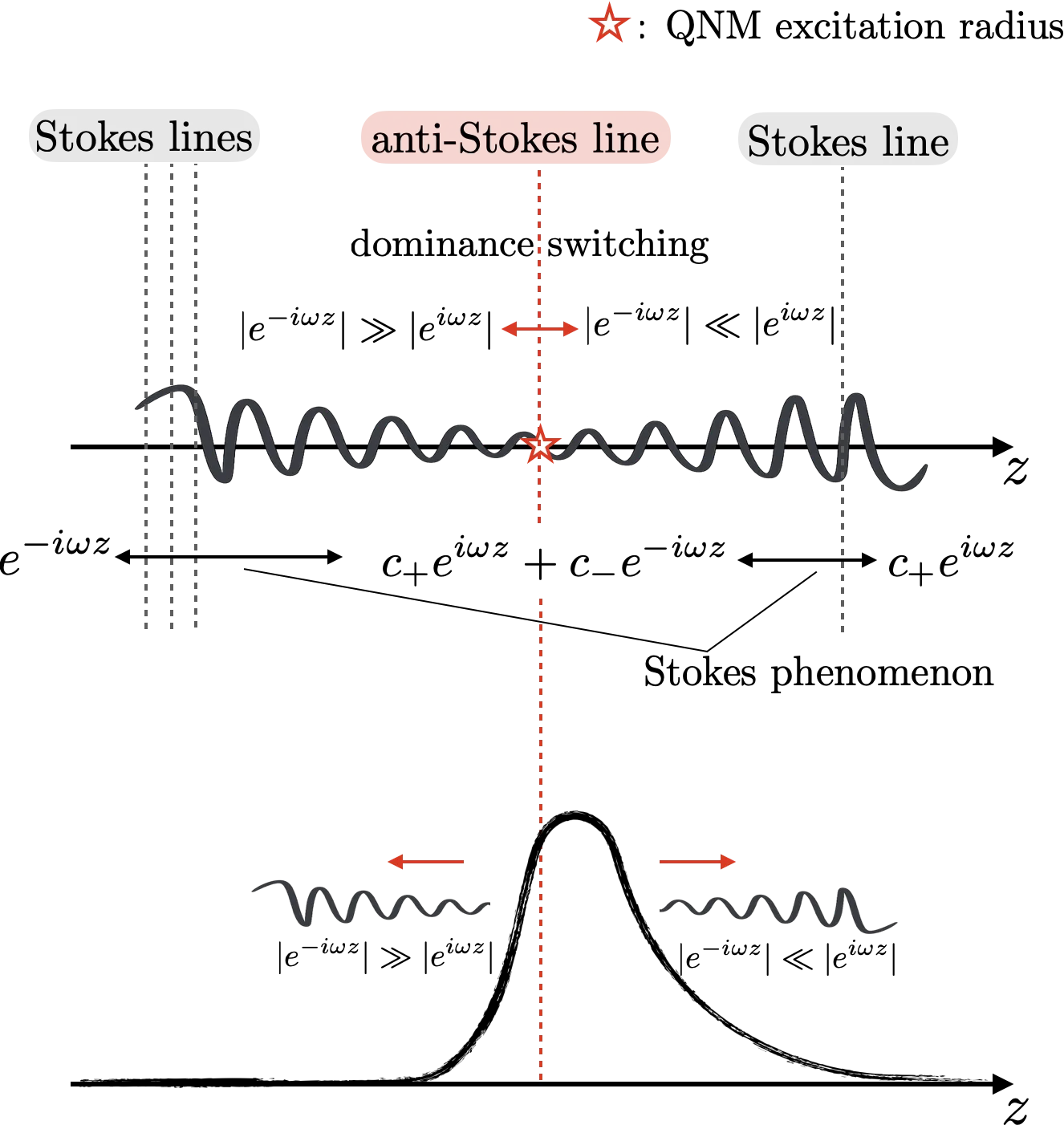
The authors proposed that the mode excitation radius is the point where the character of the wave solution changes. Around a black hole, space is so strongly curved that waves behave differently at different distances. Closer to the hole, they decay in one direction; farther away, in another. At the boundary, a standing wave is born — the ringing itself. For a non-spinning black hole, this radius turned out to be 2.557 times the black hole's mass, not 3 times as for the photon ring.
The team tested the idea numerically: they decomposed the signal into a sum of damped modes and looked at the radius from which this series converges. For moderately spinning holes, the numerical radius matched the analytical one. For a maximally spinning hole, the excitation radius crept almost to the horizon — the boundary from which nothing returns. There, modes with zero damping play the leading role and set the tone.
This means that each mode, each timbre, has its own birth region. Higher overtones 'sound' closer to the hole. Now, when listening to gravitational waves, we understand more precisely where the sound comes from.
Original abstract
as written by the authors arXiv:2607.28930v1
We investigate the excitation region of black hole quasinormal modes (QNMs) from both analytical and numerical perspectives. On the analytical side, we propose that the QNM excitation radius is identified by the dominance switching of WKB solutions across an anti-Stokes line. Based on this picture, we derive the condition for the QNM excitation radius in Kerr spacetime. In the Schwarzschild limit with mass $$M$$, we reproduce the previously known value $$r=2.556929 M$$, which differs from the light ring radius $$r=3M$$. We also show that the excitation radius is independent of the angular mode $$\ell$$ in the high-overtone limit. As an independent approach, we employ the numerical convergence test of QNM-plus-tail expansion and obtain values consistent with the Stokes geometry in the high-overtone limit at low and intermediate spins. In the extremal limit, the QNM convergence radius approaches the outer horizon, which is captured by the Stokes geometry of the zero-damping modes, rather than the high-overtone limit. This is consistent with the fact that the ringdown is dominated by zero-damping modes in the extremal limit. Based on the complementary analysis of Stokes geometry and the convergence test, we argue that in general, the QNM excitation radius depends on the QNM overtone number, giving rise to an effective QNM convergence region.
The excitation radius of a black hole does not depend on the angle at which the wave falls in, if the overtone is very high: it is always in the same place.
In the movie 'Interstellar', the heroes see a photon ring around the black hole Gargantua — the very one that, as is now clear, is not directly related to its ringing.