The Kerr metric is the exact solution to Einstein's field equations of general relativity that describes the spacetime geometry around a rotating, uncharged black hole. It was derived by Roy Kerr in 1963 and is considered one of the most important exact solutions in physics. The metric is characterized by two parameters: mass and angular momentum, and it predicts several fascinating phenomena, including frame-dragging (the dragging of spacetime around the rotating black hole) and the existence of an ergosphere, a region outside the event horizon where objects cannot remain stationary.
History
Roy Kerr, a New Zealand mathematician, derived the solution in 1963 while working at the University of Texas at Austin. His work was a breakthrough, as it provided a realistic description of black holes that form from collapsing rotating stars.
How it works
The Kerr metric is a stationary, axisymmetric solution, meaning it does not change with time and is symmetric around the rotation axis. It reduces to the Schwarzschild metric (for non-rotating black holes) when the angular momentum is zero. The metric's mathematical form involves a complex interplay of mass, spin, and the radial distance from the black hole, leading to a horizon structure that includes an outer event horizon and an inner Cauchy horizon. The ergosphere is a region where spacetime itself is dragged along with the black hole's rotation, allowing energy extraction via the Penrose process.
In practice
The Kerr metric is essential for modeling astrophysical black holes, interpreting observations of their accretion disks and jets, and analyzing gravitational wave signals from black hole mergers, as detected by LIGO and Virgo.
In 2015, the LIGO detectors caught the first ripple of spacetime from a black hole merger. Since then, hundreds of such events have piled up, each carrying the imprint of its ancestry: whether the holes were born together from a single pair of stars or met by chance in a dense cluster. The difference shows in the direction of their spin axes.
Strike a bell, and it rings at its own pitch. A black hole, after being disturbed, also rings — except instead of sound, it's the fabric of space itself that shivers. The frequencies of this ring can tell you a lot about the hole: how fast it spins, what its mass is.
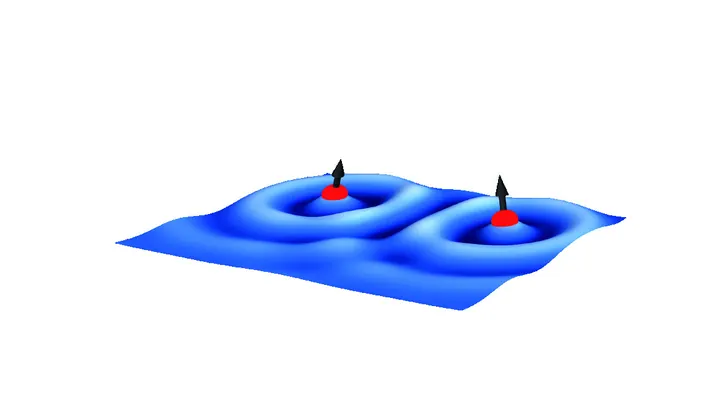
A vortex in a magnetic material is like a whirlpool, but instead of water, the directions of magnetization twist. An electron flying through such a vortex feels not just a magnetic field, but a curvature of space: its path bends as if it were rolling down a funnel with a narrow neck.
Think of a merry-go-round: the farther you sit from the center, the faster you're carried around. For a long time, astronomers assumed galaxies work the same way — stars at the edges should orbit more slowly than those near the center. But back in the 1970s, it turned out that in many spiral galaxies, the speed of stars barely drops with distance from the center.
When two heavy balls merge into one, ripples spread across the water's surface for a long time. A black hole behaves similarly: after a merger, it 'rings' for a while, emitting special gravitational oscillations — quasinormal modes. Usually, this ring fades quickly, like an echo dying out in an empty hall.
A fussy thermometer shows different temperatures depending on who is looking at it. A black hole behaves much the same way: its thermal properties, entropy and temperature, depend on how we describe the information hidden inside.
Somewhere in the center of a galaxy, a black hole is spinning. It doesn't hang in a void — around it swirls an invisible swarm of dark matter particles. Until now, this swarm was described for non-rotating holes, but in reality, holes always rotate.
An invisible scaffold holds galaxies together, keeping them from flying apart. This is dark matter — matter that doesn't shine and barely interacts with ordinary stuff. Astrophysicists have long debated what it's made of.
A black hole spun up almost to its limit is like an athlete balancing on the edge of a record. The most interesting action isn't inside the hole itself, but in the thinnest film of spacetime at its horizon. It's there that tiny corrections to Einstein's gravity can suddenly swell to gigantic proportions.
The neck of an hourglass is the narrowest point where grains of sand change sides. In quantum gravity, there is a similar object: an instanton (an instantaneous solution connecting two states of space). It acts like a tunnel through which the geometry of the universe flows from one form to another.
A rotating black hole is no calm whirlpool. Space around it shudders and rings at the slightest disturbance, like a guitar string after a pluck. These oscillations are described by the Teukolsky equation — a complex mathematical construct that physicists have studied for half a century.
Recently, a strange symmetry was noticed in this equation.
An old house. The facade is freshly painted, the stairs don't creak. A pretty picture. But try to move in heavy furniture, and the floorboards give way. The beauty of the facade says nothing about the strength of the floors.
It's much the same with black holes without singularities.
Two black holes circle in a cosmic dance, spiraling closer together. In the end, they merge into one, and that moment unleashes a powerful burst of gravitational waves, ripples in spacetime itself. But what remains after the merger?
The Kerr-NUT black hole is not just a cosmic vacuum cleaner. It's a solution to Einstein's equations where the hole has mass, rotation, and a strange NUT parameter. This parameter behaves like a magnetic charge for gravity: seemingly invisible, yet it alters the properties of surrounding space.
Imagine a postal service where couriers suddenly stop moving. It would seem that letters would stop arriving and communication between cities would break down. But what if the envelopes themselves suddenly gained the ability to change shape and transmit messages through a shared web without moving an inch?
A black hole is not an empty funnel. Invisible matter can accumulate around it, and then the familiar boundaries shift.
A group of theorists found a simple condition: if the mass of this surrounding material grows smoothly and satisfies the inequality 1 − 2m' − rm'' > 0, then the event horizon remains well-defined and the hole stays stable.
When two black holes merge, the newborn object rings like a bell. This ring, gravitational waves of a special kind, astronomers call quasinormal modes (particular damped oscillations). They decay quickly but still reveal the black hole's mass and spin. The question is where in space this ringing begins.
A thrown stone arcs through the air and falls. A planet orbiting a star is the same stone, but it falls forever, looping around the star in a closed curve. In Newton's world, that curve is a perfect ellipse, and the planet returns to the same point each orbit. In reality, the orbit slowly rotates: its closest point to the star, the perihelion, shifts.
A black hole doesn't just spin: it's surrounded by bristles of an extra field (the Kalb–Ramond field). This paper explores how a massive field (waves with mass) behaves near such a black hole when it's almost spinning at its maximum rate.
The Klein–Gordon–Fock equation for this field was separated into two independent parts — radial and angular.
A black hole is not a perfect vacuum cleaner. It is surrounded by a swarm of particles and fields, and this swarm alters its fate. In a new study, astrophysicists examined how a massive vector field, a hypothetical form of dark matter, behaves near a rotating black hole.
A black hole devours everything, even light. Yet it obeys the laws of physics: it possesses entropy — a measure of the hidden information an object 'remembers.' In the 1970s, Jacob Bekenstein and Stephen Hawking discovered a strange pattern: a black hole's entropy grows not with its volume, but…
A star circles a rotating black hole like a figure skater at the center of a rink. While it is far away and can be treated as a point, the dance remains predictable: the orbit follows clear laws, like music that is easy to glide to. But as it approaches, gravity begins to act unevenly.
A stone falls into still water — ripples spread across the surface. A black hole behaves similarly when something falls into it or when it merges with another black hole. The hole begins to oscillate, and these oscillations propagate through space as gravitational waves.
In 1973, Jacob Bekenstein proposed that black hole possess entropy — a measure of hidden disorder. Stephen Hawking later confirmed this by adding radiation, but the microscopic origin of entropy remained obscure.
At the center of nearly every galaxy lurks a supermassive black hole. Its gravity is so strong that it warps space itself. But few stop to wonder: what does it do to the very fabric of reality — the fields that permeate the cosmos?
One such field is the Higgs field.
A pot of boiling water is covered with two lids — an inner and an outer one. The thermometer under each shows its own temperature, but their harmonic mean (a special averaging method where you add the reciprocals) always remains unchanged. Heat seems to obey an invisible rule.
After a hit, a black hole rings like a bell. But instead of sound, it emits gravitational waves whose frequency rapidly decays: these are called quasinormal modes. From such a 'ring,' you can infer the hole's mass, spin, and other properties.
A black hole is a place from which nothing can escape. But some theories allow that deep inside, at the quantum level, it might bounce and turn into its opposite — a white hole, which only spews out matter and light.
A group of physicists built a computer model of such a transformation.
A black hole's horizon is not a wall but rather a one-way membrane. Anything that crosses it disappears forever. Stephen Hawking showed that this boundary should glow faintly, emitting particles. But catching such radiation from a real black hole is impossible: it's too far and too dim.
Physicists have found a workaround: build a "toy" black hole out of magnetic atoms.
A pair of black holes circles in a dance, gradually drawing closer. They lose energy and spin — a process known as angular momentum radiation. In standard Einstein theory, only gravitational waves carry away angular momentum.
The event horizon's edge is never calm. Quantum vacuum boils there, and particles sometimes burst out of this foam: that is how Stephen Hawking in 1974 discovered black hole radiation, forever linking gravity with quantum field theory.
A taut trampoline sheet dips under a heavy ball. If the ball spins quickly, the sheet begins to twist around it. Spacetime near a rotating black hole behaves similarly: it is not just curved, but also dragged along by the rotation, like water swirling around a whirlpool.
A light ray passing by a massive body gets deflected: this is the effect of gravitational lensing, familiar from images of distant galaxies. The astrophysicists started with a rotating black hole (Kerr spacetime) and added a tiny correction to how light itself propagates.
At the center of most galaxies lurk supermassive black holes — the overlords of gravity. Since 2019, thanks to interferometry with very long baselines, we’ve glimpsed their shadows: dark silhouettes set against a blazing gas backdrop. But what exactly is painting that shadow?
At the center of attention is a black hole of unusual shape. Its geometry resembles a spindle: a slight elongation is added to the usual rotation. The parameter B measures this deformation.
The spindle deformation is not just a mathematical toy.
A black hole usually hides its singularity behind an event horizon — an invisible boundary from which not even light can escape. But sometimes this 'cloak' is absent, and the singularity, a point where familiar physics breaks down, is exposed to an outside observer.
A stone drops into a pond — ripples spread and fade. Strike a bell, and it hums at its own pitch. A black hole, after being perturbed, also 'rings,' emitting gravitational waves of a decaying tone.
At the center of a classical black hole lurks a singularity — a point where the density and curvature of spacetime become infinite. Physics goes silent there.
The LIGO detectors caught the signal GW250114—a gravitational wave from the merger of two black holes. After the main burst, a decaying 'tail' remained — direct waves from the newborn hole's horizon. It was expected that their damping would reveal the gravitational strength at the horizon's surface. But the measured value came out smaller.